Building Code Glossary
Fire-resistance Rating: Building Code Definition
How the IBC 2009, IFC 2009 define fire-resistance rating, where the wording differs, and which chapters depend on the term.
On this page
Last updated September 7, 2026 · Definitions quoted from the 2009 International Codes as transcribed in this site's building-codes collection, with the source chapter linked for each quotation. Usage counts are computed over the chapters hosted here, one copy per code. The [ICC code library](https://codes.iccsafe.org/codes) publishes the current model text and the [ICC adoption maps](https://www.iccsafe.org/advocacy/code-adoption-maps/) show which edition a jurisdiction has adopted; those sources control.
Direct answer
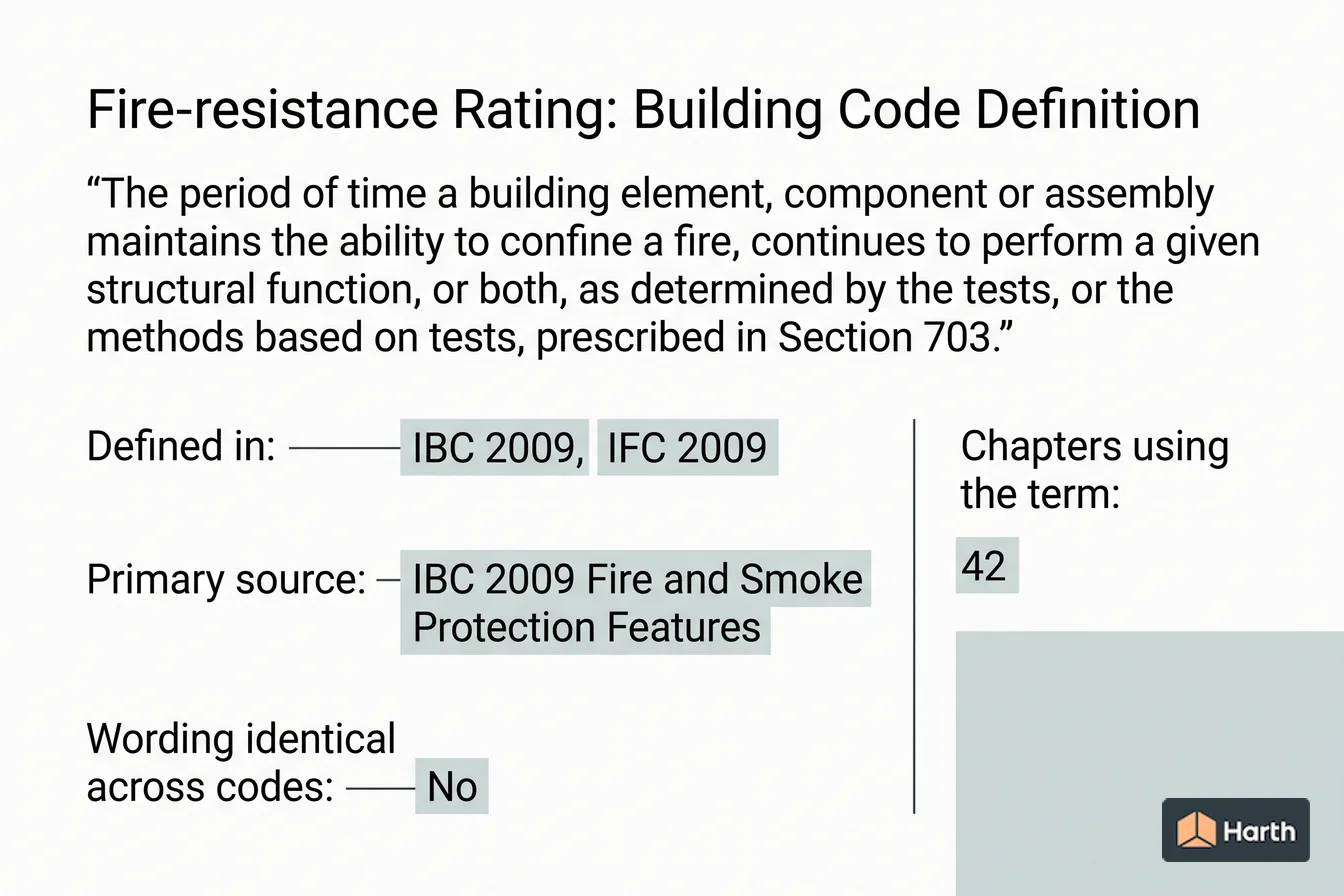
Fire-resistance rating is a defined term in the International Building Code (IBC) 2009, in Fire and Smoke Protection Features. The code's own words are: “The period of time a building element, component or assembly maintains the ability to confine a fire, continues to perform a given structural function, or both, as determined by the tests, or the methods based on tests, prescribed in Section 703.” The IFC 2009 defines the same term with different wording, so the controlling text depends on which code governs the question in front of you — the comparison below sets the versions side by side. The term is used in 42 chapters of this corpus, most often in Fire and Smoke Protection Features (IBC 2009), Special Detailed Requirements Based on Use and Occupancy (IBC 2009), Existing Structures (IBC 2009). These pages transcribe the 2009 model text; verify the definition against the edition and amendments your authority having jurisdiction has adopted.
Content and cited inputs reviewed by Scott Barrington, Harth founder and architectural technology specialist · Published 2026-09-07 · Updated 2026-09-07.
What does this term mean?
Fire-resistance Rating — IBC 2009, Fire and Smoke Protection Features:
The period of time a building element, component or assembly maintains the ability to confine a fire, continues to perform a given structural function, or both, as determined by the tests, or the methods based on tests, prescribed in Section 703.
What must be verified before using this guidance?
Two of the I-Codes in this corpus define Fire-resistance Rating, and the wording is not identical — read the version that governs your question.
| Code | Where it is defined | Definition |
|---|---|---|
| IBC 2009 | Fire and Smoke Protection Features | The period of time a building element, component or assembly maintains the ability to confine a fire, continues to perform a given structural function, or both, as determined by the tests, or the methods based on tests, prescribed in Section 703. |
| IFC 2009 | Definitions | The period of time a building element, component or assembly maintains the ability to confine a fire, continues to perform a given structural function, or both, as determined by the tests, or the methods based on tests, prescribed in Section 703 of the International Building Code. |
Where fire-resistance rating is used in the code
The term appears in 42 chapters of the 2009 I-Codes hosted here. The chapters that lean on it hardest are the ones to read next.
| Chapter | Code | Mentions |
|---|---|---|
| Fire and Smoke Protection Features | IBC 2009 | 394 |
| Special Detailed Requirements Based on Use and Occupancy | IBC 2009 | 63 |
| Existing Structures | IBC 2009 | 45 |
| Means of Egress | IBC 2009 | 35 |
| Means of Egress | IFC 2009 | 29 |
| General Building Heights and Areas | IBC 2009 | 25 |
| Building Planning | IRC 2009 | 21 |
| Elevators and Conveying Systems | IBC 2009 | 16 |
| Plastic | IBC 2009 | 16 |
| Flammable and Combustible Liquids | IFC 2009 | 16 |
| Explosives and Fireworks | IFC 2009 | 13 |
| Duct Systems | IMC 2009 | 11 |
30 further chapters mention the term.
The term in use
How the code actually writes about fire-resistance rating, quoted from the 2009 text hosted here:
The fire-resistance rating of building elements, components or assemblies shall be determined in accordance with the test procedures set forth in ASTM E 119 or UL 263 or in accordance with Section 703.3.
For buildings not greater than 420 feet (128 m) in bUilding height, the required fire-resistance rating of the fire barriers enclosing vertical shafts, other than exit enclosures and elevator hoistway enclosures, is permitted to be reduced to 1 hour where automatic sprinklers are installed within the shafts at the top and at alternate floor levels.
A wall used to create separate compartments shall be a fire barrier conforming to Section 707 with a fire-resistance rating ofnot less than 2 hours.
Fire-resistance Rating compared with Fire Protection Rating
These two are the closest pair in the 2009 I-Codes: about 46 per cent of their defining words are the same. The code states both and compares neither, so the difference is worth naming.
| Wording unique to it | |
|---|---|
| Fire-resistance Rating (IBC 2009) | building, element, component, assembly, maintains, continues, perform, given, structural, function, both, methods |
| Fire Protection Rating (IBC 2009) | opening, protective, will, maintain, 715, ratings, stated, hours, minutes |
Everything else in the two definitions is shared. If a project turns on which of the two applies, those words are the whole of the test — and a local amendment that edits one of them without editing the other moves the boundary between fire-resistance rating and fire protection rating.
The terms fire-resistance rating is built out of
The definition above leans on 2 other defined terms. Each carries its own code definition, and a local amendment to any of them changes what fire-resistance rating covers:
- Building Element — IBC 2009: A fundamental component of building construction, listed in Table 601, which mayor may not be of fire-resistance-rated construction and is constructed of materials based on the building type of construction.
- Building — IBC 2009: Any structure used or intended for supporting or sheltering any use or occupancy.
Fire-resistance Rating: what to open, and in what order
Every row is a document this term depends on. The ICC code library and the ICC adoption maps cover the middle rows.
| Check | Where | Confirmed |
|---|---|---|
| Read the definition in the adopted IBC | Fire and Smoke Protection Features | |
| Read the definition in the adopted IFC | Definitions | |
| Re-check the requirement that uses it | Fire and Smoke Protection Features (IBC 2009) | |
| Re-check the requirement that uses it | Special Detailed Requirements Based on Use and Occupancy (IBC 2009) | |
| Re-check the requirement that uses it | Existing Structures (IBC 2009) | |
| Re-check the requirement that uses it | Means of Egress (IBC 2009) | |
| Confirm the dependent definition | Building Element | |
| Confirm the dependent definition | Building | |
| Local amendment to any of the above | Jurisdiction's amendment list |
A research aid, not a code determination. The authority having jurisdiction decides which edition and which amendments apply.
Where can you explore related guidance?
- Explore all glossary guidance
- Building Element: Building Code Definition
- Building: Building Code Definition
Sources and method
Definitions quoted from the 2009 International Codes as transcribed in this site's building-codes collection, with the source chapter linked for each quotation. Usage counts are computed over the chapters hosted here, one copy per code. The ICC code library publishes the current model text and the ICC adoption maps show which edition a jurisdiction has adopted; those sources control.
Source links
Frequently asked questions
What is the code definition of fire-resistance rating?
The International Building Code (IBC) 2009 defines it in Fire and Smoke Protection Features as: “The period of time a building element, component or assembly maintains the ability to confine a fire, continues to perform a given structural function, or both, as determined by the tests, or the methods based on tests, prescribed in Section 703.” The 2009 model text is reproduced here; the definition that binds your project is the one in the edition your jurisdiction has adopted, as amended locally.
Which parts of the code depend on fire-resistance rating?
In this corpus the term is used across 42 chapters, led by Fire and Smoke Protection Features in the IBC 2009. Those are the sections whose scope moves if the definition is amended locally, so read them together with Chapter 2 rather than on their own.
What is a fire-resistance rating?
In the 2009 I-Codes hosted here it is a defined term rather than a description. The IBC 2009 states, in Fire and Smoke Protection Features: “The period of time a building element, component or assembly maintains the ability to confine a fire, continues to perform a given structural function, or both, as determined by the tests, or the methods based on tests, prescribed in Section 703.” It is defined in IBC 2009, IFC 2009. Because it is a defined term, whatever the adopted edition says it means is what every section using it means — so check Chapter 2 of that edition and any local amendment before relying on this wording.
What are the requirements for fire resistance in buildings?
Fire Resistance is a separate defined term. The IBC 2009 defines it as: “That property of materials or their assemblies that prevents or retards the passage of excessive heat, hot gases or flames under conditions of use.” That is not the same as fire-resistance rating, which the IBC 2009 defines as “The period of time a building element, component or assembly maintains the ability to confine a fire, continues to perform a given structural function, or both, as determined by the tests, or the methods based on tests, prescribed in Section …” — read both before applying either, and confirm the wording in the edition your jurisdiction has adopted.
Related pages
- Fire Point: Building Code Definition
Fire Point — IFC 2009 definition: The lowest temperature at which a liquid will ignite and achieve sustained burning when exposed to …
- Fire Protection Rating: Building Code Definition
Fire Protection Rating — IBC 2009 definition: The period of time that an opening protective will maintain the ability to confine a fire …
- Fire Protection System: Building Code Definition
Fire Protection System — IBC 2009 definition: Approved devices, equipment and systems or combinations of systems used to detect a fire, activate an …
- Fire Resistance: Building Code Definition
Fire Resistance — IBC 2009 definition: That property of materials or their assemblies that prevents or retards the passage of excessive heat …
- Fire-resistant Joint System: Building Code Definition
Fire-resistant Joint System — IBC 2009 definition: An assemblage of specific materials or products that are designed, tested and fire-resistance rated in accordance …
- Fire-retardant-treated Wood: Building Code Definition
Fire-retardant-treated Wood — IRC 2009 definition: Pressure-treated lumber and plywood that exhibit reduced surface burning characteristics and resist propagation of fire.