Building Code Glossary
Return Air: Building Code Definition
How the IRC 2009, IMC 2009 define return air, where the wording differs, and which chapters depend on the term.
On this page
Last updated September 7, 2026 · Definitions quoted from the 2009 International Codes as transcribed in this site's building-codes collection, with the source chapter linked for each quotation. Usage counts are computed over the chapters hosted here, one copy per code. The [ICC code library](https://codes.iccsafe.org/codes) publishes the current model text and the [ICC adoption maps](https://www.iccsafe.org/advocacy/code-adoption-maps/) show which edition a jurisdiction has adopted; those sources control.
Direct answer
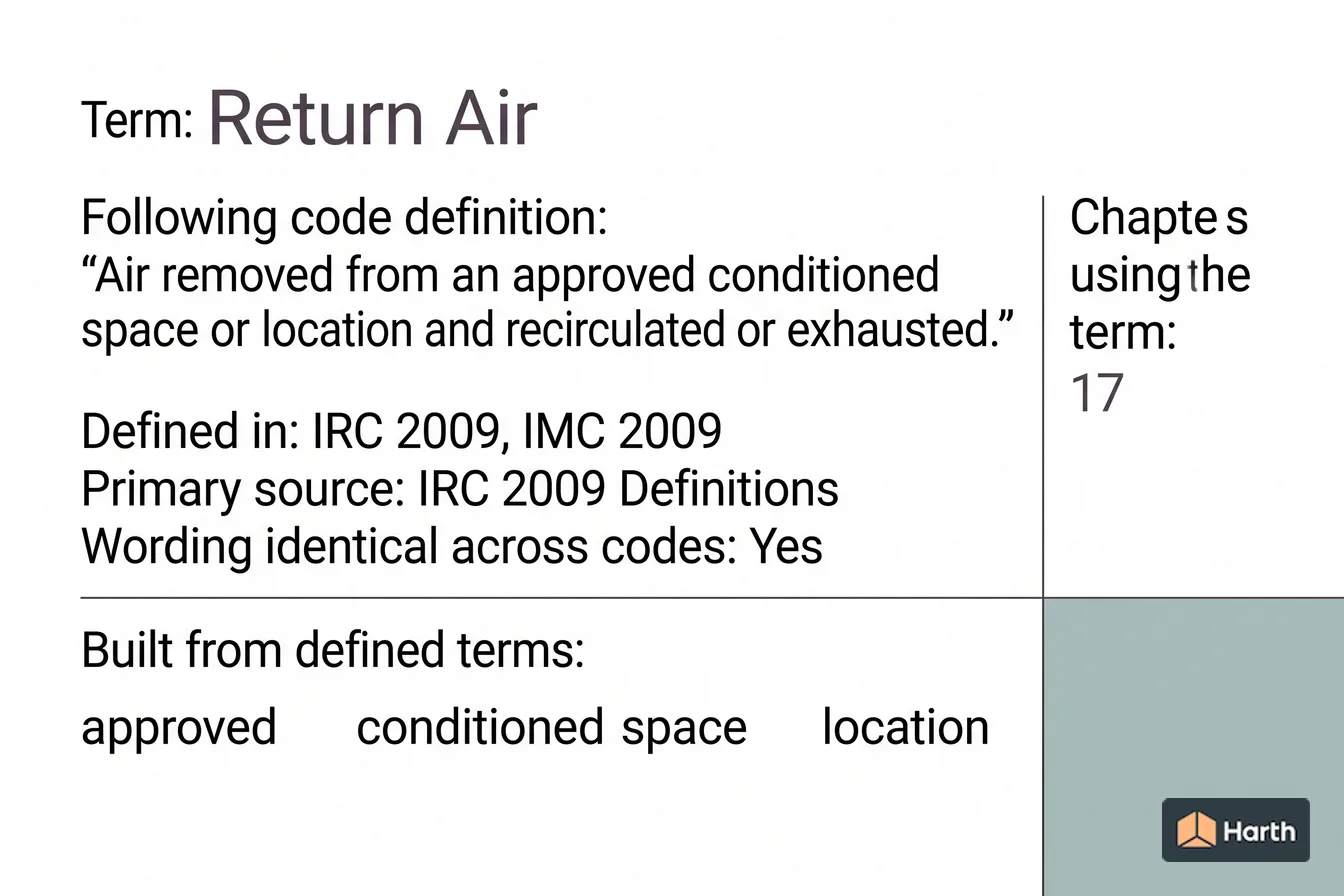
Return air is a defined term in the International Residential Code (IRC) 2009, in Definitions. The code's own words are: “Air removed from an approved conditioned space or location and recirculated or exhausted.” The IMC 2009 carries the same definition word for word, so the term means the same thing in each. The term is used in 17 chapters of this corpus, most often in Duct Systems (IMC 2009), Specific Appliances, Fireplaces and Solid Fuel-burning Equipment (IMC 2009), Duct Systems (IRC 2009). These pages transcribe the 2009 model text; verify the definition against the edition and amendments your authority having jurisdiction has adopted. Record the jurisdiction, the adopted edition, the application date and any local amendment that rewrites the definition before you use it on a live project, because a term redefined by amendment changes every requirement that depends on it.
Content and cited inputs reviewed by Scott Barrington, Harth founder and architectural technology specialist · Published 2026-09-07 · Updated 2026-09-07.
What does this term mean?
Return Air — IRC 2009, Definitions:
Air removed from an approved conditioned space or location and recirculated or exhausted.
What must be verified before using this guidance?
Two of the I-Codes in this corpus define Return Air, in identical words.
| Code | Where it is defined | Definition |
|---|---|---|
| IRC 2009 | Definitions | Air removed from an approved conditioned space or location and recirculated or exhausted. |
| IMC 2009 | Definitions | Air removed from an approved conditioned space or location and recirculated or exhausted. |
Where return air is used in the code
The term appears in 17 chapters of the 2009 I-Codes hosted here. The chapters that lean on it hardest are the ones to read next.
| Chapter | Code | Mentions |
|---|---|---|
| Duct Systems | IMC 2009 | 39 |
| Specific Appliances, Fireplaces and Solid Fuel-burning Equipment | IMC 2009 | 24 |
| Duct Systems | IRC 2009 | 24 |
| Fuel Gas | IRC 2009 | 24 |
| Fire Protection Systems | IBC 2009 | 21 |
| Fire Protection Systems | IFC 2009 | 18 |
| Means of Egress | IBC 2009 | 7 |
| Means of Egress | IFC 2009 | 7 |
| Commercial Energy Efficiency | IECC 2009 | 4 |
| Ventilation | IMC 2009 | 4 |
| Definitions | IMC 2009 | 3 |
| Foundations | IRC 2009 | 3 |
5 further chapters mention the term.
The term in use
How the code actually writes about return air, quoted from the 2009 text hosted here:
The use of gypsum boards to form air shafts (ducts) shall be limited to return air systems where the air temperatures do not exceed 125°F (52°C) and the gypsum board surface temperature is maintained above the airstream dew-point temperature.
The minimum unobstructed total area of the outdoor and return air ducts or openings to a forced-air warm-air furnace shall be not less than 2 square inches per 1,000 Btulh (4402 mm2/kW) output rating capacity of the furnace and not less than that specified in the furnace manufacturer's installation instructions.
Furnaces and air-handling systems that supply air to living spaces shall not supply air to or return air from a garage.
The terms return air is built out of
The definition above leans on 2 other defined terms. Each carries its own code definition, and a local amendment to any of them changes what return air covers:
- Conditioned Space — IRC 2009: For energy purposes, space within a building that is provided with heating and/or cooling equipmentor systems capable of maintaining, through design or heat loss/gain, 50°F (IO°C) during the heating season and 85°F (29°C) during the cooling season, or communicates directly …
- Approved — IBC 2009: Acceptable to the code official or authority having jurisdiction.
Return Air: what to open, and in what order
Every row is a document this term depends on. The ICC code library and the ICC adoption maps cover the middle rows.
| Check | Where | Confirmed |
|---|---|---|
| Read the definition in the adopted IRC | Definitions | |
| Read the definition in the adopted IMC | Definitions | |
| Re-check the requirement that uses it | Duct Systems (IMC 2009) | |
| Re-check the requirement that uses it | Specific Appliances, Fireplaces and Solid Fuel-burning Equipment (IMC 2009) | |
| Re-check the requirement that uses it | Duct Systems (IRC 2009) | |
| Re-check the requirement that uses it | Fuel Gas (IRC 2009) | |
| Confirm the dependent definition | Conditioned Space | |
| Confirm the dependent definition | Approved | |
| Local amendment to any of the above | Jurisdiction's amendment list |
A research aid, not a code determination. The authority having jurisdiction decides which edition and which amendments apply.
Where can you explore related guidance?
- Explore all glossary guidance
- Conditioned Space: Building Code Definition
- Approved: Building Code Definition
Sources and method
Definitions quoted from the 2009 International Codes as transcribed in this site's building-codes collection, with the source chapter linked for each quotation. Usage counts are computed over the chapters hosted here, one copy per code. The ICC code library publishes the current model text and the ICC adoption maps show which edition a jurisdiction has adopted; those sources control.
Source links
Frequently asked questions
What is the code definition of return air?
The International Residential Code (IRC) 2009 defines it in Definitions as: “Air removed from an approved conditioned space or location and recirculated or exhausted.” The 2009 model text is reproduced here; the definition that binds your project is the one in the edition your jurisdiction has adopted, as amended locally.
Which parts of the code depend on return air?
In this corpus the term is used across 17 chapters, led by Duct Systems in the IMC 2009. Those are the sections whose scope moves if the definition is amended locally, so read them together with Chapter 2 rather than on their own.
What are the rules for return air ducts?
In the 2009 I-Codes hosted here it is a defined term rather than a description. The IRC 2009 states, in Definitions: “Air removed from an approved conditioned space or location and recirculated or exhausted.” It is defined in IRC 2009, IMC 2009. Because it is a defined term, whatever the adopted edition says it means is what every section using it means — so check Chapter 2 of that edition and any local amendment before relying on this wording.
What is the difference between supply air and return air?
In the 2009 I-Codes hosted here it is a defined term rather than a description. The IRC 2009 states, in Definitions: “Air removed from an approved conditioned space or location and recirculated or exhausted.” It is defined in IRC 2009, IMC 2009. It is not the same as Supply Air, which the IRC 2009 defines separately as “Air delivered to a conditioned space through ducts or plenums from the heat exchanger of a heating, cooling or ventilating system.” Because it is a defined term, whatever the adopted edition says it means is what every section using it means — so check Chapter 2 of that edition and any local amendment before relying on this wording.
Related pages
- Resistance Factor: Building Code Definition
Resistance Factor — IBC 2009 definition: A factor that accounts for deviations of the actual strength from the nominal strength and the …
- Responsible Person: Building Code Definition
Responsible Person — IFC 2009 definition: A person trained in the safety and fire safety considerations concerned with hot work.
- Retail Display Area: Building Code Definition
Retail Display Area — IFC 2009 definition: The area of a Group M occupancy open for the purpose of viewing or purchasing merchandise …
- Ridge: Building Code Definition
Ridge — IRC 2009 definition: With respect to topographic wind effects, an elongated crest of a hill characterized by strong relief …
- Riser: Building Code Definition
Riser — IRC 2009 definition: A water pipe that extends vertically one full story or more to convey water to branches …
- Roll Coating: Building Code Definition
Roll Coating — IFC 2009 definition: The process of coating, spreading and impregnating fabrics, paper or other materials as they are passed …