Climate & Energy Design Data
Heating & Cooling Design Temperatures (99%, 1% / 0.4%)
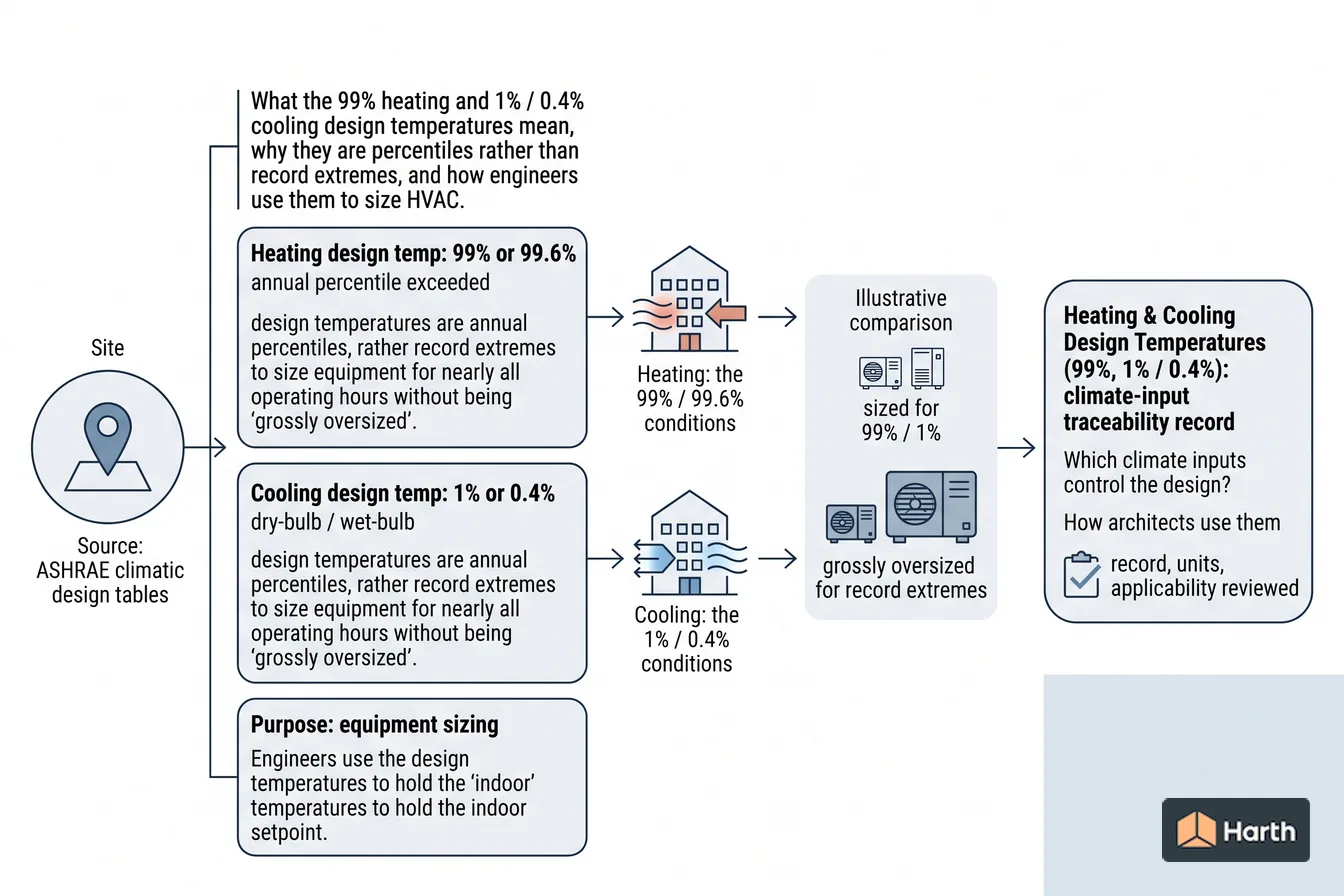
What the 99% heating and 1% / 0.4% cooling design temperatures mean, why they are percentiles rather than record extremes, and how engineers use them to size HVAC.
On this page
Last updated August 14, 2026 · Definitions follow the ASHRAE Handbook — Fundamentals design-condition methodology. Any specific temperatures are typical/illustrative; the official ASHRAE Climatic Design Conditions tables (and the values the AHJ-adopted code references) are authoritative for sizing. Official references: [ASHRAE standards and guidelines](https://www.ashrae.org/technical-resources/standards-and-guidelines/titles-purposes-and-scopes).
Direct answer
What the 99% heating and 1% / 0.4% cooling design temperatures mean, why they are percentiles rather than record extremes, and how engineers use them to size HVAC. A key reference is heating design temp: 99% or 99.6%; check the cited source, edition, units, and applicability before using it for design, compliance, procurement, or approval. Heating design temp is 99% or 99.6%; annual percentile exceeded. Cooling design temp is 1% or 0.4%; dry-bulb / wet-bulb. Purpose is equipment sizing; not record extremes. A design temperature is the outdoor condition an engineer sizes heating or cooling equipment to hold the indoor setpoint against. Rather than the record extreme, ASHRAE defines these as annual percentiles so equipment is sized for nearly all operating hours without being grossly oversized for a handful of extreme ones.
Content and cited inputs reviewed by Harth team · Published 2026-08-14 · Updated 2026-08-14.
Which climate inputs control the design?
A design temperature is the outdoor condition an engineer sizes heating or cooling equipment to hold the indoor setpoint against. Rather than the record extreme, ASHRAE defines these as annual percentiles so equipment is sized for nearly all operating hours without being grossly oversized for a handful of extreme ones.
Heating: the 99% / 99.6% conditions
The heating design temperature is a low percentile of annual dry-bulb temperature:
- 99% — the temperature exceeded (warmer than) 99% of annual hours; colder about 1% of the year.
- 99.6% — a more conservative value, colder only 0.4% of hours.
Heating equipment is sized so it can maintain the indoor setpoint down to this outdoor temperature. Colder codes and critical facilities tend to use the 99.6% value.
Cooling: the 1% / 0.4% conditions
The cooling design conditions are high percentiles, published as a dry-bulb temperature with a coincident wet-bulb:
- 1% — dry-bulb exceeded only 1% of annual hours.
- 0.4% — a more conservative value, exceeded only 0.4% of hours (the common commercial default).
Because cooling load includes humidity, the accompanying wet-bulb value lets the engineer size the latent (dehumidification) load as well as the sensible load.
Illustrative comparison
| Condition | Percentile | What it sizes | Note |
|---|---|---|---|
| Heating dry-bulb | 99% / 99.6% | Heating capacity | Higher percentile = more conservative |
| Cooling dry-bulb | 1% / 0.4% | Sensible cooling | 0.4% typical for commercial |
| Coincident wet-bulb | with cooling DB | Latent / dehumidification | Matters most in moist (A) zones |
Values above describe the method, not a specific site.
How architects use them
You generally won't run the load calculation yourself, but the design conditions shape the brief: they justify the mechanical engineer's equipment size, drive envelope trade-offs (a better envelope shrinks the peak load and the equipment), and feed peak heating/cooling estimates during schematic design. Always pull the authoritative values from the ASHRAE Climatic Design Conditions for the nearest representative weather station.
Heating & Cooling Design Temperatures (99%, 1% / 0.4%): climate-input traceability record
| Input | Project entry | Source record |
|---|---|---|
| Site coordinates and elevation | — | Survey / authoritative location source |
| Climate zone and governing edition | — | Official map, lookup and adoption record |
| Weather station / grid cell | — | Identifier, distance, elevation and fit |
| Observation period or weather-file vintage | — | Named dataset and release |
| Variable, percentile and units | — | Exact table / file / method |
| Intended use | — | Context, simulation, code or plant sizing |
| Local hazard source | — | Hazard-specific authority; not a zone proxy |
| Preparer, checker and date | — | Project QA record |
Project-use verification: never substitute a monthly normal for a design condition or a climate zone for a separate hazard lookup. Keep each input tied to its intended use.
Where can you explore related guidance?
- Explore all climate data guidance
- ASHRAE / IECC Climate Zones Explained (Zones 1–8, A/B/C)
- IECC Envelope Requirements by Climate Zone
Sources and method
Definitions follow the ASHRAE Handbook — Fundamentals design-condition methodology. Any specific temperatures are typical/illustrative; the official ASHRAE Climatic Design Conditions tables (and the values the AHJ-adopted code references) are authoritative for sizing. Official references: ASHRAE standards and guidelines.
Source links
Frequently asked questions
Why not size to the record low or record high?
Sizing to an all-time extreme would oversize equipment for conditions that occur for a few hours a decade, hurting efficiency, comfort (short-cycling), and cost the rest of the time. The percentile design conditions capture nearly all real operating hours while keeping equipment right-sized. A modest safety margin covers the rare excursions beyond them.
What does a 99% heating design temperature mean?
It is the outdoor dry-bulb temperature that the location is at or above 99% of the annual hours — i.e. it is colder than this value only about 1% of the year (roughly 88 hours). A 99.6% value is more conservative (colder is exceeded only 0.4% of hours). Heating equipment is sized to hold the indoor setpoint down to this temperature.
Why do cooling conditions include a wet-bulb value?
Cooling load has both a sensible part (dry-bulb temperature) and a latent part (humidity). ASHRAE publishes cooling design conditions as a dry-bulb with a coincident (mean) wet-bulb, plus separate wet-bulb percentiles, so the engineer can size for both the sensible and dehumidification loads — critical in moist (A) zones where latent load is significant.
Related pages
- Climate Design Data: Zamboanga, Philippines
Zamboanga, Philippines climate design data (NASA POWER 2001–2020): annual mean 27.5 °C, monthly max 32.1 °C (May), min 24.1 °C (January), RH 81%; monthly table.
- Climate Design Data: Zaria, Nigeria
Zaria, Nigeria climate design data (NASA POWER 2001–2020): annual mean 24.4 °C, monthly max 41.2 °C (April), min 6.5 °C (January), RH 58%; monthly table.
- Climate Design Data: Zayed City, UAE
Zayed City, UAE climate design data (NASA POWER 2001–2020): annual mean 28.8 °C, monthly max 49.3 °C (June), min 6.0 °C (February), RH 42%; monthly table.
- IECC Envelope Requirements by Climate Zone
See how IECC insulation, fenestration U-factor, and SHGC requirements vary by climate zone, with an adopted-edition verification worksheet.
- Climate & Energy Design Data: India
India climate & energy design data for architects: 37 city pages covering climate design data, each with a reproducible location record and source path.
- Climate & Energy Design Data: Ireland
Ireland climate & energy design data for architects: 20 city pages covering climate design data, each with a reproducible location record and source path.