Building Code Glossary
Agent: Building Code Definition
How the IFC 2009 define agent, where the wording differs, and which chapters depend on the term.
On this page
Last updated September 7, 2026 · Definitions quoted from the 2009 International Codes as transcribed in this site's building-codes collection, with the source chapter linked for each quotation. Usage counts are computed over the chapters hosted here, one copy per code. The [ICC code library](https://codes.iccsafe.org/codes) publishes the current model text and the [ICC adoption maps](https://www.iccsafe.org/advocacy/code-adoption-maps/) show which edition a jurisdiction has adopted; those sources control.
Direct answer
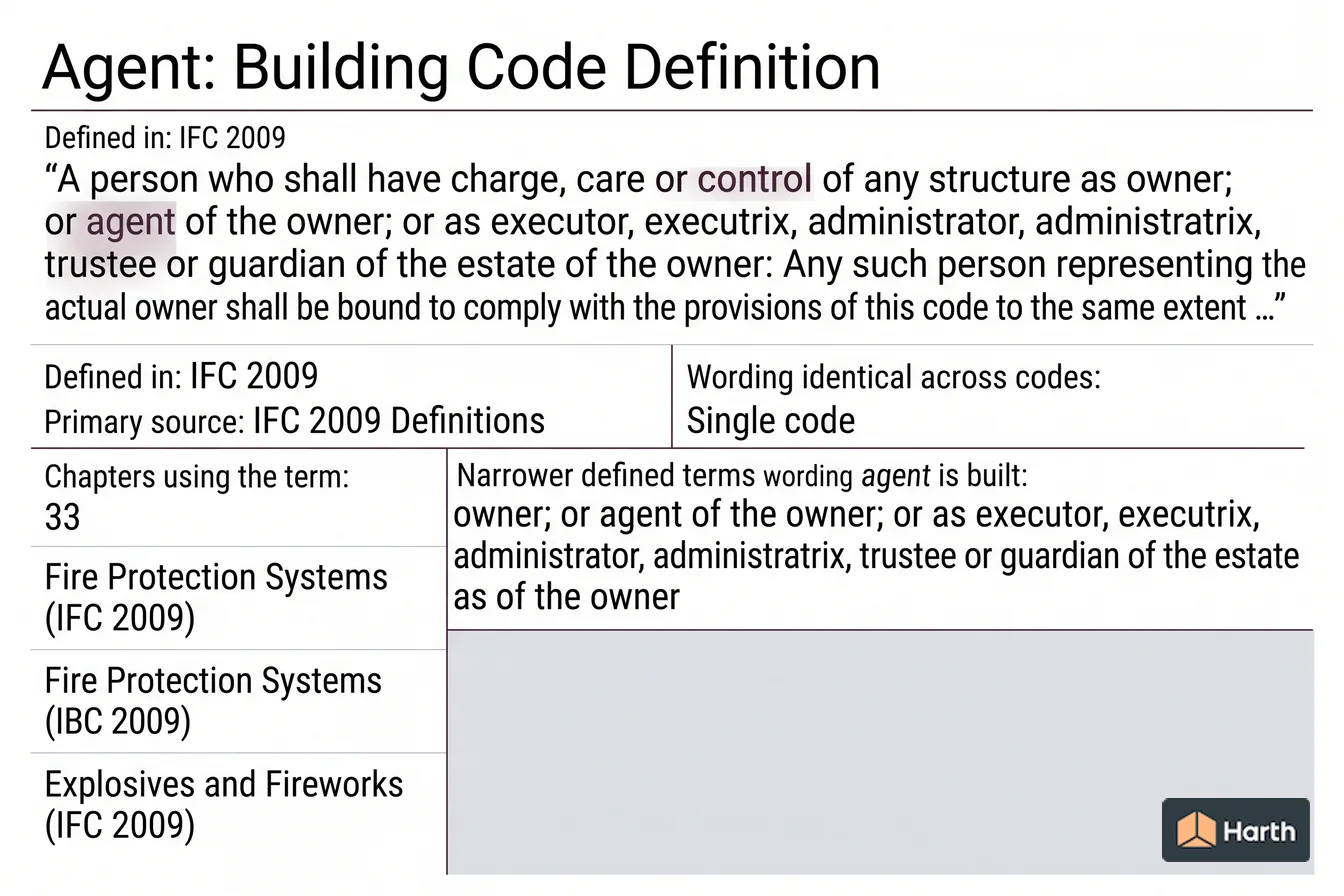
Agent is a defined term in the International Fire Code (IFC) 2009, in Definitions. The code's own words are: “A person who shall have charge, care or control of any structure as owner; or agent of the owner; or as executor, executrix, administrator, administratrix, trustee or guardian of the estate ofthe owner: Any such person representing the actual owner shall be bound to comply with the provisions of this code to the same extent …” No other I-Code in this corpus defines it, so the IFC 2009 definition is the one to work from. The term is used in 33 chapters of this corpus, most often in Fire Protection Systems (IFC 2009), Fire Protection Systems (IBC 2009), Explosives and Fireworks (IFC 2009). These pages transcribe the 2009 model text; verify the definition against the edition and amendments your authority having jurisdiction has adopted.
Content and cited inputs reviewed by Scott Barrington, Harth founder and architectural technology specialist · Published 2026-09-07 · Updated 2026-09-07.
What does this term mean?
Agent — IFC 2009, Definitions:
A person who shall have charge, care or control of any structure as owner; or agent of the owner; or as executor, executrix, administrator, administratrix, trustee or guardian of the estate ofthe owner: Any such person representing the actual owner shall be bound to comply with the provisions of this code to the same extent as if that person was the owner:
What must be verified before using this guidance?
Agent is defined once in this corpus, in the Definitions chapter of the International Fire Code (IFC) 2009:
A person who shall have charge, care or control of any structure as owner; or agent of the owner; or as executor, executrix, administrator, administratrix, trustee or guardian of the estate ofthe owner: Any such person representing the actual owner shall be bound to comply with the provisions of this code to the same extent as if that person was the owner:
Where agent is used in the code
The term appears in 33 chapters of the 2009 I-Codes hosted here. The chapters that lean on it hardest are the ones to read next.
| Chapter | Code | Mentions |
|---|---|---|
| Fire Protection Systems | IFC 2009 | 29 |
| Fire Protection Systems | IBC 2009 | 21 |
| Explosives and Fireworks | IFC 2009 | 21 |
| Scope and Administration | IMC 2009 | 10 |
| Scope and Administration | IPC 2009 | 9 |
| Definitions | IFC 2009 | 8 |
| Scope and Administration | IRC 2009 | 8 |
| Scope and Administration | IBC 2009 | 7 |
| Scope and Administration | IFC 2009 | 7 |
| Structural Tests and Special Inspections | IBC 2009 | 5 |
| Aviation Facilities | IFC 2009 | 5 |
| Building Services and Systems | IFC 2009 | 5 |
21 further chapters mention the term.
The term in use
How the code actually writes about agent, quoted from the 2009 text hosted here:
Where alarms are required to indicate the operation of automatic fire-extinguishing systems, distinctive audible, visible alarms and warning signs shall be provided to warn of pending agent discharge.
The permit holder shall furnish a bond or certificate of insurance in an amount deemed adequate by the fire code official for the payment ofall potential damages to a person or persons or to property by reason of the permitted display, and arising from any acts of the permit holder, the agent, employees or subcontractors.
The owner or the owner's designated agent shall be responsible for maintenance of mechanical systems.
The terms agent is built out of
The definition above leans on 5 other defined terms. Each carries its own code definition, and a local amendment to any of them changes what agent covers:
- Structure — IPC 2009: That which is built or constructed or a portion thereof.
- Control — IRC 2009: A manual or automatic device designed to regulate the gas, air, water or electrical supply to, or operation of, a mechanical system.
- Person — IBC 2009: An individual, heirs, executors, administrators or assigns, and also includes a firm, partnership or corporation, its or their successors or assigns, or the agent of any of the aforesaid.
- Owner — IBC 2009: Any person, agent, firm or corporation having a legal or equitable interest in the property.
- Shall — IRC 2009: The term, when used in the code, is construed as mandatory.
Agent: what to open, and in what order
Every row is a document this term depends on. The ICC code library and the ICC adoption maps cover the middle rows.
| Check | Where | Confirmed |
|---|---|---|
| Read the definition in the adopted IFC | Definitions | |
| Re-check the requirement that uses it | Fire Protection Systems (IFC 2009) | |
| Re-check the requirement that uses it | Fire Protection Systems (IBC 2009) | |
| Re-check the requirement that uses it | Explosives and Fireworks (IFC 2009) | |
| Re-check the requirement that uses it | Scope and Administration (IMC 2009) | |
| Confirm the dependent definition | Structure | |
| Confirm the dependent definition | Control | |
| Confirm the dependent definition | Person | |
| Local amendment to any of the above | Jurisdiction's amendment list |
A research aid, not a code determination. The authority having jurisdiction decides which edition and which amendments apply.
Where can you explore related guidance?
- Explore all glossary guidance
- Structure: Building Code Definition
- Control: Building Code Definition
- Person: Building Code Definition
- Owner: Building Code Definition
Sources and method
Definitions quoted from the 2009 International Codes as transcribed in this site's building-codes collection, with the source chapter linked for each quotation. Usage counts are computed over the chapters hosted here, one copy per code. The ICC code library publishes the current model text and the ICC adoption maps show which edition a jurisdiction has adopted; those sources control.
Source links
Frequently asked questions
What is the code definition of agent?
The International Fire Code (IFC) 2009 defines it in Definitions as: “A person who shall have charge, care or control of any structure as owner; or agent of the owner; or as executor, executrix, administrator, administratrix, trustee or guardian of the estate ofthe owner: Any such person representing the actual owner shall be bound to comply with the provisions of this code to the same extent as if that person was the owner:” The 2009 model text is reproduced here; the definition that binds your project is the one in the edition your jurisdiction has adopted, as amended locally.
Which parts of the code depend on agent?
In this corpus the term is used across 33 chapters, led by Fire Protection Systems in the IFC 2009. Those are the sections whose scope moves if the definition is amended locally, so read them together with Chapter 2 rather than on their own.
What is the definition of a building code?
Building is a separate defined term. The IBC 2009 defines it as: “Any structure used or intended for supporting or sheltering any use or occupancy.” That is not the same as agent, which the IFC 2009 defines as “A person who shall have charge, care or control of any structure as owner; or agent of the owner; or as executor, executrix, administrator, administratrix, trustee or guardian of the estate ofthe owner: Any such person representing the actual owner …” — read both before applying either, and confirm the wording in the edition your jurisdiction has adopted.
What is an agent in code?
In the 2009 I-Codes hosted here it is a defined term rather than a description. The IFC 2009 states, in Definitions: “A person who shall have charge, care or control of any structure as owner; or agent of the owner; or as executor, executrix, administrator, administratrix, trustee or guardian of the estate ofthe owner: Any such person representing the actual owner shall be bound to comply with the provisions of this code to the same extent …” It is defined in IFC 2009. Because it is a defined term, whatever the adopted edition says it means is what every section using it means — so check Chapter 2 of that edition and any local amendment before relying on this wording.
Related pages
- Adhered Masonry Veneer: Building Code Definition
Adhered Masonry Veneer — IBC 2009 definition: Veneer secured and supported through the adhesion of an approved bonding material applied to an approved …
- Aerosol Container: Building Code Definition
Aerosol Container — IBC 2009 definition: A metal can or a glass or plastic bottle designed to dispense an aerosol.
- Aerosol: Building Code Definition
Aerosol — IBC 2009 definition: A product that is dispensed from an aerosol container by a propellant.
- Aggregate: Building Code Definition
Aggregate — IBC 2009 definition: In roofing, crushed stone, crushed slag or water-worn gravel used for surfacing for roof coverings.
- Agricultural Building: Building Code Definition
Agricultural Building — IFC 2009 definition: A structure designed and constructed to house farm implements, hay, grain, poultry, livestock or other horticultural …
- Air Admittance Valve: Building Code Definition
Air Admittance Valve — IRC 2009 definition: A one-way valve designed to allow air into the plumbing drainage system when a negative pressure …