Building Code Glossary
Ampacity: Building Code Definition
How the IRC 2009 define ampacity, where the wording differs, and which chapters depend on the term.
On this page
Last updated September 7, 2026 · Definitions quoted from the 2009 International Codes as transcribed in this site's building-codes collection, with the source chapter linked for each quotation. Usage counts are computed over the chapters hosted here, one copy per code. The [ICC code library](https://codes.iccsafe.org/codes) publishes the current model text and the [ICC adoption maps](https://www.iccsafe.org/advocacy/code-adoption-maps/) show which edition a jurisdiction has adopted; those sources control.
Direct answer
Ampacity is a defined term in the International Residential Code (IRC) 2009, in Electrical Definitions. The code's own words are: “The current in amperes that a conductor can carry continuously under the conditions of use without exceeding its temperature rating.” No other I-Code in this corpus defines it, so the IRC 2009 definition is the one to work from. The term is used in 6 chapters of this corpus, most often in Branch Circuit and Feeder Requirements (IRC 2009), Services (IRC 2009), Building Services and Systems (IFC 2009). These pages transcribe the 2009 model text; verify the definition against the edition and amendments your authority having jurisdiction has adopted. Record the jurisdiction, the adopted edition, the application date and any local amendment that rewrites the definition before you use it on a live project, because a term redefined by amendment changes every requirement that depends on it.
Content and cited inputs reviewed by Scott Barrington, Harth founder and architectural technology specialist · Published 2026-09-07 · Updated 2026-09-07.
What does this term mean?
Ampacity — IRC 2009, Electrical Definitions:
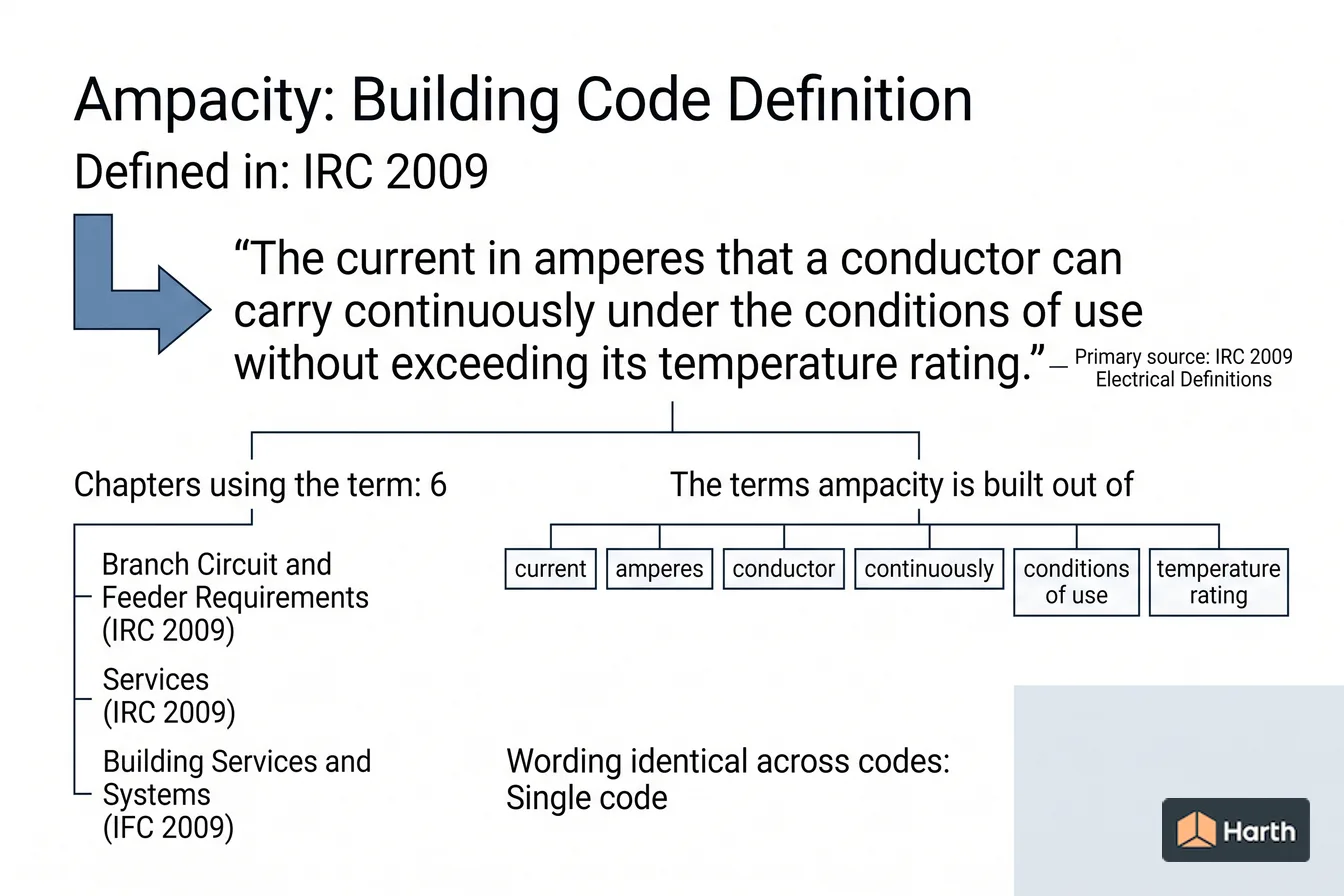
The current in amperes that a conductor can carry continuously under the conditions of use without exceeding its temperature rating.
What must be verified before using this guidance?
Ampacity is defined once in this corpus, in the Electrical Definitions chapter of the International Residential Code (IRC) 2009:
The current in amperes that a conductor can carry continuously under the conditions of use without exceeding its temperature rating.
Where ampacity is used in the code
The term appears in 6 chapters of the 2009 I-Codes hosted here. The chapters that lean on it hardest are the ones to read next.
| Chapter | Code | Mentions |
|---|---|---|
| Branch Circuit and Feeder Requirements | IRC 2009 | 46 |
| Services | IRC 2009 | 19 |
| Building Services and Systems | IFC 2009 | 4 |
| Electrical Definitions | IRC 2009 | 3 |
| Swimming Pools | IRC 2009 | 2 |
| General Regulations | IMC 2009 | 1 |
The term in use
How the code actually writes about ampacity, quoted from the 2009 text hosted here:
Where a branch circuit or a feeder supplies continuous loads or any combination of continuous and noncontinuous loads, the minimum branch-circuit or feeder conductor size, before the application of any adjustment or correction factors, shall have an allowable ampacity equal to or greater than the noncontinuous load plus 125 percent of the continuous load.
Ungrounded service conductors shall have an ampacity of not less than the load served.
The ampacity of the extension cords shall not be less than the rated capacity of the portable appliance supplied by the cord.
The ampacity of the branch-circuit conductors and the rating or setting of overcurrent protective devices shall be not less than 125 percent of the total nameplate load rating.
The terms ampacity is built out of
The definition above leans on 1 other defined term. Each carries its own code definition, and a local amendment to any of them changes what ampacity covers:
- Conductor — IPC 2009: A pipe inside the building that conveys storm water from the roof to a storm or combined bUilding drain.
Ampacity: what to open, and in what order
Every row is a document this term depends on. The ICC code library and the ICC adoption maps cover the middle rows.
| Check | Where | Confirmed |
|---|---|---|
| Read the definition in the adopted IRC | Electrical Definitions | |
| Re-check the requirement that uses it | Branch Circuit and Feeder Requirements (IRC 2009) | |
| Re-check the requirement that uses it | Services (IRC 2009) | |
| Re-check the requirement that uses it | Building Services and Systems (IFC 2009) | |
| Re-check the requirement that uses it | Electrical Definitions (IRC 2009) | |
| Confirm the dependent definition | Conductor | |
| Local amendment to any of the above | Jurisdiction's amendment list |
A research aid, not a code determination. The authority having jurisdiction decides which edition and which amendments apply.
Where can you explore related guidance?
- Explore all glossary guidance
- Conductor: Building Code Definition
- Appliance: Building Code Definition
- Plenum: Building Code Definition
- Outlet: Building Code Definition
Sources and method
Definitions quoted from the 2009 International Codes as transcribed in this site's building-codes collection, with the source chapter linked for each quotation. Usage counts are computed over the chapters hosted here, one copy per code. The ICC code library publishes the current model text and the ICC adoption maps show which edition a jurisdiction has adopted; those sources control.
Source links
Frequently asked questions
What is the code definition of ampacity?
The International Residential Code (IRC) 2009 defines it in Electrical Definitions as: “The current in amperes that a conductor can carry continuously under the conditions of use without exceeding its temperature rating.” The 2009 model text is reproduced here; the definition that binds your project is the one in the edition your jurisdiction has adopted, as amended locally.
Which parts of the code depend on ampacity?
In this corpus the term is used across 6 chapters, led by Branch Circuit and Feeder Requirements in the IRC 2009. Those are the sections whose scope moves if the definition is amended locally, so read them together with Chapter 2 rather than on their own.
What is the NEC definition of ampacity?
In the 2009 I-Codes hosted here it is a defined term rather than a description. The IRC 2009 states, in Electrical Definitions: “The current in amperes that a conductor can carry continuously under the conditions of use without exceeding its temperature rating.” It is defined in IRC 2009. Because it is a defined term, whatever the adopted edition says it means is what every section using it means — so check Chapter 2 of that edition and any local amendment before relying on this wording.
Related pages
- Alternating Tread Device: Building Code Definition
Alternating Tread Device — IBC 2009 definition: A device that has a series of steps between 50 and 70 degrees (0.87 and 1.22 …
- Alternative Engineered Design: Building Code Definition
Alternative Engineered Design — IPC 2009 definition: A plumbing system that performs in accordance with the intent of Chapters 3 through 12 and …
- Ambulatory Health Care Facility: Building Code Definition
Ambulatory Health Care Facility — IBC 2009 definition: Buildings or portions thereof used to provide medical, surgical, psychiatric, nursing or similar care on a …
- Anchor Building: Building Code Definition
Anchor Building — IBC 2009 definition: An exterior perimeter building of a group other than H having direct access to a coveredmall …
- Anchor: Building Code Definition
Anchor — IBC 2009 definition: Metal rod, wire or strap that secures masonry to its structural support.
- Annunciator: Building Code Definition
Annunciator — IBC 2009 definition: A unit containing one or more indicator lamps, alphanumeric displays or other equivalent means in which …