Building Code Glossary
Building Sewer: Building Code Definition
How the IRC 2009, IPC 2009 define building sewer, where the wording differs, and which chapters depend on the term.
On this page
Last updated September 7, 2026 · Definitions quoted from the 2009 International Codes as transcribed in this site's building-codes collection, with the source chapter linked for each quotation. Usage counts are computed over the chapters hosted here, one copy per code. The [ICC code library](https://codes.iccsafe.org/codes) publishes the current model text and the [ICC adoption maps](https://www.iccsafe.org/advocacy/code-adoption-maps/) show which edition a jurisdiction has adopted; those sources control.
Direct answer
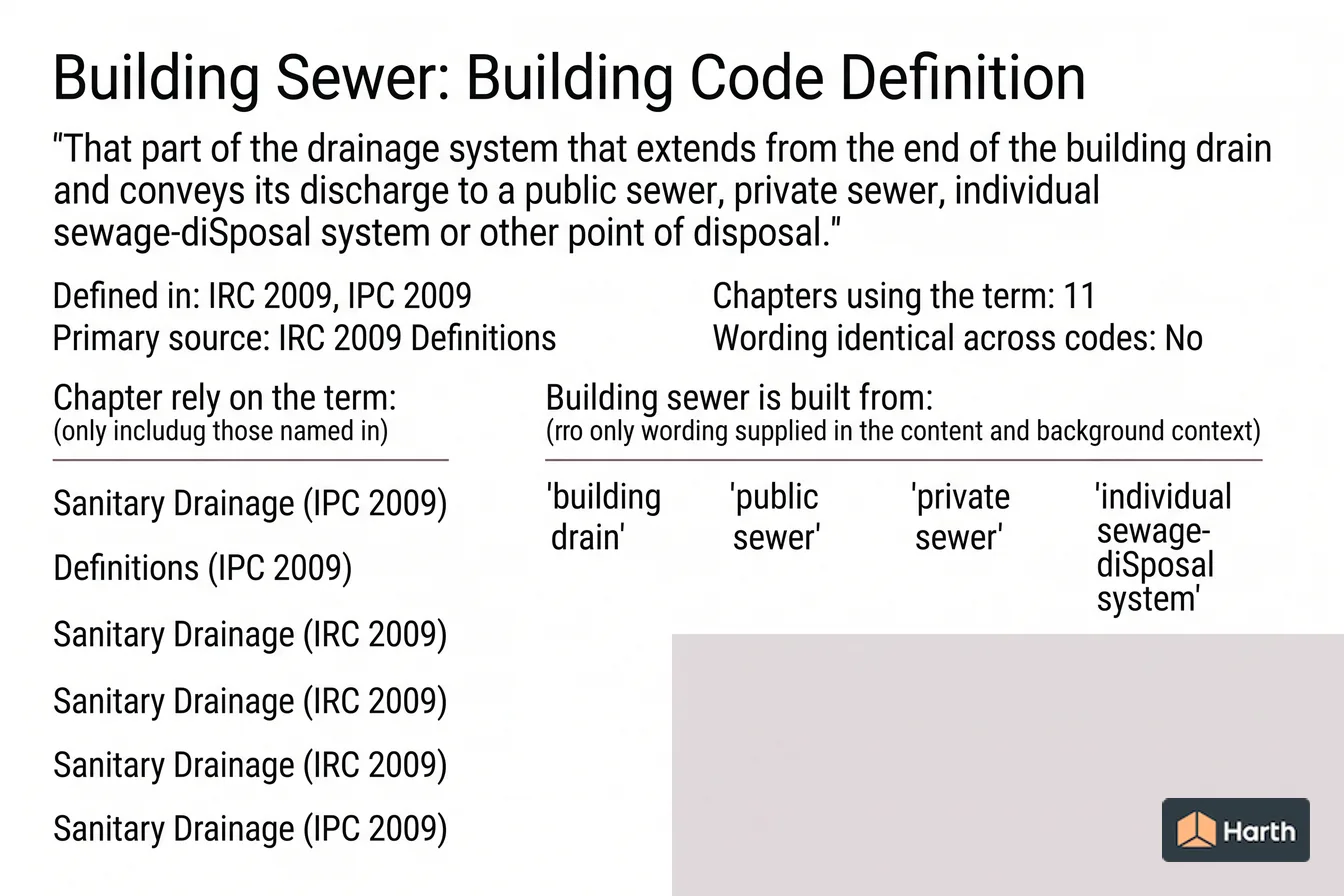
Building sewer is a defined term in the International Residential Code (IRC) 2009, in Definitions. The code's own words are: “That part of the drainage system that extends from the end of the building drain and conveys its discharge to a public sewer, private sewer, individual sewage-diSposal system or other point of disposal.” The IPC 2009 defines the same term with different wording, so the controlling text depends on which code governs the question in front of you — the comparison below sets the versions side by side. The term is used in 11 chapters of this corpus, most often in Sanitary Drainage (IPC 2009), Definitions (IPC 2009), Sanitary Drainage (IRC 2009). These pages transcribe the 2009 model text; verify the definition against the edition and amendments your authority having jurisdiction has adopted.
Content and cited inputs reviewed by Scott Barrington, Harth founder and architectural technology specialist · Published 2026-09-07 · Updated 2026-09-07.
What does this term mean?
Building Sewer — IRC 2009, Definitions:
That part of the drainage system that extends from the end of the building drain and conveys its discharge to a public sewer, private sewer, individual sewage-diSposal system or other point of disposal.
What must be verified before using this guidance?
Two of the I-Codes in this corpus define Building Sewer, and the wording is not identical — read the version that governs your question.
| Code | Where it is defined | Definition |
|---|---|---|
| IRC 2009 | Definitions | That part of the drainage system that extends from the end of the building drain and conveys its discharge to a public sewer, private sewer, individual sewage-diSposal system or other point of disposal. |
| IPC 2009 | Definitions | That part of the drainage system that extends from the end of the building drain and conveys the discharge to a public sewer, private sewer, individual sewage disposal system or other point of disposal. |
Where building sewer is used in the code
The term appears in 11 chapters of the 2009 I-Codes hosted here. The chapters that lean on it hardest are the ones to read next.
| Chapter | Code | Mentions |
|---|---|---|
| Sanitary Drainage | IPC 2009 | 31 |
| Definitions | IPC 2009 | 20 |
| Sanitary Drainage | IRC 2009 | 18 |
| General Regulations | IPC 2009 | 7 |
| Plumbing Administration | IRC 2009 | 7 |
| Water Supply and Distribution | IRC 2009 | 6 |
| Water Supply and Distribution | IPC 2009 | 4 |
| Special Detailed Requirements Based on Use and Occupancy | IBC 2009 | 3 |
| Definitions | IRC 2009 | 3 |
| General Plumbing Requirements | IRC 2009 | 2 |
| Storm Drainage | IPC 2009 | 1 |
The term in use
How the code actually writes about building sewer, quoted from the 2009 text hosted here:
Where located on the same lot, multiple buildings shall not be prohibited from connecting to a common building sewer that connects to the public sewer.
BUilding sewer piping shall be as shown in Table P3002.2.
Gravity sewer tests shall consist of plugging the end of the building sewer at the point of connection with the public sewer, filling the building sewer with water, testing with not less than a 10-foot (3048 mm) head of water and maintaining such pressure for 15 minutes.
The terms building sewer is built out of
The definition above leans on 5 other defined terms. Each carries its own code definition, and a local amendment to any of them changes what building sewer covers:
- Individual Sewage Disposal System — IRC 2009: A system for disposal of sewage by means of a septic tank or mechanical treatment, designed for use apart from a public sewer to serve a single establishment or building.
- Drainage System — IPC 2009: Piping within a public or private premise that conveys sewage, rainwater or other liquid wastes to a point of disposal.
- Building Drain — IRC 2009: The lowest piping that collects the discharge from all other drainage piping inside the house and extends 30 inches (762 mm) in developed length of pipe, beyond the exterior walls and conveys the drainage to the building sewer.
- Public Sewer — IRC 2009: A common sewer directly controlled by public authority.
- Building — IBC 2009: Any structure used or intended for supporting or sheltering any use or occupancy.
Building Sewer: what to open, and in what order
Every row is a document this term depends on. The ICC code library and the ICC adoption maps cover the middle rows.
| Check | Where | Confirmed |
|---|---|---|
| Read the definition in the adopted IRC | Definitions | |
| Read the definition in the adopted IPC | Definitions | |
| Re-check the requirement that uses it | Sanitary Drainage (IPC 2009) | |
| Re-check the requirement that uses it | Definitions (IPC 2009) | |
| Re-check the requirement that uses it | Sanitary Drainage (IRC 2009) | |
| Re-check the requirement that uses it | General Regulations (IPC 2009) | |
| Confirm the dependent definition | Individual Sewage Disposal System | |
| Confirm the dependent definition | Drainage System | |
| Confirm the dependent definition | Building Drain | |
| Local amendment to any of the above | Jurisdiction's amendment list |
A research aid, not a code determination. The authority having jurisdiction decides which edition and which amendments apply.
Where can you explore related guidance?
- Explore all glossary guidance
- Individual Sewage Disposal System: Building Code Definition
- Drainage System: Building Code Definition
- Building Drain: Building Code Definition
- Public Sewer: Building Code Definition
Sources and method
Definitions quoted from the 2009 International Codes as transcribed in this site's building-codes collection, with the source chapter linked for each quotation. Usage counts are computed over the chapters hosted here, one copy per code. The ICC code library publishes the current model text and the ICC adoption maps show which edition a jurisdiction has adopted; those sources control.
Source links
Frequently asked questions
What is the code definition of building sewer?
The International Residential Code (IRC) 2009 defines it in Definitions as: “That part of the drainage system that extends from the end of the building drain and conveys its discharge to a public sewer, private sewer, individual sewage-diSposal system or other point of disposal.” The 2009 model text is reproduced here; the definition that binds your project is the one in the edition your jurisdiction has adopted, as amended locally.
Which parts of the code depend on building sewer?
In this corpus the term is used across 11 chapters, led by Sanitary Drainage in the IPC 2009. Those are the sections whose scope moves if the definition is amended locally, so read them together with Chapter 2 rather than on their own.
What is the definition of a building sewer?
In the 2009 I-Codes hosted here it is a defined term rather than a description. The IRC 2009 states, in Definitions: “That part of the drainage system that extends from the end of the building drain and conveys its discharge to a public sewer, private sewer, individual sewage-diSposal system or other point of disposal.” It is defined in IRC 2009, IPC 2009. Because it is a defined term, whatever the adopted edition says it means is what every section using it means — so check Chapter 2 of that edition and any local amendment before relying on this wording.
What's the difference between a building drain and a building sewer?
In the 2009 I-Codes hosted here it is a defined term rather than a description. The IRC 2009 states, in Definitions: “That part of the drainage system that extends from the end of the building drain and conveys its discharge to a public sewer, private sewer, individual sewage-diSposal system or other point of disposal.” It is defined in IRC 2009, IPC 2009. It is not the same as Building Drain, which the IRC 2009 defines separately as “The lowest piping that collects the discharge from all other drainage piping inside the house and extends 30 inches (762 mm) in developed length of pipe, beyond the exterior walls and conveys the drainage to …” Because it is a defined term, whatever the adopted edition says it means is what every section using it means — so check Chapter 2 of that edition and any local amendment before relying on this wording.
Related pages
- Building, Existing: Building Code Definition
Building, Existing — IRC 2009 definition: Existing building is a building erected prior to the adoption of this code, or one for …
- Building Line: Building Code Definition
Building Line — IBC 2009 definition: The line established by law, beyond which a building shall not extend, except as specifically provided …
- Building Official: Building Code Definition
Building Official — IBC 2009 definition: The officer or other designated authority charged with the administration and enforcement of this code, or …
- Building Subdrain: Building Code Definition
Building Subdrain — IPC 2009 definition: That portion of a drainage system that does not drain by gravity into the bUilding sewer.
- Building Thermal Envelope: Building Code Definition
Building Thermal Envelope — IRC 2009 definition: The basement walls, exterior walls, floor, roof and any other building element that enclose conditioned spaces.
- Building Trap: Building Code Definition
Building Trap — IPC 2009 definition: A device, fitting or assembly of fittings installed in the building drain to prevent circulation of …