Building Code Glossary
Condensate: Building Code Definition
How the IRC 2009, IMC 2009 define condensate, where the wording differs, and which chapters depend on the term.
On this page
Last updated September 7, 2026 · Definitions quoted from the 2009 International Codes as transcribed in this site's building-codes collection, with the source chapter linked for each quotation. Usage counts are computed over the chapters hosted here, one copy per code. The [ICC code library](https://codes.iccsafe.org/codes) publishes the current model text and the [ICC adoption maps](https://www.iccsafe.org/advocacy/code-adoption-maps/) show which edition a jurisdiction has adopted; those sources control.
Direct answer
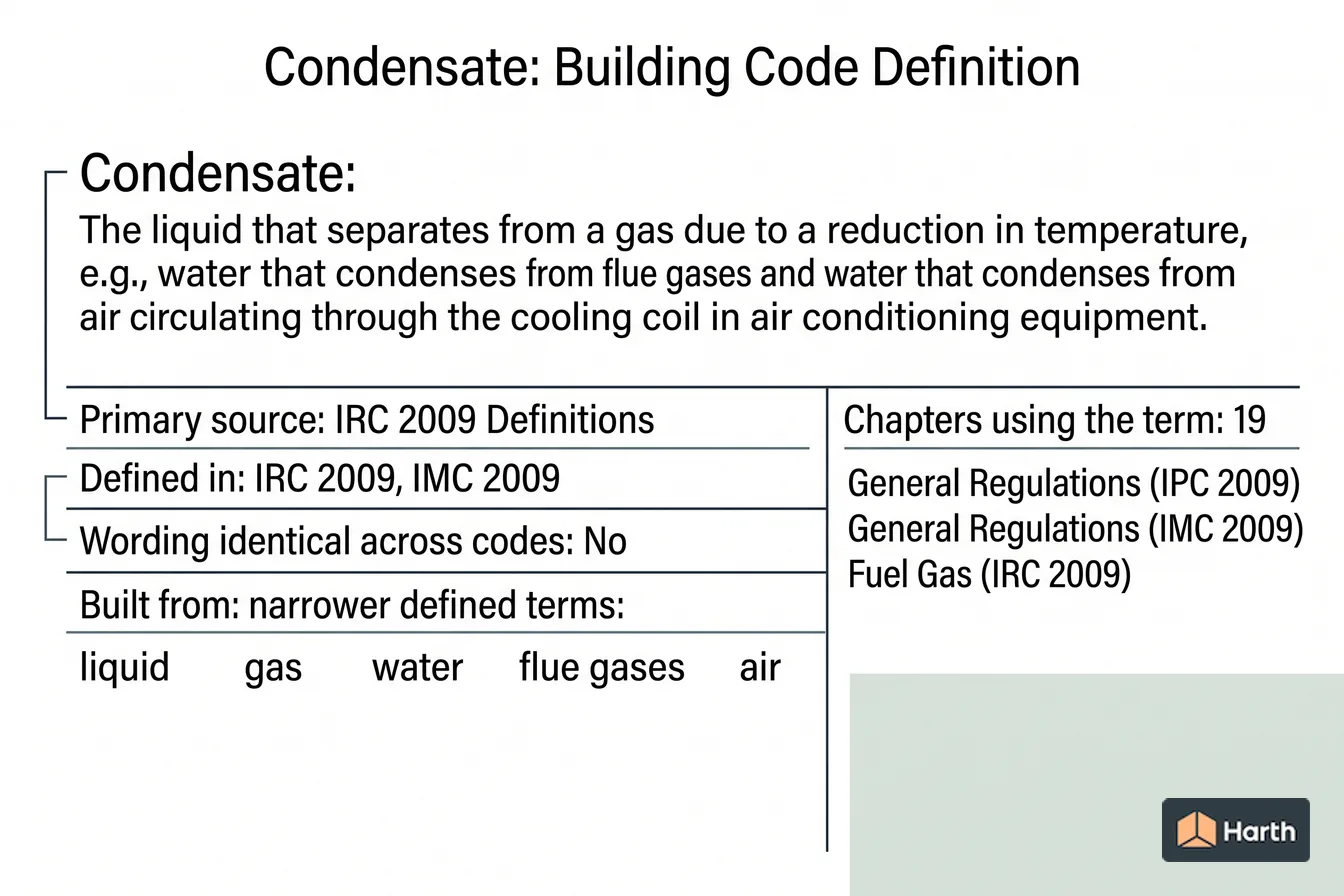
Condensate is a defined term in the International Residential Code (IRC) 2009, in Definitions. The code's own words are: “The liquid that separates from a gas due to a reduction in temperature, e.g., water that condenses from flue gases and water that condenses from air circulating through the cooling coil in air conditioning equipment.” The IMC 2009 defines the same term with different wording, so the controlling text depends on which code governs the question in front of you — the comparison below sets the versions side by side. The term is used in 19 chapters of this corpus, most often in General Regulations (IPC 2009), General Regulations (IMC 2009), Fuel Gas (IRC 2009). These pages transcribe the 2009 model text; verify the definition against the edition and amendments your authority having jurisdiction has adopted.
Content and cited inputs reviewed by Scott Barrington, Harth founder and architectural technology specialist · Published 2026-09-07 · Updated 2026-09-07.
What does this term mean?
Condensate — IRC 2009, Definitions:
The liquid that separates from a gas due to a reduction in temperature, e.g., water that condenses from flue gases and water that condenses from air circulating through the cooling coil in air conditioning equipment.
What must be verified before using this guidance?
Two of the I-Codes in this corpus define Condensate, and the wording is not identical — read the version that governs your question.
| Code | Where it is defined | Definition |
|---|---|---|
| IRC 2009 | Definitions | The liquid that separates from a gas due to a reduction in temperature, e.g., water that condenses from flue gases and water that condenses from air circulating through the cooling coil in air conditioning equipment. |
| IMC 2009 | Definitions | The liquid that condenses from a gas (including flue gas) caused by a reduction in temperature. |
Where condensate is used in the code
The term appears in 19 chapters of the 2009 I-Codes hosted here. The chapters that lean on it hardest are the ones to read next.
| Chapter | Code | Mentions |
|---|---|---|
| General Regulations | IPC 2009 | 34 |
| General Regulations | IMC 2009 | 31 |
| Fuel Gas | IRC 2009 | 25 |
| Heating and Cooling Equipment | IRC 2009 | 18 |
| Motor Fuel-dispensing Facilities and Repair Garages | IFC 2009 | 8 |
| Fixtures, Faucets and Fixture Fittings | IPC 2009 | 6 |
| Definitions | IMC 2009 | 3 |
| Masonry | IBC 2009 | 2 |
| Chimneys and Vents | IMC 2009 | 2 |
| Exhaust Systems | IMC 2009 | 2 |
| Water Heaters | IPC 2009 | 2 |
| Water Supply and Distribution | IPC 2009 | 2 |
7 further chapters mention the term.
The term in use
How the code actually writes about condensate, quoted from the 2009 text hosted here:
Condensate drain systems shall be provided for equipment and appliances containing evaporators or cooling coils.
Category IV condensing appliances shall be provided with an auxiliary drain pan where damage to any building component will occur as a result of stoppage in the condensate drainage system.
Condensate from all cooling coils or evaporators shall be conveyed from the drain pan outlet to an approved place of disposal.
The terms condensate is built out of
The definition above leans on 4 other defined terms. Each carries its own code definition, and a local amendment to any of them changes what condensate covers:
- Air Conditioning — IMC 2009: The treatment of air so as to control simultaneously the temperature, humidity, cleanness and distribution of the air to meet the requirements of a conditioned space.
- Flue Gases — IRC 2009: Products of combustion plus excess air in appliance flues or heat exchangers.
- Equipment — IRC 2009: All piping, ducts, vents, control devices and other components of systems other than appliances that are permanently installed and integrated to provide control of environmental conditions for buildings.
- Liquid — IBC 2009: A material that has a melting point that is equal to or less than 68°F (20°C) and a boiling point that is greater than 68°F (20°C) at 14.7 pounds per square inch absolute (psia) (101 kPa).
Condensate: what to open, and in what order
Every row is a document this term depends on. The ICC code library and the ICC adoption maps cover the middle rows.
| Check | Where | Confirmed |
|---|---|---|
| Read the definition in the adopted IRC | Definitions | |
| Read the definition in the adopted IMC | Definitions | |
| Re-check the requirement that uses it | General Regulations (IPC 2009) | |
| Re-check the requirement that uses it | General Regulations (IMC 2009) | |
| Re-check the requirement that uses it | Fuel Gas (IRC 2009) | |
| Re-check the requirement that uses it | Heating and Cooling Equipment (IRC 2009) | |
| Confirm the dependent definition | Air Conditioning | |
| Confirm the dependent definition | Flue Gases | |
| Confirm the dependent definition | Equipment | |
| Local amendment to any of the above | Jurisdiction's amendment list |
A research aid, not a code determination. The authority having jurisdiction decides which edition and which amendments apply.
Where can you explore related guidance?
- Explore all glossary guidance
- Air Conditioning: Building Code Definition
- Flue Gases: Building Code Definition
- Equipment: Building Code Definition
- Liquid: Building Code Definition
Sources and method
Definitions quoted from the 2009 International Codes as transcribed in this site's building-codes collection, with the source chapter linked for each quotation. Usage counts are computed over the chapters hosted here, one copy per code. The ICC code library publishes the current model text and the ICC adoption maps show which edition a jurisdiction has adopted; those sources control.
Source links
Frequently asked questions
What is the code definition of condensate?
The International Residential Code (IRC) 2009 defines it in Definitions as: “The liquid that separates from a gas due to a reduction in temperature, e.g., water that condenses from flue gases and water that condenses from air circulating through the cooling coil in air conditioning equipment.” The 2009 model text is reproduced here; the definition that binds your project is the one in the edition your jurisdiction has adopted, as amended locally.
Which parts of the code depend on condensate?
In this corpus the term is used across 19 chapters, led by General Regulations in the IPC 2009. Those are the sections whose scope moves if the definition is amended locally, so read them together with Chapter 2 rather than on their own.
What is the definition of condensate?
In the 2009 I-Codes hosted here it is a defined term rather than a description. The IRC 2009 states, in Definitions: “The liquid that separates from a gas due to a reduction in temperature, e.g., water that condenses from flue gases and water that condenses from air circulating through the cooling coil in air conditioning equipment.” It is defined in IRC 2009, IMC 2009. Because it is a defined term, whatever the adopted edition says it means is what every section using it means — so check Chapter 2 of that edition and any local amendment before relying on this wording.
What are the building code requirements for condensate drains?
In the 2009 I-Codes hosted here it is a defined term rather than a description. The IRC 2009 states, in Definitions: “The liquid that separates from a gas due to a reduction in temperature, e.g., water that condenses from flue gases and water that condenses from air circulating through the cooling coil in air conditioning equipment.” It is defined in IRC 2009, IMC 2009. It is not the same as Building, which the IBC 2009 defines separately as “Any structure used or intended for supporting or sheltering any use or occupancy.” Because it is a defined term, whatever the adopted edition says it means is what every section using it means — so check Chapter 2 of that edition and any local amendment before relying on this wording.
Related pages
- Concrete, Lightweight Aggregate: Building Code Definition
Concrete, Lightweight Aggregate — IBC 2009 definition: Concrete made with aggregates of expanded clay, shale, slag or slate or sintered fly ash or …
- Concrete, Perlite: Building Code Definition
Concrete, Perlite — IBC 2009 definition: A lightweight insulating concrete having a dry unit weight of approximately 30 pcf (480 kg/m3) made …
- Concrete, Vermiculite: Building Code Definition
Concrete, Vermiculite — IBC 2009 definition: A lightweight insulating concrete made with vermiculite concrete aggregate which is laminated micaceous material produced by …
- Condenser: Building Code Definition
Condenser — IMC 2009 definition: A heat exchanger designed to liquefy refrigerant vapor by removal of heat.
- Condensing Appliance: Building Code Definition
Condensing Appliance — IRC 2009 definition: An appliance that condenses water generated by the burning of fuels.
- Conditioned Air: Building Code Definition
Conditioned Air — IRC 2009 definition: Air treated to control its temperature, relative humidity or quality.