Building Code Glossary
Excess Air: Building Code Definition
How the IRC 2009, IMC 2009 define excess air, where the wording differs, and which chapters depend on the term.
On this page
Last updated September 7, 2026 · Definitions quoted from the 2009 International Codes as transcribed in this site's building-codes collection, with the source chapter linked for each quotation. Usage counts are computed over the chapters hosted here, one copy per code. The [ICC code library](https://codes.iccsafe.org/codes) publishes the current model text and the [ICC adoption maps](https://www.iccsafe.org/advocacy/code-adoption-maps/) show which edition a jurisdiction has adopted; those sources control.
Direct answer
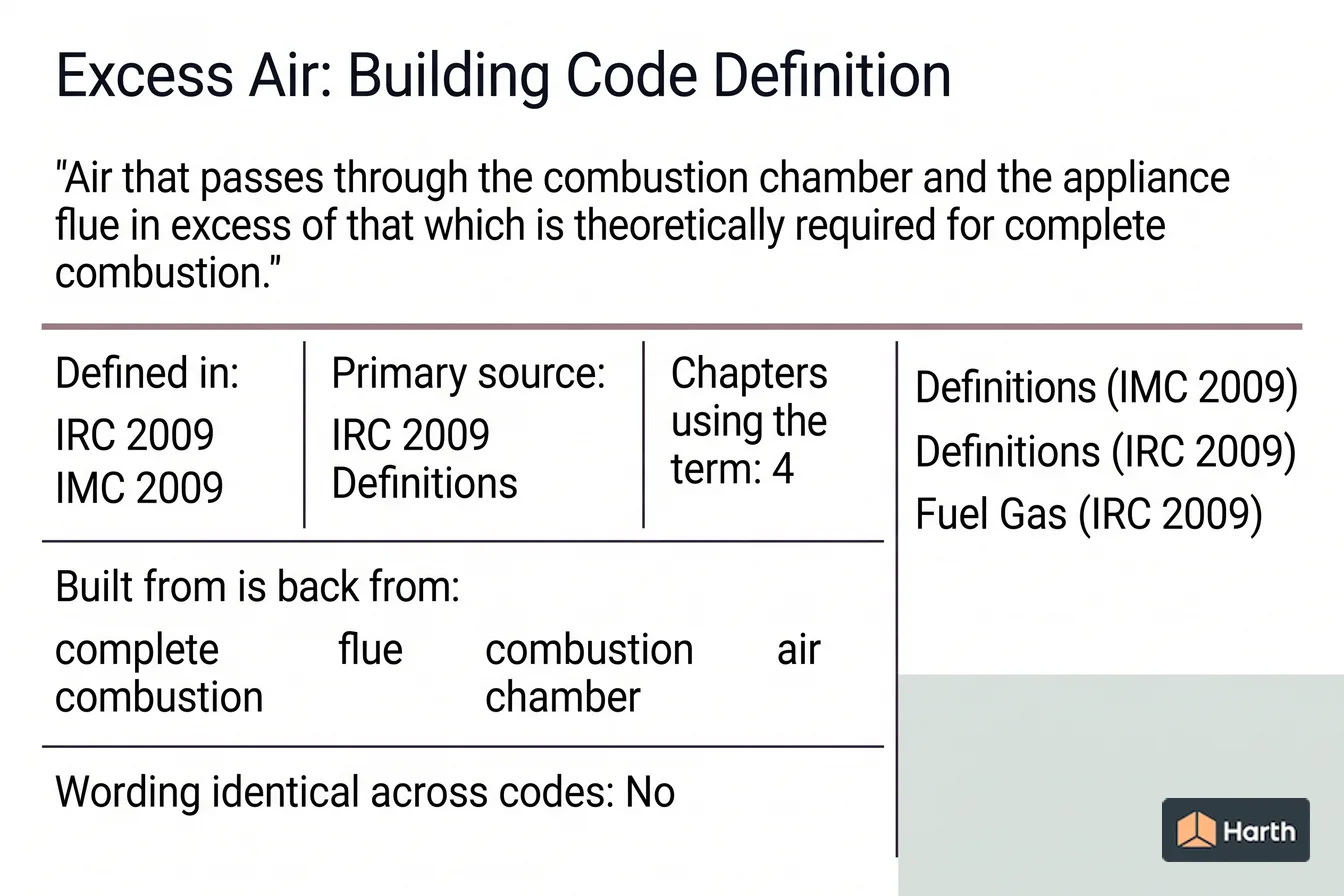
Excess air is a defined term in the International Residential Code (IRC) 2009, in Definitions. The code's own words are: “Air that passes through the combustion chamber and the appliance flue in excess of that which is theoretically required for complete combustion.” The IMC 2009 defines the same term with different wording, so the controlling text depends on which code governs the question in front of you — the comparison below sets the versions side by side. The term is used in 4 chapters of this corpus, most often in Definitions (IMC 2009), Definitions (IRC 2009), Fuel Gas (IRC 2009). These pages transcribe the 2009 model text; verify the definition against the edition and amendments your authority having jurisdiction has adopted.
Content and cited inputs reviewed by Scott Barrington, Harth founder and architectural technology specialist · Published 2026-09-07 · Updated 2026-09-07.
What does this term mean?
Excess Air — IRC 2009, Definitions:
Air that passes through the combustion chamber and the appliance flue in excess of that which is theoretically required for complete combustion.
What must be verified before using this guidance?
Two of the I-Codes in this corpus define Excess Air, and the wording is not identical — read the version that governs your question.
| Code | Where it is defined | Definition |
|---|---|---|
| IRC 2009 | Definitions | Air that passes through the combustion chamber and the appliance flue in excess of that which is theoretically required for complete combustion. |
| IMC 2009 | Definitions | The amount of air provided in addition to theoretical air to achieve complete combustion of a fuel, thereby preventing the formation of dangerous products of combustion. |
Where excess air is used in the code
The term appears in 4 chapters of the 2009 I-Codes hosted here. The chapters that lean on it hardest are the ones to read next.
| Chapter | Code | Mentions |
|---|---|---|
| Definitions | IMC 2009 | 4 |
| Definitions | IRC 2009 | 3 |
| Fuel Gas | IRC 2009 | 3 |
| Exhaust Systems | IMC 2009 | 1 |
The term in use
How the code actually writes about excess air, quoted from the 2009 text hosted here:
If a greater quantity of air is supplied by a mechanical ventilating supply system than is removed by a mechanical exhaust for a room, adequate means shall be provided for the natural or mechanical exhaust of the excess air supplied.
The terms excess air is built out of
The definition above leans on 5 other defined terms. Each carries its own code definition, and a local amendment to any of them changes what excess air covers:
- Combustion Chamber — IRC 2009: The portion of an appliance within which combustion occurs.
- Combustion — IRC 2009: In the context of this code, refers to the rapid oxidation of fuel accompanied by the production of heat or heat and light.
- Appliance — IRC 2009: Utilization equipment, normally built in standardized sizes or types, that is installed or connected as a unit to perform one or more functions such as clothes washing, air conditioning, food mixing, deep frying, etc.
- Dangerous — IBC 2009: Any building or structure or portion thereof that meets any of the conditions described below shall be deemed dangerous:
- Addition — IBC 2009: An extension or increase in floor area or height of a building or structure.
Excess Air: what to open, and in what order
Every row is a document this term depends on. The ICC code library and the ICC adoption maps cover the middle rows.
| Check | Where | Confirmed |
|---|---|---|
| Read the definition in the adopted IRC | Definitions | |
| Read the definition in the adopted IMC | Definitions | |
| Re-check the requirement that uses it | Definitions (IMC 2009) | |
| Re-check the requirement that uses it | Definitions (IRC 2009) | |
| Re-check the requirement that uses it | Fuel Gas (IRC 2009) | |
| Re-check the requirement that uses it | Exhaust Systems (IMC 2009) | |
| Confirm the dependent definition | Combustion Chamber | |
| Confirm the dependent definition | Combustion | |
| Confirm the dependent definition | Appliance | |
| Local amendment to any of the above | Jurisdiction's amendment list |
A research aid, not a code determination. The authority having jurisdiction decides which edition and which amendments apply.
Where can you explore related guidance?
- Explore all glossary guidance
- Combustion Chamber: Building Code Definition
- Combustion: Building Code Definition
- Dangerous: Building Code Definition
- Appliance: Building Code Definition
Sources and method
Definitions quoted from the 2009 International Codes as transcribed in this site's building-codes collection, with the source chapter linked for each quotation. Usage counts are computed over the chapters hosted here, one copy per code. The ICC code library publishes the current model text and the ICC adoption maps show which edition a jurisdiction has adopted; those sources control.
Source links
Frequently asked questions
What is the code definition of excess air?
The International Residential Code (IRC) 2009 defines it in Definitions as: “Air that passes through the combustion chamber and the appliance flue in excess of that which is theoretically required for complete combustion.” The 2009 model text is reproduced here; the definition that binds your project is the one in the edition your jurisdiction has adopted, as amended locally.
Which parts of the code depend on excess air?
In this corpus the term is used across 4 chapters, led by Definitions in the IMC 2009. Those are the sections whose scope moves if the definition is amended locally, so read them together with Chapter 2 rather than on their own.
What does "excess air" mean?
In the 2009 I-Codes hosted here it is a defined term rather than a description. The IRC 2009 states, in Definitions: “Air that passes through the combustion chamber and the appliance flue in excess of that which is theoretically required for complete combustion.” It is defined in IRC 2009, IMC 2009. Because it is a defined term, whatever the adopted edition says it means is what every section using it means — so check Chapter 2 of that edition and any local amendment before relying on this wording.
Related pages
- Essentially Toxic Transfer Fluids: Building Code Definition
Essentially Toxic Transfer Fluids — IRC 2009 definition: Soil, water or gray water and fluids having a Gosselin rating of 2 or more including …
- Evaporative Cooler: Building Code Definition
Evaporative Cooler — IRC 2009 definition: A device used for reducing air temperature by the process of evaporating water into an airstream.
- Evaporator: Building Code Definition
Evaporator — IMC 2009 definition: That part of the system in which liquid refrigerant is vaporized to produce refrigeration.
- Excess Flow Control: Building Code Definition
Excess Flow Control — IFC 2009 definition: A fail-safe system or other approved means designed to shut off flow caused by a rupture …
- Exhaust System: Building Code Definition
Exhaust System — IMC 2009 definition: An assembly of connected ducts, plenums, fittings, registers, grilles and hoods through which air is conducted …
- Exhausted Enclosure: Building Code Definition
Exhausted Enclosure — IBC 2009 definition: An appliance or piece of equipment that consists ofa top, a back and two sides providing …