Building Code Glossary
Flash Point: Building Code Definition
How the IBC 2009, IFC 2009, IMC 2009 define flash point, where the wording differs, and which chapters depend on the term.
On this page
Last updated September 7, 2026 · Definitions quoted from the 2009 International Codes as transcribed in this site's building-codes collection, with the source chapter linked for each quotation. Usage counts are computed over the chapters hosted here, one copy per code. The [ICC code library](https://codes.iccsafe.org/codes) publishes the current model text and the [ICC adoption maps](https://www.iccsafe.org/advocacy/code-adoption-maps/) show which edition a jurisdiction has adopted; those sources control.
Direct answer
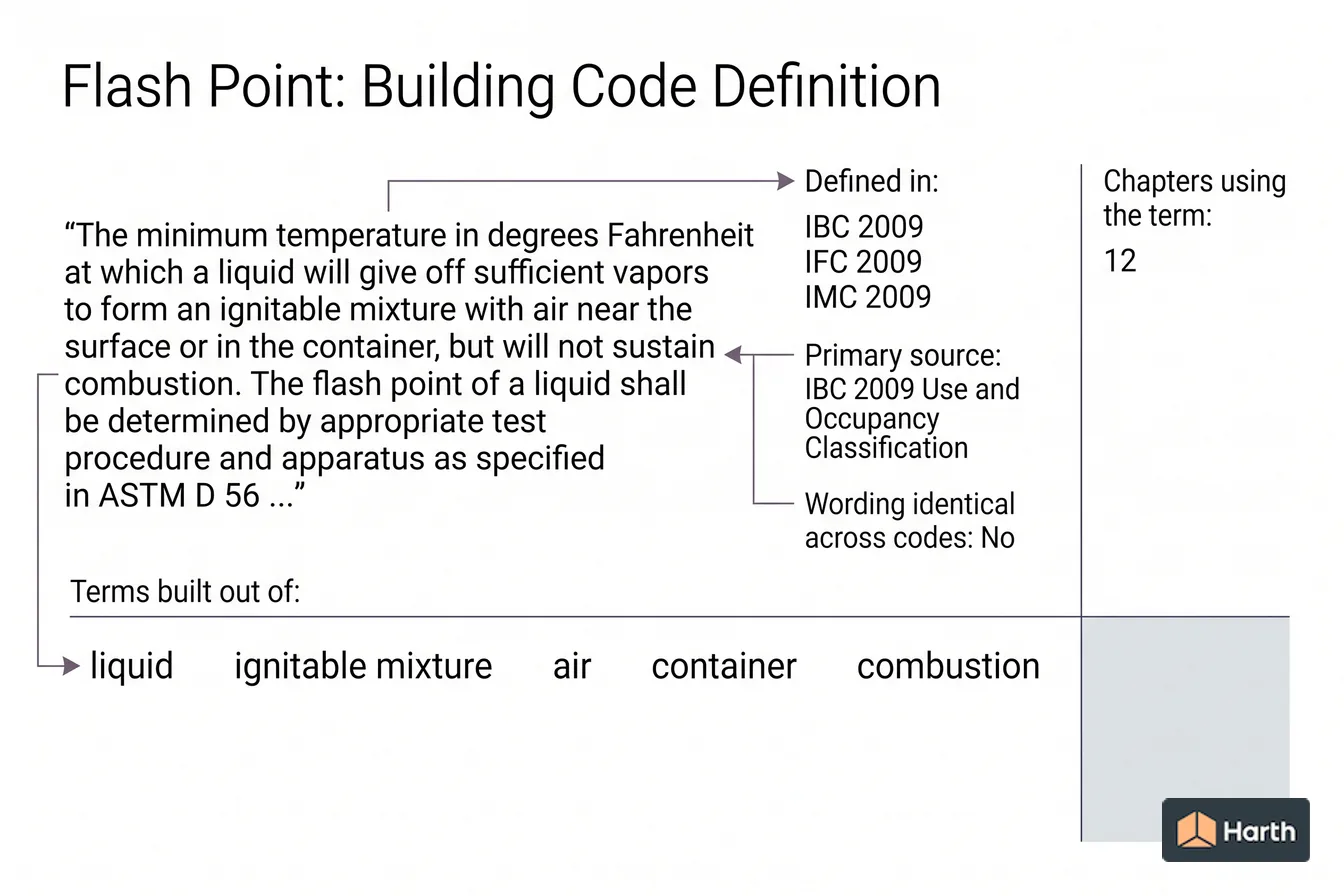
Flash point is a defined term in the International Building Code (IBC) 2009, in Use and Occupancy Classification. The code's own words are: “The minimum temperature in degrees Fahrenheit at which a liquid will give off sufficient vapors to form an ignitable mixture with air near the surface or in the container, but will not sustain combustion. The flash point of a liquid shall be determined by appropriate test procedure and apparatus as specified in ASTM D 56 …” The IFC 2009, IMC 2009 define the same term with different wording, so the controlling text depends on which code governs the question in front of you — the comparison below sets the versions side by side. The term is used in 12 chapters of this corpus, most often in Flammable and Combustible Liquids (IFC 2009), Definitions (IMC 2009), Use and Occupancy Classification (IBC 2009). These pages transcribe the 2009 model text; verify the definition against the edition and amendments your authority having jurisdiction has adopted.
Content and cited inputs reviewed by Scott Barrington, Harth founder and architectural technology specialist · Published 2026-09-07 · Updated 2026-09-07.
What does this term mean?
Flash Point — IBC 2009, Use and Occupancy Classification:
The minimum temperature in degrees Fahrenheit at which a liquid will give off sufficient vapors to form an ignitable mixture with air near the surface or in the container, but will not sustain combustion. The flash point of a liquid shall be determined by appropriate test procedure and apparatus as specified in ASTM D 56, ASTM D 93 or ASTM D 3278.
What must be verified before using this guidance?
Three of the I-Codes in this corpus define Flash Point, and the wording is not identical — read the version that governs your question.
| Code | Where it is defined | Definition |
|---|---|---|
| IBC 2009 | Use and Occupancy Classification | The minimum temperature in degrees Fahrenheit at which a liquid will give off sufficient vapors to form an ignitable mixture with air near the surface or in the container, but will not sustain combustion. The flash point of a liquid shall be determined by appropriate test procedure and apparatus as specified in ASTM D 56, ASTM D 93 or ASTM D 3278. |
| IFC 2009 | Flammable and Combustible Liquids | The minimum temperature in degrees Fahrenheit at which a liquid will give off sufficient vapors to form an ignitable mixture with air near the surface or in the container, but will not sustain combustion. The flash point of a liquid shall be determined by appropriate test procedure and apparatus as specified in ASTM D 56, ASTM D 93 or ASTM D 3278. |
| IMC 2009 | Definitions | The minimum temperature corrected to a pressure of 14.7 psia (101 kPa) at which the application of a test flame causes the vapors of a portion of the sample to ignite under the conditions specified by the test procedures and apparatus. The flash point of a liquid shall be determined in accordance with ASTM D 56, ASTM D 93 or ASTM D 3278. |
Where flash point is used in the code
The term appears in 12 chapters of the 2009 I-Codes hosted here. The chapters that lean on it hardest are the ones to read next.
| Chapter | Code | Mentions |
|---|---|---|
| Flammable and Combustible Liquids | IFC 2009 | 37 |
| Definitions | IMC 2009 | 23 |
| Use and Occupancy Classification | IBC 2009 | 20 |
| Dry Cleaning | IFC 2009 | 16 |
| Flammable Finishes | IFC 2009 | 6 |
| Definitions | IFC 2009 | 5 |
| Solar Systems | IMC 2009 | 5 |
| Hydronic Piping | IMC 2009 | 4 |
| Duct Systems | IMC 2009 | 3 |
| Aviation Facilities | IFC 2009 | 2 |
| Definitions | IBC 2009 | 1 |
| Fumigation and Thermal Insecticidal Fogging | IFC 2009 | 1 |
The term in use
How the code actually writes about flash point, quoted from the 2009 text hosted here:
It shall identify the liquids for which the unit has been listed for distillation purposes along with each liquid's flash point and auto-ignition temperature.
The use of solvents with a flash point below that for which a machine is designed or listed shall be prohibited.
Tanks shall be equipped with a high-temperature limit switch arranged to sound an alarm when the temperature of the quenching medium reaches 50°F (10°C) below the flash point.
The terms flash point is built out of
The definition above leans on 4 other defined terms. Each carries its own code definition, and a local amendment to any of them changes what flash point covers:
- Combustion — IRC 2009: In the context of this code, refers to the rapid oxidation of fuel accompanied by the production of heat or heat and light.
- Container — IFC 2009: A vessel of 60 gallons (227 L) or less in capacity used for transporting or storing hazardous materials.
- Liquid — IBC 2009: A material that has a melting point that is equal to or less than 68°F (20°C) and a boiling point that is greater than 68°F (20°C) at 14.7 pounds per square inch absolute (psia) (101 kPa).
- Shall — IRC 2009: The term, when used in the code, is construed as mandatory.
Flash Point: what to open, and in what order
Every row is a document this term depends on. The ICC code library and the ICC adoption maps cover the middle rows.
| Check | Where | Confirmed |
|---|---|---|
| Read the definition in the adopted IBC | Use and Occupancy Classification | |
| Read the definition in the adopted IFC | Flammable and Combustible Liquids | |
| Read the definition in the adopted IMC | Definitions | |
| Re-check the requirement that uses it | Flammable and Combustible Liquids (IFC 2009) | |
| Re-check the requirement that uses it | Definitions (IMC 2009) | |
| Re-check the requirement that uses it | Use and Occupancy Classification (IBC 2009) | |
| Re-check the requirement that uses it | Dry Cleaning (IFC 2009) | |
| Confirm the dependent definition | Combustion | |
| Confirm the dependent definition | Container | |
| Confirm the dependent definition | Liquid | |
| Local amendment to any of the above | Jurisdiction's amendment list |
A research aid, not a code determination. The authority having jurisdiction decides which edition and which amendments apply.
Where can you explore related guidance?
- Explore all glossary guidance
- Combustion: Building Code Definition
- Container: Building Code Definition
- Liquid: Building Code Definition
Sources and method
Definitions quoted from the 2009 International Codes as transcribed in this site's building-codes collection, with the source chapter linked for each quotation. Usage counts are computed over the chapters hosted here, one copy per code. The ICC code library publishes the current model text and the ICC adoption maps show which edition a jurisdiction has adopted; those sources control.
Source links
Frequently asked questions
What is the code definition of flash point?
The International Building Code (IBC) 2009 defines it in Use and Occupancy Classification as: “The minimum temperature in degrees Fahrenheit at which a liquid will give off sufficient vapors to form an ignitable mixture with air near the surface or in the container, but will not sustain combustion. The flash point of a liquid shall be determined by appropriate test procedure and apparatus as specified in ASTM D 56, ASTM D 93 or ASTM D 3278.” The 2009 model text is reproduced here; the definition that binds your project is the one in the edition your jurisdiction has adopted, as amended locally.
Do the I-Codes define flash point the same way?
No. IBC 2009, IFC 2009, IMC 2009 all define the term, but the wording is not identical, and a difference in wording can change which requirements are triggered. The comparison table above sets the versions side by side so you can read the one that governs your question.
Which parts of the code depend on flash point?
In this corpus the term is used across 12 chapters, led by Flammable and Combustible Liquids in the IFC 2009. Those are the sections whose scope moves if the definition is amended locally, so read them together with Chapter 2 rather than on their own.
What is the definition of flash point?
In the 2009 I-Codes hosted here it is a defined term rather than a description. The IBC 2009 states, in Use and Occupancy Classification: “The minimum temperature in degrees Fahrenheit at which a liquid will give off sufficient vapors to form an ignitable mixture with air near the surface or in the container, but will not sustain combustion. The flash point of a liquid shall be determined by appropriate test procedure and apparatus as specified in ASTM D 56 …” It is defined in IBC 2009, IFC 2009, IMC 2009. Because it is a defined term, whatever the adopted edition says it means is what every section using it means — so check Chapter 2 of that edition and any local amendment before relying on this wording.
Related pages
- Flammable Solid: Building Code Definition
Flammable Solid — IBC 2009 definition: A solid, other than a blasting agent or explosive, that is capable of causing fire through …
- Flammable Vapor Area: Building Code Definition
Flammable Vapor Area — IFC 2009 definition: An area in which the concentration of flammable constituents (vapor, gas, fume, mist or dust) in …
- Flammable Vapors or Fumes: Building Code Definition
Flammable Vapors or Fumes — IBC 2009 definition: The concentration of flammable constituents in air that exceed 25 percent of their lower flammable limit …
- Fleet Vehicle Motor Fuel-dispensing Facility: Building Code Definition
Fleet Vehicle Motor Fuel-dispensing Facility — IFC 2009 definition: That portion of a commercial, industrial, governmental or manufacturing property where liquids used as f…
- Flight: Building Code Definition
Flight — IBC 2009 definition: A continuous run of rectangular treads, winders or combination thereof from one landing to another.
- Float: Building Code Definition
Float — IFC 2009 definition: A floating structure normally used as a point of transfer for passengers and goods, or both …