Building Code Glossary
Float: Building Code Definition
How the IFC 2009 define float, where the wording differs, and which chapters depend on the term.
On this page
Last updated September 7, 2026 · Definitions quoted from the 2009 International Codes as transcribed in this site's building-codes collection, with the source chapter linked for each quotation. Usage counts are computed over the chapters hosted here, one copy per code. The [ICC code library](https://codes.iccsafe.org/codes) publishes the current model text and the [ICC adoption maps](https://www.iccsafe.org/advocacy/code-adoption-maps/) show which edition a jurisdiction has adopted; those sources control.
Direct answer
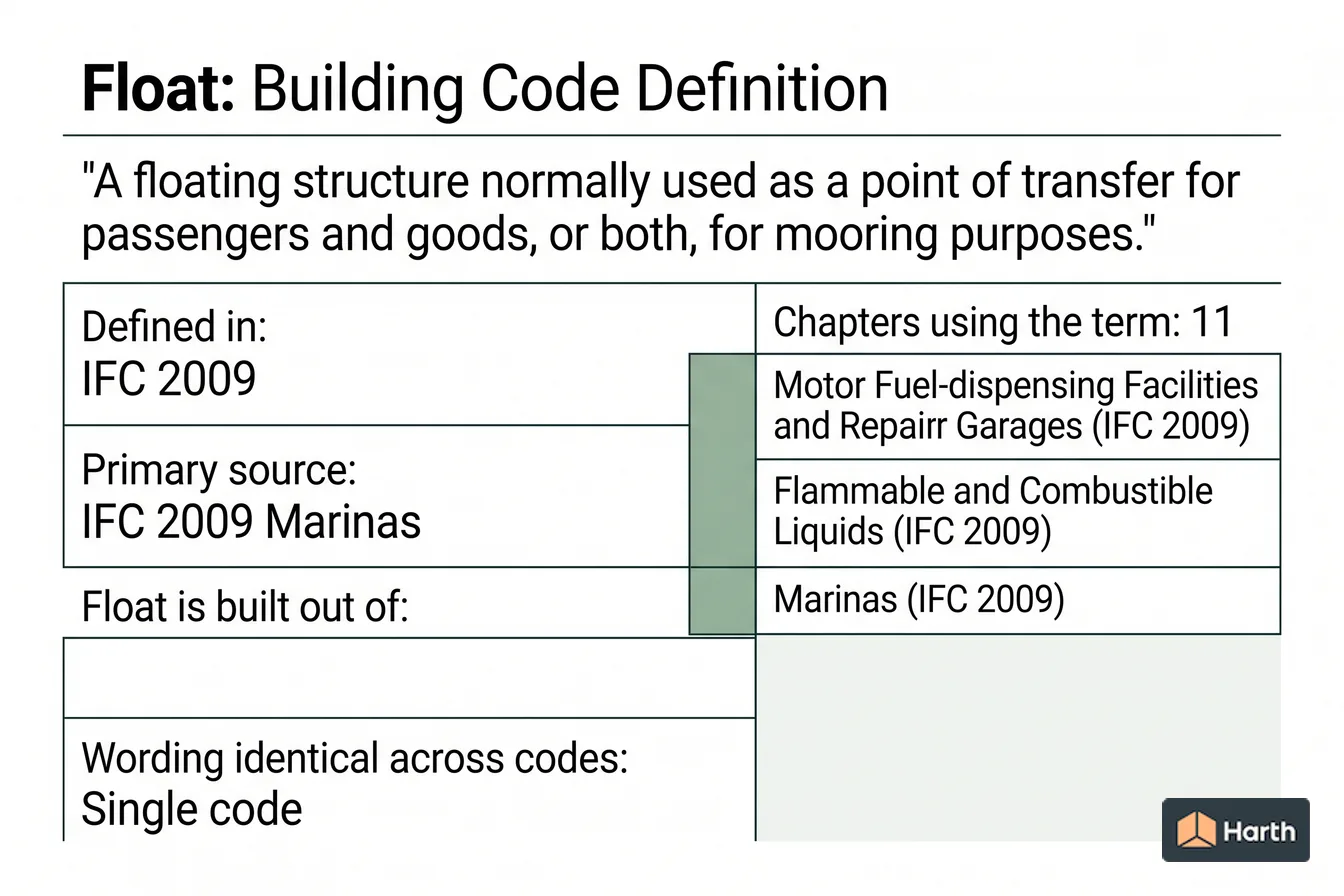
Float is a defined term in the International Fire Code (IFC) 2009, in Marinas. The code's own words are: “A floating structure normally used as a point of transfer for passengers and goods, or both, for mooring purposes.” No other I-Code in this corpus defines it, so the IFC 2009 definition is the one to work from. The term is used in 11 chapters of this corpus, most often in Motor Fuel-dispensing Facilities and Repair Garages (IFC 2009), Flammable and Combustible Liquids (IFC 2009), Marinas (IFC 2009). These pages transcribe the 2009 model text; verify the definition against the edition and amendments your authority having jurisdiction has adopted. Record the jurisdiction, the adopted edition, the application date and any local amendment that rewrites the definition before you use it on a live project, because a term redefined by amendment changes every requirement that depends on it.
Content and cited inputs reviewed by Scott Barrington, Harth founder and architectural technology specialist · Published 2026-09-07 · Updated 2026-09-07.
What does this term mean?
Float — IFC 2009, Marinas:
A floating structure normally used as a point of transfer for passengers and goods, or both, for mooring purposes.
What must be verified before using this guidance?
Float is defined once in this corpus, in the Marinas chapter of the International Fire Code (IFC) 2009:
A floating structure normally used as a point of transfer for passengers and goods, or both, for mooring purposes.
Where float is used in the code
The term appears in 11 chapters of the 2009 I-Codes hosted here. The chapters that lean on it hardest are the ones to read next.
| Chapter | Code | Mentions |
|---|---|---|
| Motor Fuel-dispensing Facilities and Repair Garages | IFC 2009 | 17 |
| Flammable and Combustible Liquids | IFC 2009 | 13 |
| Marinas | IFC 2009 | 11 |
| Definitions | IPC 2009 | 4 |
| Gypsum Board and Plaster | IBC 2009 | 3 |
| Glass and Glazing | IBC 2009 | 1 |
| Definitions | IFC 2009 | 1 |
| Exhaust Systems | IMC 2009 | 1 |
| Traps, Interceptors and Separators | IPC 2009 | 1 |
| Building Planning | IRC 2009 | 1 |
| Plumbing Fixtures | IRC 2009 | 1 |
The term in use
How the code actually writes about float, quoted from the 2009 text hosted here:
Fueling shall not be conducted at the pier, wharf or float during the course of such emergency repairs.
Tanks storing Class I, II and IlIA liquids inside buildings shall be equipped with a device or other means to prevent overflow into the building including, but not limited to: a float valve;
Open-flame devices used for lighting or decoration on the exterior of a vessel, float, pier or wharf shall be approved.
The terms float is built out of
The definition above leans on 1 other defined term. Each carries its own code definition, and a local amendment to any of them changes what float covers:
- Structure — IPC 2009: That which is built or constructed or a portion thereof.
Float: what to open, and in what order
Every row is a document this term depends on. The ICC code library and the ICC adoption maps cover the middle rows.
| Check | Where | Confirmed |
|---|---|---|
| Read the definition in the adopted IFC | Marinas | |
| Re-check the requirement that uses it | Motor Fuel-dispensing Facilities and Repair Garages (IFC 2009) | |
| Re-check the requirement that uses it | Flammable and Combustible Liquids (IFC 2009) | |
| Re-check the requirement that uses it | Marinas (IFC 2009) | |
| Re-check the requirement that uses it | Definitions (IPC 2009) | |
| Confirm the dependent definition | Structure | |
| Local amendment to any of the above | Jurisdiction's amendment list |
A research aid, not a code determination. The authority having jurisdiction decides which edition and which amendments apply.
Where can you explore related guidance?
- Explore all glossary guidance
- Structure: Building Code Definition
- Vessel: Building Code Definition
- Pier: Building Code Definition
- Marina: Building Code Definition
Sources and method
Definitions quoted from the 2009 International Codes as transcribed in this site's building-codes collection, with the source chapter linked for each quotation. Usage counts are computed over the chapters hosted here, one copy per code. The ICC code library publishes the current model text and the ICC adoption maps show which edition a jurisdiction has adopted; those sources control.
Source links
Frequently asked questions
What is the code definition of float?
The International Fire Code (IFC) 2009 defines it in Marinas as: “A floating structure normally used as a point of transfer for passengers and goods, or both, for mooring purposes.” The 2009 model text is reproduced here; the definition that binds your project is the one in the edition your jurisdiction has adopted, as amended locally.
Which parts of the code depend on float?
In this corpus the term is used across 11 chapters, led by Motor Fuel-dispensing Facilities and Repair Garages in the IFC 2009. Those are the sections whose scope moves if the definition is amended locally, so read them together with Chapter 2 rather than on their own.
What is a float in a building?
In the 2009 I-Codes hosted here it is a defined term rather than a description. The IFC 2009 states, in Marinas: “A floating structure normally used as a point of transfer for passengers and goods, or both, for mooring purposes.” It is defined in IFC 2009. It is not the same as Building, which the IBC 2009 defines separately as “Any structure used or intended for supporting or sheltering any use or occupancy.” Because it is a defined term, whatever the adopted edition says it means is what every section using it means — so check Chapter 2 of that edition and any local amendment before relying on this wording.
What does "float" mean in code?
In the 2009 I-Codes hosted here it is a defined term rather than a description. The IFC 2009 states, in Marinas: “A floating structure normally used as a point of transfer for passengers and goods, or both, for mooring purposes.” It is defined in IFC 2009. Because it is a defined term, whatever the adopted edition says it means is what every section using it means — so check Chapter 2 of that edition and any local amendment before relying on this wording.
Related pages
- Flash Point: Building Code Definition
Flash Point — IBC 2009 definition: The minimum temperature in degrees Fahrenheit at which a liquid will give off sufficient vapors to …
- Fleet Vehicle Motor Fuel-dispensing Facility: Building Code Definition
Fleet Vehicle Motor Fuel-dispensing Facility — IFC 2009 definition: That portion of a commercial, industrial, governmental or manufacturing property where liquids used as f…
- Flight: Building Code Definition
Flight — IBC 2009 definition: A continuous run of rectangular treads, winders or combination thereof from one landing to another.
- Flood Insurance Rate Map (FIRM): Building Code Definition
Flood Insurance Rate Map (FIRM) — IBC 2009 definition: An official map of a community on which the Federal Emergency Management Agency (FEMA) has delineated …
- Flood Insurance Study: Building Code Definition
Flood Insurance Study — IBC 2009 definition: The official report provided by the Federal Emergency Management Agency containing the Flood Insurance Rate Map …
- Flood Level Rim: Building Code Definition
Flood Level Rim — IPC 2009 definition: The edge of the receptacle from which water overflows.