Building Code Glossary
Grade: Building Code Definition
How the IRC 2009 define grade, where the wording differs, and which chapters depend on the term.
On this page
Last updated September 7, 2026 · Definitions quoted from the 2009 International Codes as transcribed in this site's building-codes collection, with the source chapter linked for each quotation. Usage counts are computed over the chapters hosted here, one copy per code. The [ICC code library](https://codes.iccsafe.org/codes) publishes the current model text and the [ICC adoption maps](https://www.iccsafe.org/advocacy/code-adoption-maps/) show which edition a jurisdiction has adopted; those sources control.
Direct answer
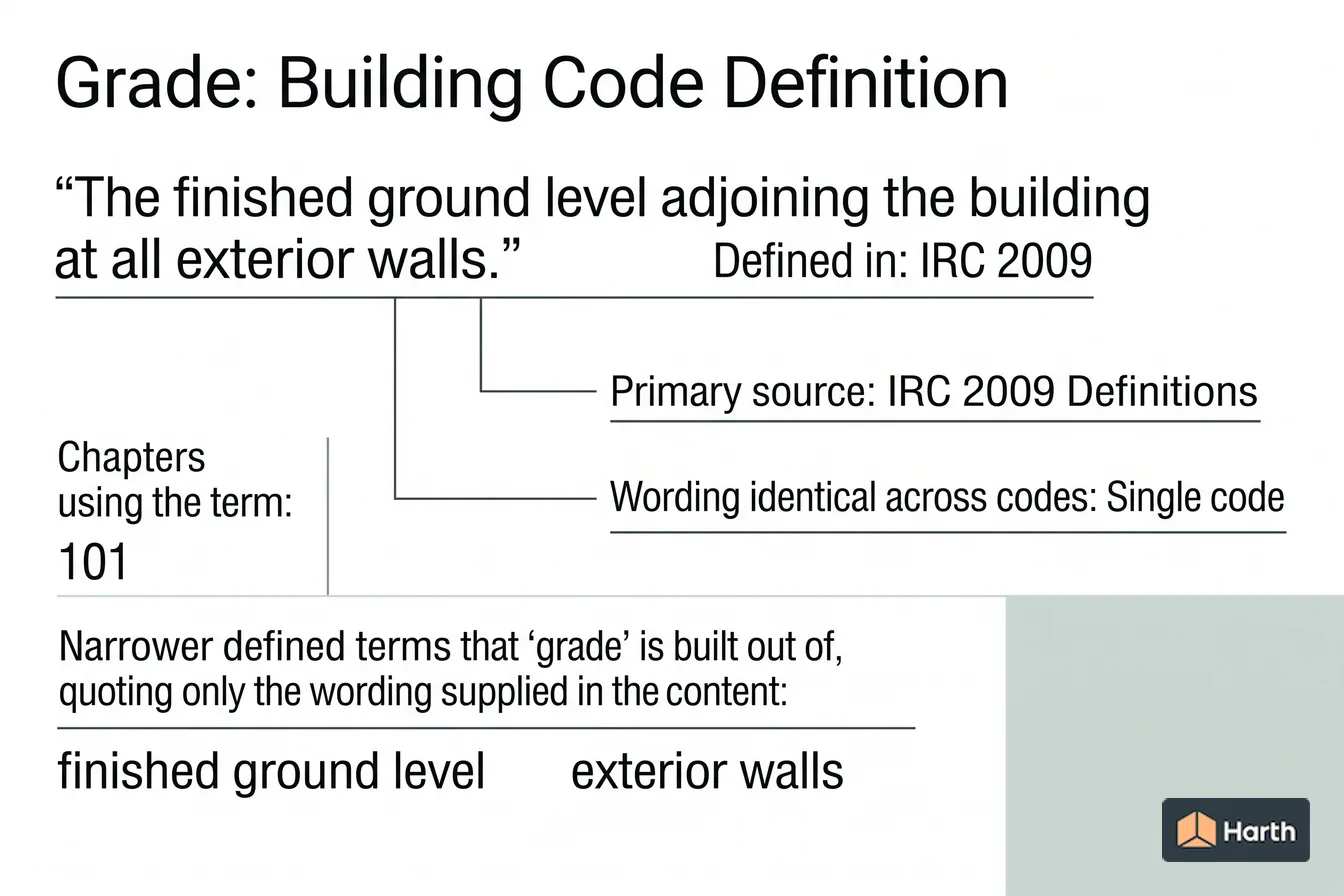
Grade is a defined term in the International Residential Code (IRC) 2009, in Definitions. The code's own words are: “The finished ground level adjoining the building at all exterior walls.” No other I-Code in this corpus defines it, so the IRC 2009 definition is the one to work from. The term is used in 101 chapters of this corpus, most often in Foundations (IRC 2009), Wall Construction (IRC 2009), Building Planning (IRC 2009). These pages transcribe the 2009 model text; verify the definition against the edition and amendments your authority having jurisdiction has adopted. Record the jurisdiction, the adopted edition, the application date and any local amendment that rewrites the definition before you use it on a live project, because a term redefined by amendment changes every requirement that depends on it.
Content and cited inputs reviewed by Harth team · Published 2026-09-07 · Updated 2026-09-07.
What does this term mean?
Grade — IRC 2009, Definitions:
The finished ground level adjoining the building at all exterior walls.
What must be verified before using this guidance?
Grade is defined once in this corpus, in the Definitions chapter of the International Residential Code (IRC) 2009:
The finished ground level adjoining the building at all exterior walls.
Where grade is used in the code
The term appears in 101 chapters of the 2009 I-Codes hosted here. The chapters that lean on it hardest are the ones to read next.
| Chapter | Code | Mentions |
|---|---|---|
| Foundations | IRC 2009 | 155 |
| Wall Construction | IRC 2009 | 105 |
| Building Planning | IRC 2009 | 80 |
| Flammable and Combustible Liquids | IFC 2009 | 64 |
| Wood | IBC 2009 | 60 |
| General Building Heights and Areas | IBC 2009 | 52 |
| Floors | IRC 2009 | 51 |
| Soils and Foundations | IBC 2009 | 49 |
| Motor Fuel-dispensing Facilities and Repair Garages | IFC 2009 | 40 |
| Commercial Energy Efficiency | IECC 2009 | 39 |
| Means of Egress | IBC 2009 | 38 |
| Roof-ceiling Construction | IRC 2009 | 36 |
89 further chapters mention the term.
The term in use
How the code actually writes about grade, quoted from the 2009 text hosted here:
The grade shall fall a minimum of 6 inches (152 mm)within the first 10 feet (3048 mm).
Load-bearing dimension lumber for studs, plates and headers shall be identified by a grade mark of a lumber grading or inspection agency that has been approved by an accreditation body that complies with DOC PS 20.
Detached one-and two-family dwellings with exterior above-grade concrete walls shall comply with the requirements of section R611, PCA 100 or shall be designed in accordance with ACI 318.
The terms grade is built out of
The definition above leans on 1 other defined term. Each carries its own code definition, and a local amendment to any of them changes what grade covers:
- Building — IBC 2009: Any structure used or intended for supporting or sheltering any use or occupancy.
Grade: what to open, and in what order
Every row is a document this term depends on. The ICC code library and the ICC adoption maps cover the middle rows.
| Check | Where | Confirmed |
|---|---|---|
| Read the definition in the adopted IRC | Definitions | |
| Re-check the requirement that uses it | Foundations (IRC 2009) | |
| Re-check the requirement that uses it | Wall Construction (IRC 2009) | |
| Re-check the requirement that uses it | Building Planning (IRC 2009) | |
| Re-check the requirement that uses it | Flammable and Combustible Liquids (IFC 2009) | |
| Confirm the dependent definition | Building | |
| Local amendment to any of the above | Jurisdiction's amendment list |
A research aid, not a code determination. The authority having jurisdiction decides which edition and which amendments apply.
Where can you explore related guidance?
- Explore all glossary guidance
- Building: Building Code Definition
- Construction Documents: Building Code Definition
- Registered Design Professional: Building Code Definition
- Dwelling Unit: Building Code Definition
Sources and method
Definitions quoted from the 2009 International Codes as transcribed in this site's building-codes collection, with the source chapter linked for each quotation. Usage counts are computed over the chapters hosted here, one copy per code. The ICC code library publishes the current model text and the ICC adoption maps show which edition a jurisdiction has adopted; those sources control.
Source links
Frequently asked questions
What is the code definition of grade?
The International Residential Code (IRC) 2009 defines it in Definitions as: “The finished ground level adjoining the building at all exterior walls.” The 2009 model text is reproduced here; the definition that binds your project is the one in the edition your jurisdiction has adopted, as amended locally.
Which parts of the code depend on grade?
In this corpus the term is used across 101 chapters, led by Foundations in the IRC 2009. Those are the sections whose scope moves if the definition is amended locally, so read them together with Chapter 2 rather than on their own.
What is the definition of building grade?
In the 2009 I-Codes hosted here it is a defined term rather than a description. The IRC 2009 states, in Definitions: “The finished ground level adjoining the building at all exterior walls.” It is defined in IRC 2009. It is not the same as Building, which the IBC 2009 defines separately as “Any structure used or intended for supporting or sheltering any use or occupancy.” Because it is a defined term, whatever the adopted edition says it means is what every section using it means — so check Chapter 2 of that edition and any local amendment before relying on this wording.
What is considered grade in construction?
In the 2009 I-Codes hosted here it is a defined term rather than a description. The IRC 2009 states, in Definitions: “The finished ground level adjoining the building at all exterior walls.” It is defined in IRC 2009. Because it is a defined term, whatever the adopted edition says it means is what every section using it means — so check Chapter 2 of that edition and any local amendment before relying on this wording.
What does IRC mean in building code?
Building is a separate defined term. The IBC 2009 defines it as: “Any structure used or intended for supporting or sheltering any use or occupancy.” That is not the same as grade, which the IRC 2009 defines as “The finished ground level adjoining the building at all exterior walls.” — read both before applying either, and confirm the wording in the edition your jurisdiction has adopted.
Related pages
- Accessible Means OF Egress: Building Code Definition
Accessible Means OF Egress — IBC 2009 definition: A continuous and unobstructed way of egress travel from any accessible point in a building or …
- Accessible: Building Code Definition
Accessible — IBC 2009 definition: A site, building, facilityor portion thereof that complies with this chapter.
- Addition: Building Code Definition
Addition — IBC 2009 definition: An extension or increase in floor area or height of a building or structure.
- Aerosol: Building Code Definition
Aerosol — IBC 2009 definition: A product that is dispensed from an aerosol container by a propellant.
- Air-conditioning System: Building Code Definition
Air-conditioning System — IRC 2009 definition: A system that consists of heat exchangers, blowers, filters, supply, exhaust and return-air systems, and shall …
- Air, Exhaust: Building Code Definition
Air, Exhaust — IRC 2009 definition: Air being removed from any space or piece of equipment or appliance and conveyed directly to …