Building Code Glossary
Mark: Building Code Definition
How the IBC 2009, IRC 2009 define mark, where the wording differs, and which chapters depend on the term.
On this page
Last updated September 7, 2026 · Definitions quoted from the 2009 International Codes as transcribed in this site's building-codes collection, with the source chapter linked for each quotation. Usage counts are computed over the chapters hosted here, one copy per code. The [ICC code library](https://codes.iccsafe.org/codes) publishes the current model text and the [ICC adoption maps](https://www.iccsafe.org/advocacy/code-adoption-maps/) show which edition a jurisdiction has adopted; those sources control.
Direct answer
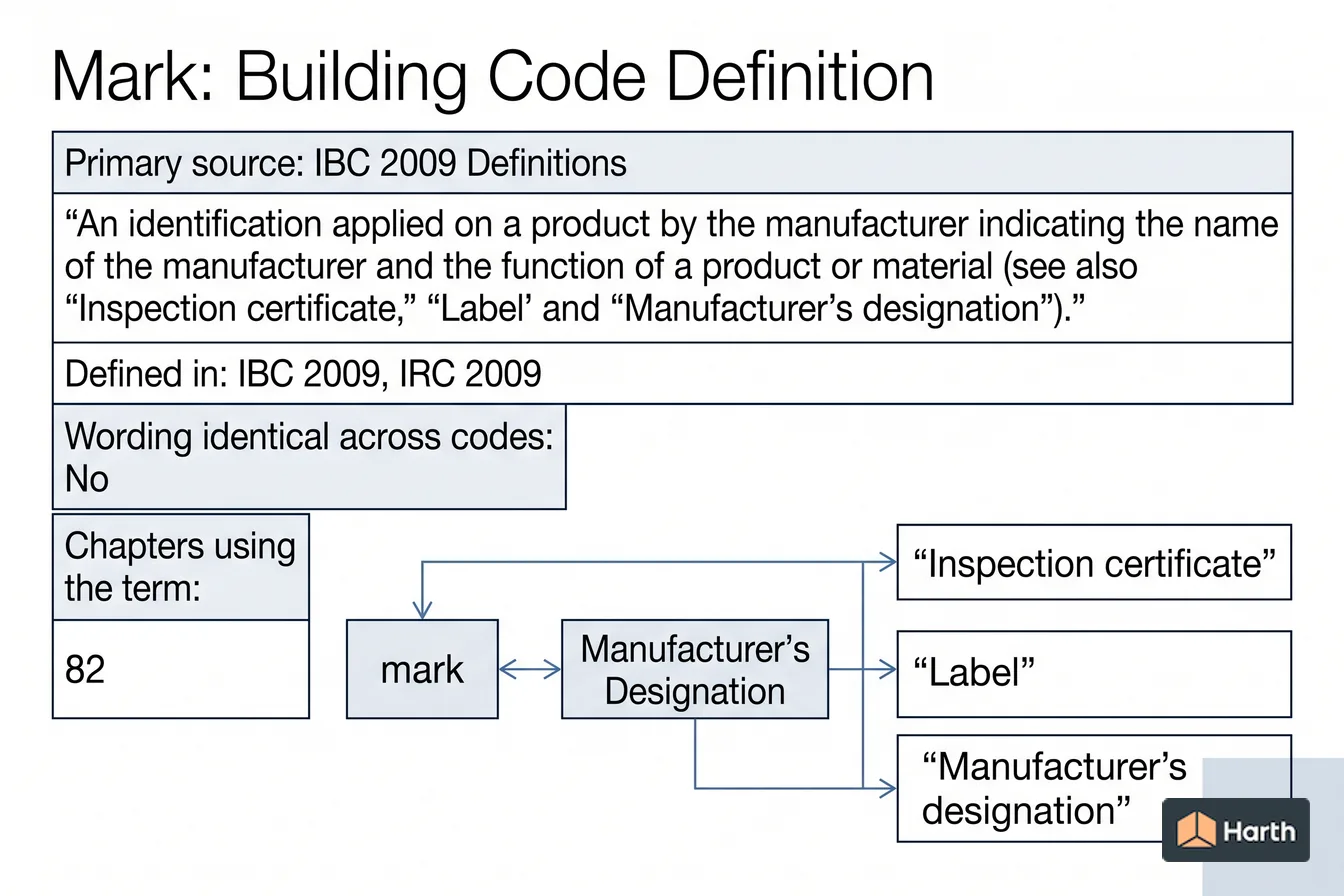
Mark is a defined term in the International Building Code (IBC) 2009, in Definitions. The code's own words are: “An identification applied on a product by the manufacturer indicating the name of the manufacturer and the function of a product or material (see also "Inspection certificate," "Label' and "Manufacturer's designation").” The IRC 2009 defines the same term with different wording, so the controlling text depends on which code governs the question in front of you — the comparison below sets the versions side by side. The term is used in 82 chapters of this corpus, most often in Means of Egress (IBC 2009), Means of Egress (IFC 2009), Flammable Gases and Flammable Cryogenic Fluids (IFC 2009). These pages transcribe the 2009 model text; verify the definition against the edition and amendments your authority having jurisdiction has adopted.
Content and cited inputs reviewed by Harth team · Published 2026-09-07 · Updated 2026-09-07.
What does this term mean?
Mark — IBC 2009, Definitions:
An identification applied on a product by the manufacturer indicating the name of the manufacturer and the function of a product or material (see also "Inspection certificate," "Label' and "Manufacturer's designation").
What must be verified before using this guidance?
Two of the I-Codes in this corpus define Mark, and the wording is not identical — read the version that governs your question.
| Code | Where it is defined | Definition |
|---|---|---|
| IBC 2009 | Definitions | An identification applied on a product by the manufacturer indicating the name of the manufacturer and the function of a product or material (see also "Inspection certificate," "Label' and "Manufacturer's designation"). |
| IRC 2009 | Definitions | An identification applied on a product by the manufacturer indicating the name of the manufacturer and the function of a product or material. (See also "Manufacturer's designation" and" Label.") |
Where mark is used in the code
The term appears in 82 chapters of the 2009 I-Codes hosted here. The chapters that lean on it hardest are the ones to read next.
| Chapter | Code | Mentions |
|---|---|---|
| Means of Egress | IBC 2009 | 80 |
| Means of Egress | IFC 2009 | 54 |
| Flammable Gases and Flammable Cryogenic Fluids | IFC 2009 | 32 |
| Fire Protection Systems | IFC 2009 | 27 |
| Fire Protection Systems | IBC 2009 | 24 |
| Wood | IBC 2009 | 22 |
| Compressed Gases | IFC 2009 | 21 |
| Wall Construction | IRC 2009 | 21 |
| General Requirements | IFC 2009 | 20 |
| Climate Zones | IECC 2009 | 18 |
| General Requirements | IRC 2009 | 18 |
| Power and Lighting Distribution | IRC 2009 | 18 |
70 further chapters mention the term.
The term in use
How the code actually writes about mark, quoted from the 2009 text hosted here:
The report shall include identification of all devices by manufacturer, nameplate data, design values, measured values and identification tag or mark.
Sawn lumber used for load-supporting purposes, including end-jointed or edge-glued lumber, machine stress-rated or machine-evaluated lumber, shall be identified by the grade mark of a lumber grading or inspection agency that has been approved by an accreditation body that complies with DOC PS 20 or equivalent.
Load-bearing dimension lumber for studs, plates and headers shall be identified by a grade mark of a lumber grading or inspection agency that has been approved by an accreditation body that complies with DOC PS 20.
Mark compared with Manufacturer's Designation
These two are the closest pair in the 2009 I-Codes: about 61 per cent of their defining words are the same. The code states both and compares neither, so the difference is worth naming.
| Wording unique to it | |
|---|---|
| Mark (IBC 2009) | name, function, s, designation |
| Manufacturer's Designation (IBC 2009) | complies, specified, standard, set, rules, mark |
Everything else in the two definitions is shared. If a project turns on which of the two applies, those words are the whole of the test — and a local amendment that edits one of them without editing the other moves the boundary between mark and manufacturer's designation.
The terms mark is built out of
The definition above leans on 3 other defined terms. Each carries its own code definition, and a local amendment to any of them changes what mark covers:
- Manufacturer's Designation — IBC 2009: An identification applied on a product by the manufacturer indicating that a product or material complies with a specified standard or set of rules (see also "Inspection certificate," "Label' and" Mark").
- Inspection Certificate — IBC 2009: An identification applied on a product by an approved agency containing the name of the manufacturer, the function and performance characteristics, and the name and identification of an approved agency that indicates that the product or material has been inspected …
- Label — IBC 2009: An identification applied on a product by the manufacturer that contains the name of the manufacturer, the function and performance characteristics of the product or material, and the name and identification of an approved agency and that indicates that the …
Mark: what to open, and in what order
Every row is a document this term depends on. The ICC code library and the ICC adoption maps cover the middle rows.
| Check | Where | Confirmed |
|---|---|---|
| Read the definition in the adopted IBC | Definitions | |
| Read the definition in the adopted IRC | Definitions | |
| Re-check the requirement that uses it | Means of Egress (IBC 2009) | |
| Re-check the requirement that uses it | Means of Egress (IFC 2009) | |
| Re-check the requirement that uses it | Flammable Gases and Flammable Cryogenic Fluids (IFC 2009) | |
| Re-check the requirement that uses it | Fire Protection Systems (IFC 2009) | |
| Confirm the dependent definition | Manufacturer's Designation | |
| Confirm the dependent definition | Inspection Certificate | |
| Confirm the dependent definition | Label | |
| Local amendment to any of the above | Jurisdiction's amendment list |
A research aid, not a code determination. The authority having jurisdiction decides which edition and which amendments apply.
Where can you explore related guidance?
Sources and method
Definitions quoted from the 2009 International Codes as transcribed in this site's building-codes collection, with the source chapter linked for each quotation. Usage counts are computed over the chapters hosted here, one copy per code. The ICC code library publishes the current model text and the ICC adoption maps show which edition a jurisdiction has adopted; those sources control.
Source links
Frequently asked questions
What is the code definition of mark?
The International Building Code (IBC) 2009 defines it in Definitions as: “An identification applied on a product by the manufacturer indicating the name of the manufacturer and the function of a product or material (see also "Inspection certificate," "Label' and "Manufacturer's designation").” The 2009 model text is reproduced here; the definition that binds your project is the one in the edition your jurisdiction has adopted, as amended locally.
Which parts of the code depend on mark?
In this corpus the term is used across 82 chapters, led by Means of Egress in the IBC 2009. Those are the sections whose scope moves if the definition is amended locally, so read them together with Chapter 2 rather than on their own.
What is the definition of a building code?
Building is a separate defined term. The IBC 2009 defines it as: “Any structure used or intended for supporting or sheltering any use or occupancy.” That is not the same as mark, which the IBC 2009 defines as “An identification applied on a product by the manufacturer indicating the name of the manufacturer and the function of a product or material (see also "Inspection certificate," "Label' and "Manufacturer's designation").” — read both before applying either, and confirm the wording in the edition your jurisdiction has adopted.
What is a question mark (?)?
In the 2009 I-Codes hosted here it is a defined term rather than a description. The IBC 2009 states, in Definitions: “An identification applied on a product by the manufacturer indicating the name of the manufacturer and the function of a product or material (see also "Inspection certificate," "Label' and "Manufacturer's designation").” It is defined in IBC 2009, IRC 2009. Because it is a defined term, whatever the adopted edition says it means is what every section using it means — so check Chapter 2 of that edition and any local amendment before relying on this wording.
Related pages
- Lot: Building Code Definition
Lot — IBC 2009 definition: A portion or parcel of land considered as a unit.
- Lower Flammable Limit (LFL): Building Code Definition
Lower Flammable Limit (LFL) — IBC 2009 definition: The minimum concentration of vapor in air at which propagation of flame will occur in the …
- Main: Building Code Definition
Main — IRC 2009 definition: The principal pipe artery to which branches may be connected.
- Masonry Unit: Building Code Definition
Masonry Unit — IBC 2009 definition: Brick, tile, stone, glass block or concrete block conforming to the requirements specified in Section 2103.
- Means OF Egress: Building Code Definition
Means OF Egress — IBC 2009 definition: A continuous and unobstructed path of vertical and horizontal egress travel from any occupied portion of …
- Mechanical Joint: Building Code Definition
Mechanical Joint — IMC 2009 definition: A connection between pipes, fittings, or pipes and fittings, which is neither screwed, caulked, threaded, soldered …