Building Code Glossary
Mechanical Joint: Building Code Definition
How the IMC 2009, IPC 2009 define mechanical joint, where the wording differs, and which chapters depend on the term.
On this page
Last updated September 7, 2026 · Definitions quoted from the 2009 International Codes as transcribed in this site's building-codes collection, with the source chapter linked for each quotation. Usage counts are computed over the chapters hosted here, one copy per code. The [ICC code library](https://codes.iccsafe.org/codes) publishes the current model text and the [ICC adoption maps](https://www.iccsafe.org/advocacy/code-adoption-maps/) show which edition a jurisdiction has adopted; those sources control.
Direct answer
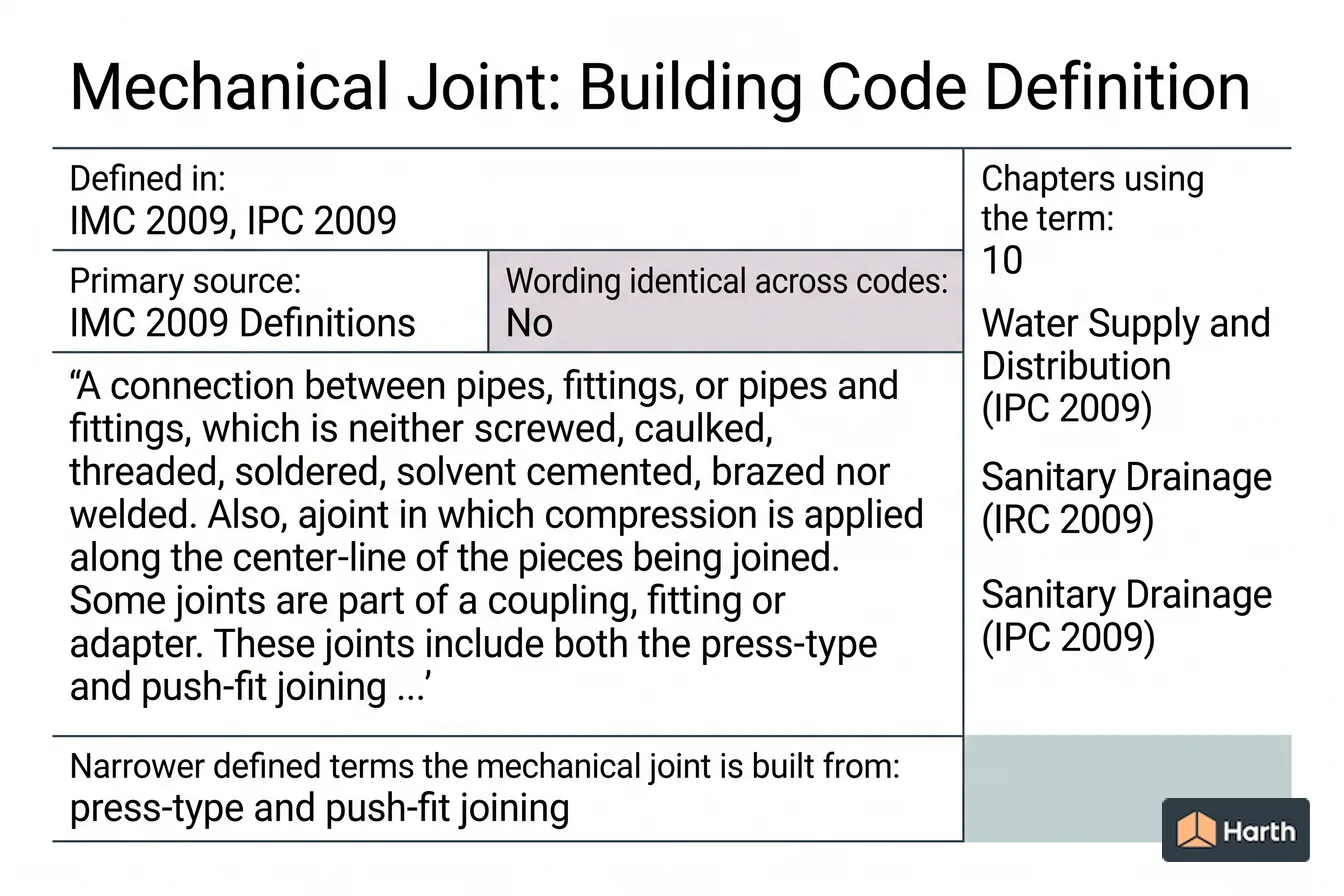
Mechanical joint is a defined term in the International Mechanical Code (IMC) 2009, in Definitions. The code's own words are: “A connection between pipes, fittings, or pipes and fittings, which is neither screwed, caulked, threaded, soldered, solvent cemented, brazed nor welded. Also, ajoint in which compression is applied along the center-line of the pieces being joined. Some joints are part of a coupling, fitting or adapter. These joints include both the press-type and push-fit joining …” The IPC 2009 defines the same term with different wording, so the controlling text depends on which code governs the question in front of you — the comparison below sets the versions side by side. The term is used in 10 chapters of this corpus, most often in Water Supply and Distribution (IPC 2009), Sanitary Drainage (IRC 2009), Sanitary Drainage (IPC 2009). These pages transcribe the 2009 model text; verify the definition against the edition and amendments your authority having jurisdiction has adopted.
Content and cited inputs reviewed by Scott Barrington, Harth founder and architectural technology specialist · Published 2026-09-07 · Updated 2026-09-07.
What does this term mean?
Mechanical Joint — IMC 2009, Definitions:
A connection between pipes, fittings, or pipes and fittings, which is neither screwed, caulked, threaded, soldered, solvent cemented, brazed nor welded. Also, ajoint in which compression is applied along the center-line of the pieces being joined. Some joints are part of a coupling, fitting or adapter. These joints include both the press-type and push-fit joining systems.
What must be verified before using this guidance?
Two of the I-Codes in this corpus define Mechanical Joint, and the wording is not identical — read the version that governs your question.
| Code | Where it is defined | Definition |
|---|---|---|
| IMC 2009 | Definitions | A connection between pipes, fittings, or pipes and fittings, which is neither screwed, caulked, threaded, soldered, solvent cemented, brazed nor welded. Also, ajoint in which compression is applied along the center-line of the pieces being joined. Some joints are part of a coupling, fitting or adapter. These joints include both the press-type and push-fit joining systems. |
| IPC 2009 | Definitions | A connection between pipes, fittings, or pipes and fittings that is not screwed, caulked, threaded, soldered, solvent cemented, brazed or welded. A joint in which compression is applied along the centerline of the pieces beingjoined. In some applications, the joint is part of a coupling, fitting or adapter. |
Where mechanical joint is used in the code
The term appears in 10 chapters of the 2009 I-Codes hosted here. The chapters that lean on it hardest are the ones to read next.
| Chapter | Code | Mentions |
|---|---|---|
| Water Supply and Distribution | IPC 2009 | 47 |
| Sanitary Drainage | IRC 2009 | 29 |
| Sanitary Drainage | IPC 2009 | 27 |
| Materials | IPC 2009 | 19 |
| Water Supply and Distribution | IRC 2009 | 17 |
| Fuel Oil Piping and Storage | IMC 2009 | 13 |
| Hydronic Piping | IMC 2009 | 12 |
| Definitions | IPC 2009 | 3 |
| Definitions | IMC 2009 | 2 |
| Refrigeration | IMC 2009 | 2 |
The term in use
How the code actually writes about mechanical joint, quoted from the 2009 text hosted here:
Joints between different piping materials shall be made with a mechanical joint of the compression or mechanical-sealing type, or as permitted in Sections 605.24.1, 605.24.2 and 605.24.3.
Mechanical joint couplings for hubless pipe and fittings shall comply with CISPI 310 or ASTM C 1277.
Mechanical joint couplings shall be installed in accordance with the manufacturer's installation instructions.
The terms mechanical joint is built out of
The definition above leans on 2 other defined terms. Each carries its own code definition, and a local amendment to any of them changes what mechanical joint covers:
- Fitting — IRC 2009: An accessory such as a locknut, bushing or other part of a wiring system that is intended primarily to perform a mechanical rather than an electrical function.
- Joint — IBC 2009: The linear opening in or between adjacent fire-resistance-rated assemblies that is designed to allow independent movement of the building in any plane caused by thermal, seismic, wind or any other loading.
Mechanical Joint: what to open, and in what order
Every row is a document this term depends on. The ICC code library and the ICC adoption maps cover the middle rows.
| Check | Where | Confirmed |
|---|---|---|
| Read the definition in the adopted IMC | Definitions | |
| Read the definition in the adopted IPC | Definitions | |
| Re-check the requirement that uses it | Water Supply and Distribution (IPC 2009) | |
| Re-check the requirement that uses it | Sanitary Drainage (IRC 2009) | |
| Re-check the requirement that uses it | Sanitary Drainage (IPC 2009) | |
| Re-check the requirement that uses it | Materials (IPC 2009) | |
| Confirm the dependent definition | Fitting | |
| Confirm the dependent definition | Joint | |
| Local amendment to any of the above | Jurisdiction's amendment list |
A research aid, not a code determination. The authority having jurisdiction decides which edition and which amendments apply.
Where can you explore related guidance?
Sources and method
Definitions quoted from the 2009 International Codes as transcribed in this site's building-codes collection, with the source chapter linked for each quotation. Usage counts are computed over the chapters hosted here, one copy per code. The ICC code library publishes the current model text and the ICC adoption maps show which edition a jurisdiction has adopted; those sources control.
Source links
Frequently asked questions
What is the code definition of mechanical joint?
The International Mechanical Code (IMC) 2009 defines it in Definitions as: “A connection between pipes, fittings, or pipes and fittings, which is neither screwed, caulked, threaded, soldered, solvent cemented, brazed nor welded. Also, ajoint in which compression is applied along the center-line of the pieces being joined. Some joints are part of a coupling, fitting or adapter. These joints include both the press-type and push-fit joining systems.” The 2009 model text is reproduced here; the definition that binds your project is the one in the edition your jurisdiction has adopted, as amended locally.
Do the I-Codes define mechanical joint the same way?
No. IMC 2009, IPC 2009 all define the term, but the wording is not identical, and a difference in wording can change which requirements are triggered. The comparison table above sets the versions side by side so you can read the one that governs your question.
Which parts of the code depend on mechanical joint?
In this corpus the term is used across 10 chapters, led by Water Supply and Distribution in the IPC 2009. Those are the sections whose scope moves if the definition is amended locally, so read them together with Chapter 2 rather than on their own.
What's the difference between a flange and a mechanical joint?
In the 2009 I-Codes hosted here it is a defined term rather than a description. The IMC 2009 states, in Definitions: “A connection between pipes, fittings, or pipes and fittings, which is neither screwed, caulked, threaded, soldered, solvent cemented, brazed nor welded. Also, ajoint in which compression is applied along the center-line of the pieces being joined. Some joints are part of a coupling, fitting or adapter. These joints include both the press-type and push-fit joining …” It is defined in IMC 2009, IPC 2009. Because it is a defined term, whatever the adopted edition says it means is what every section using it means — so check Chapter 2 of that edition and any local amendment before relying on this wording.
Related pages
- Means OF Egress: Building Code Definition
Means OF Egress — IBC 2009 definition: A continuous and unobstructed path of vertical and horizontal egress travel from any occupied portion of …
- Mechanical Draft System: Building Code Definition
Mechanical Draft System — IRC 2009 definition: A venting system designed to remove flue or vent gases by mechanical means, that consists of …
- Mechanical Exhaust System: Building Code Definition
Mechanical Exhaust System — IRC 2009 definition: A system for removing air from a room or space by mechanical means.
- Mechanical System: Building Code Definition
Mechanical System — IRC 2009 definition: A system specifically addressed and regulated in this code and composed of components, devices, appliances and …
- Mechanical Systems: Building Code Definition
Mechanical Systems — IBC 2009 definition: For the purposes of determining seismic loads in ASCE 7, mechanical systems shall include plumbing systems …
- Medical Gas System: Building Code Definition
Medical Gas System — IPC 2009 definition: The complete system to convey medical gases for direct patient application from central supply systems (bulk …