Building Code Glossary
Pressure Vessel: Building Code Definition
How the IFC 2009 define pressure vessel, where the wording differs, and which chapters depend on the term.
On this page
Last updated September 7, 2026 · Definitions quoted from the 2009 International Codes as transcribed in this site's building-codes collection, with the source chapter linked for each quotation. Usage counts are computed over the chapters hosted here, one copy per code. The [ICC code library](https://codes.iccsafe.org/codes) publishes the current model text and the [ICC adoption maps](https://www.iccsafe.org/advocacy/code-adoption-maps/) show which edition a jurisdiction has adopted; those sources control.
Direct answer
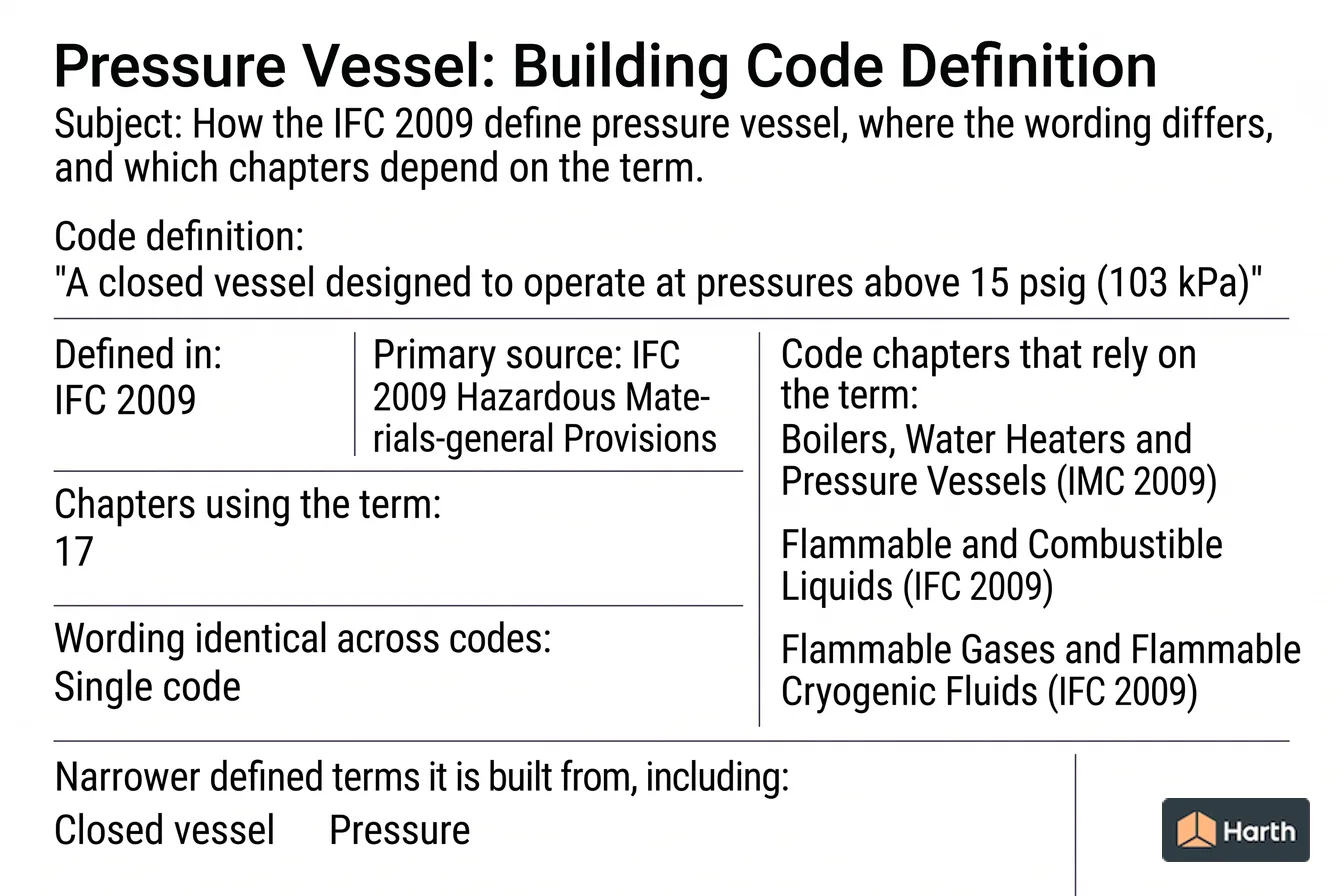
Pressure vessel is a defined term in the International Fire Code (IFC) 2009, in Hazardous Materials-general Provisions. The code's own words are: “A closed vessel designed to operate at pressures above 15 psig (103 kPa).” No other I-Code in this corpus defines it, so the IFC 2009 definition is the one to work from. The term is used in 17 chapters of this corpus, most often in Boilers, Water Heaters and Pressure Vessels (IMC 2009), Flammable and Combustible Liquids (IFC 2009), Flammable Gases and Flammable Cryogenic Fluids (IFC 2009). These pages transcribe the 2009 model text; verify the definition against the edition and amendments your authority having jurisdiction has adopted. Record the jurisdiction, the adopted edition, the application date and any local amendment that rewrites the definition before you use it on a live project, because a term redefined by amendment changes every requirement that depends on it.
Content and cited inputs reviewed by Scott Barrington, Harth founder and architectural technology specialist · Published 2026-09-07 · Updated 2026-09-07.
What does this term mean?
Pressure Vessel — IFC 2009, Hazardous Materials-general Provisions:
A closed vessel designed to operate at pressures above 15 psig (103 kPa).
What must be verified before using this guidance?
Pressure Vessel is defined once in this corpus, in the Hazardous Materials-general Provisions chapter of the International Fire Code (IFC) 2009:
A closed vessel designed to operate at pressures above 15 psig (103 kPa).
Where pressure vessel is used in the code
The term appears in 17 chapters of the 2009 I-Codes hosted here. The chapters that lean on it hardest are the ones to read next.
| Chapter | Code | Mentions |
|---|---|---|
| Boilers, Water Heaters and Pressure Vessels | IMC 2009 | 36 |
| Flammable and Combustible Liquids | IFC 2009 | 16 |
| Flammable Gases and Flammable Cryogenic Fluids | IFC 2009 | 11 |
| Hazardous Materials-general Provisions | IFC 2009 | 7 |
| Compressed Gases | IFC 2009 | 4 |
| Cryogenic Fluids | IFC 2009 | 4 |
| Hydronic Piping | IMC 2009 | 4 |
| Definitions | IPC 2009 | 4 |
| Motor Fuel-dispensing Facilities and Repair Garages | IFC 2009 | 3 |
| Flammable Finishes | IFC 2009 | 2 |
| Highly Toxic and Toxic Materials | IFC 2009 | 2 |
| Definitions | IMC 2009 | 2 |
5 further chapters mention the term.
The term in use
How the code actually writes about pressure vessel, quoted from the 2009 text hosted here:
All pressure vessels shall be in accordance with the ASME Boiler and Pressure Vessel Code, shall bear the label of an approved agency and shall be installed in accordance with the manufacturer's installation instructions.
Tanks which are to be reinstalled for flammable or combustible liquid service shall be in accordance with this chapter, ASME Boiler and Pressure vessel Code (Section VIII), API 12-P, API 1615, UL 58 and UL 1316.
The inner vessel of storage tanks in liquid hydrogen service shall be designed and constructed in accordance with Section VIII, Division 1, of the ASME Boiler and Pressure vessel Code and shall be vacuum jacketed in accordance with Section 3506.3.2.
The terms pressure vessel is built out of
The definition above leans on 1 other defined term. Each carries its own code definition, and a local amendment to any of them changes what pressure vessel covers:
- Vessel — IFC 2009: A motorized watercraft, other than a seaplane on the water, used or capable of being used as a means of transportation.
Pressure Vessel: what to open, and in what order
Every row is a document this term depends on. The ICC code library and the ICC adoption maps cover the middle rows.
| Check | Where | Confirmed |
|---|---|---|
| Read the definition in the adopted IFC | Hazardous Materials-general Provisions | |
| Re-check the requirement that uses it | Boilers, Water Heaters and Pressure Vessels (IMC 2009) | |
| Re-check the requirement that uses it | Flammable and Combustible Liquids (IFC 2009) | |
| Re-check the requirement that uses it | Flammable Gases and Flammable Cryogenic Fluids (IFC 2009) | |
| Re-check the requirement that uses it | Hazardous Materials-general Provisions (IFC 2009) | |
| Confirm the dependent definition | Vessel | |
| Local amendment to any of the above | Jurisdiction's amendment list |
A research aid, not a code determination. The authority having jurisdiction decides which edition and which amendments apply.
Where can you explore related guidance?
- Explore all glossary guidance
- Vessel: Building Code Definition
- Container: Building Code Definition
- System: Building Code Definition
- Chemical: Building Code Definition
Sources and method
Definitions quoted from the 2009 International Codes as transcribed in this site's building-codes collection, with the source chapter linked for each quotation. Usage counts are computed over the chapters hosted here, one copy per code. The ICC code library publishes the current model text and the ICC adoption maps show which edition a jurisdiction has adopted; those sources control.
Source links
Frequently asked questions
What is the code definition of pressure vessel?
The International Fire Code (IFC) 2009 defines it in Hazardous Materials-general Provisions as: “A closed vessel designed to operate at pressures above 15 psig (103 kPa).” The 2009 model text is reproduced here; the definition that binds your project is the one in the edition your jurisdiction has adopted, as amended locally.
Which parts of the code depend on pressure vessel?
In this corpus the term is used across 17 chapters, led by Boilers, Water Heaters and Pressure Vessels in the IMC 2009. Those are the sections whose scope moves if the definition is amended locally, so read them together with Chapter 2 rather than on their own.
What is a pressure vessel?
In the 2009 I-Codes hosted here it is a defined term rather than a description. The IFC 2009 states, in Hazardous Materials-general Provisions: “A closed vessel designed to operate at pressures above 15 psig (103 kPa).” It is defined in IFC 2009. Because it is a defined term, whatever the adopted edition says it means is what every section using it means — so check Chapter 2 of that edition and any local amendment before relying on this wording.
Related pages
- Pressure-relief Valve: Building Code Definition
Pressure-relief Valve — IRC 2009 definition: A pressure-actuated valve held closed by a spring or other means and designed to automatically relieve …
- Pressure Relief Valve: Building Code Definition
Pressure Relief Valve — IMC 2009 definition: A pressure-actuated valve held closed by a spring or other means and designed to relieve pressure …
- Pressure Test: Building Code Definition
Pressure Test — IRC 2009 definition: An operation performed to verify the gas-tight integrity of gas piping following its installation or modification.
- Pressure Vessels: Building Code Definition
Pressure Vessels — IMC 2009 definition: Closed containers, tanks or vessels that are designed to contain liquids or gases, or both, under …
- Primary Containment: Building Code Definition
Primary Containment — IFC 2009 definition: The first level of containment, consisting of the inside portion of that container which comes into …
- Primary Function: Building Code Definition
Primary Function — IBC 2009 definition: A primary function is a major activity for which the facility is intended.