Building Permits & Process
The Building Permit Process, Explained (2026)
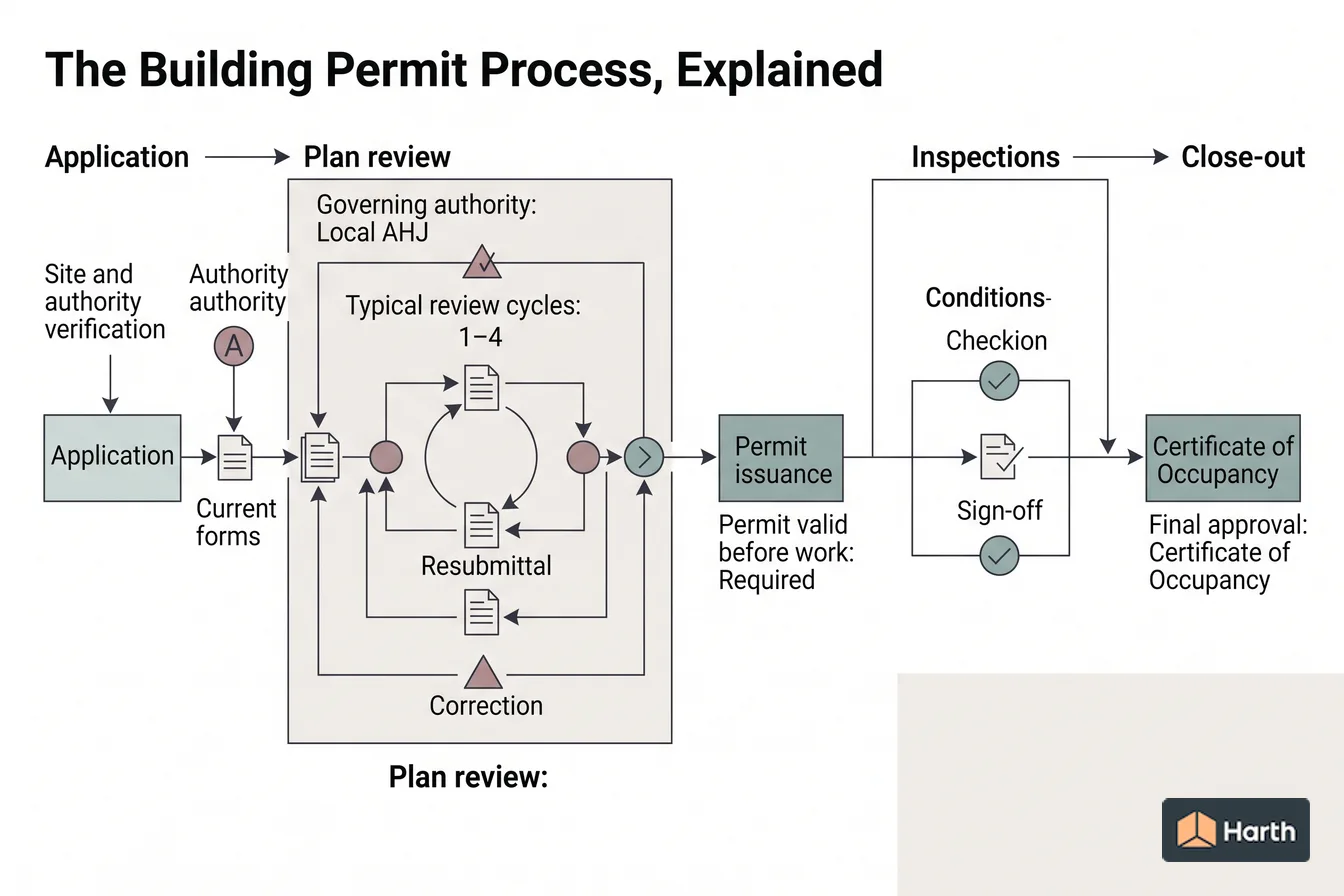
The end-to-end permitting flow for a commercial project — application, plan review, permit issuance, inspections, and certificate of occupancy.
On this page
Last updated August 14, 2026 · General process compiled from common U.S. building-department workflows under the I-Codes; fees, forms, and timelines vary by jurisdiction and the AHJ's published schedule and submittal requirements are authoritative. Confirm the process with your local building department. Official references: [ICC code-adoption map](https://www.iccsafe.org/international-code-adoptions/).
Direct answer
The end-to-end permitting flow for a commercial project — application, plan review, permit issuance, inspections, and certificate of occupancy. A key reference is typical review cycles: 1–4; check the cited source, edition, units, and applicability before using it for design, compliance, procurement, or approval. Governing authority is Local AHJ; city or county building dept. Typical review cycles is 1–4; each adds resubmittal time. Permit valid before work is Required; issued after review + fees. Almost every jurisdiction in the United States follows the same basic sequence, even though the forms, fees, and portals differ. The process moves from a complete application, through plan review and corrections, to an issued permit, then inspections during construction, and finally a certificate of occupancy.
Content and cited inputs reviewed by Harth team · Published 2026-08-14 · Updated 2026-08-14.
Which authority and approval steps control the project?
Almost every jurisdiction in the United States follows the same basic sequence, even though the forms, fees, and portals differ. The process moves from a complete application, through plan review and corrections, to an issued permit, then inspections during construction, and finally a certificate of occupancy.
| Stage | What happens | Who acts |
|---|---|---|
| 1. Application & intake | Submit stamped drawings, forms, and fees; department checks the set is complete | Applicant / design professional |
| 2. Plan review | Building, and often fire, health, zoning, and public-works reviewers check code compliance | AHJ reviewers |
| 3. Corrections | Department issues comments; applicant revises and resubmits | Design professional |
| 4. Permit issuance | Plans approved, fees paid, permit card issued | AHJ / applicant |
| 5. Inspections | Staged field inspections as work progresses (footing, framing, rough MEP, final) | Contractor / inspector |
| 6. Certificate of Occupancy | Final sign-off allowing legal occupancy | AHJ |
Plan review is where schedules live or die
The single biggest variable is the number of review cycles. A clean, coordinated set that anticipates code issues can clear in one or two cycles; a set with unresolved conflicts can loop three, four, or more times, each cycle adding days or weeks back in the queue. See how long plan review takes for the drivers.
Trade permits and other agencies
The building permit is often only one of several approvals. Mechanical, electrical, plumbing, and fire-protection work commonly need separate trade permits, and projects may also touch zoning/planning, health, fire, public works, and utility departments. Sequencing these matters — some can run in parallel, others gate the building permit.
Inspections and closeout
Once issued, the permit governs a series of field inspections tied to construction milestones. Passing the final inspection and any required special inspections leads to the certificate of occupancy (CO) — the document that makes the building legal to occupy. A temporary CO (TCO) may be granted when limited items remain.
Assemble the set before you submit
Most correction cycles trace back to an incomplete or uncoordinated submittal. Use the permit submittal checklist to confirm every discipline, calculation, and compliance form is present, and coordinate the set in Harth so the drawings you submit already agree with each other.
The Building Permit Process, Explained (2026): jurisdiction verification record
| Approval field | Project entry | Official evidence |
|---|---|---|
| Site address and parcel | — | Survey / assessor / authority record |
| Authority and approval route | — | Current agency page |
| Project type and scope | — | Written scope and code pathway |
| Required forms and drawing set | — | Current checklist and form revision |
| Fees and calculation date | — | Official fee schedule |
| Target review stages | — | Published service target, not a promise |
| Corrections, conditions and inspections | — | Portal or written authority record |
| Close-out evidence | — | Final approval / certificate / record |
Project-use verification: verify every form, fee and timing at the named authority on the submission date; generic guidance cannot confirm a project's requirements.
Where can you explore related guidance?
- Explore all permits guidance
- Commercial Building Permit Submittal Checklist (2026)
- How Long Does Building Plan Review Take? (2026)
- Building Permits in Los Angeles, CA (LADBS Overview, 2026)
Sources and method
General process compiled from common U.S. building-department workflows under the I-Codes; fees, forms, and timelines vary by jurisdiction and the AHJ's published schedule and submittal requirements are authoritative. Confirm the process with your local building department. Official references: ICC code-adoption map.
Source links
Frequently asked questions
When do I need a building permit?
Most new construction, additions, structural alterations, and changes of occupancy require a permit; minor cosmetic work (paint, finishes, like-for-like repairs) often does not. Mechanical, electrical, plumbing, and fire-protection work usually require their own trade permits. The AHJ's permit-exemption list is the authoritative reference — thresholds differ by jurisdiction.
Who pulls the permit — the architect or the contractor?
Typically the general contractor or a licensed trade contractor pulls the permit as the responsible party for construction, while the design professional prepares and stamps the drawings submitted for review. On owner-builder or design-build projects this varies. The applicant of record is accountable for keeping the permit active and scheduling inspections.
How long is a permit valid?
Permits commonly expire if work does not start within about 6–12 months of issuance, or if inspections lapse for a similar period, though the exact window is set by the AHJ. Extensions are usually available on request. Check the expiration terms printed on the permit and the local administrative code.
Related pages
- Commercial Building Permit Submittal Checklist (2026)
Use this commercial permit checklist to assemble discipline drawings, calculations, energy documents, and forms before jurisdictional intake.
- Building Permits in Los Angeles, CA (LADBS Overview, 2026)
How building permits work in Los Angeles: LADBS plan-check and permit steps, who reviews what, and links to the official fee schedules and forms.
- How Long Does Building Plan Review Take? (2026)
How long building plan review takes — typical timelines by project type, what drives delays, and expedited, self-certification, and over-the-counter review options.