Building Permits & Process
How Long Does Building Plan Review Take? (2026)
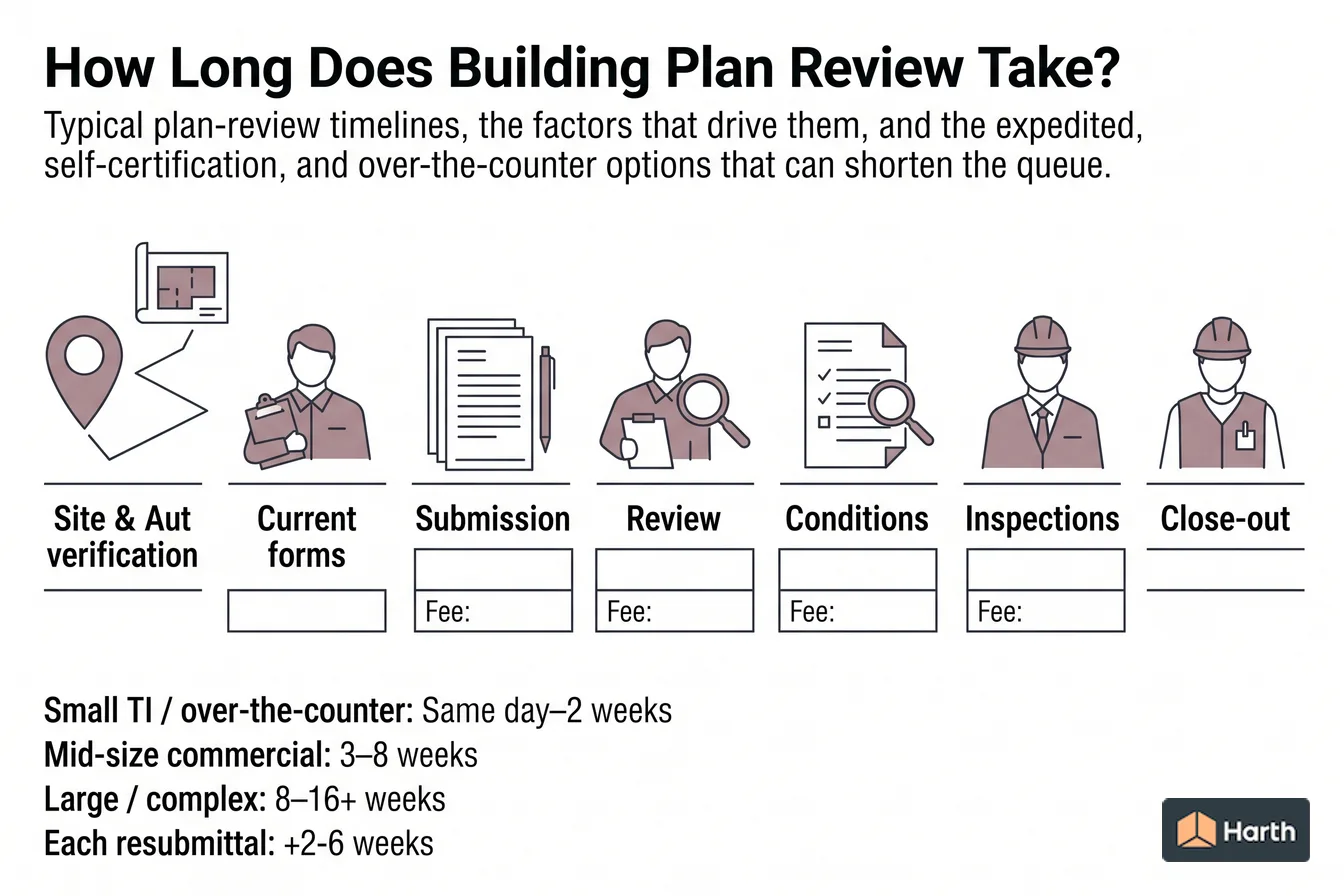
Typical plan-review timelines, the factors that drive them, and the expedited, self-certification, and over-the-counter options that can shorten the queue.
On this page
Last updated August 14, 2026 · Illustrative timeline ranges based on common U.S. building-department turnaround targets; actual review times, expedited programs, and self-certification eligibility vary by jurisdiction and workload, and the AHJ's published service standards are authoritative. Confirm timelines with your local building department. Official references: [ICC code-adoption map](https://www.iccsafe.org/international-code-adoptions/).
Direct answer
Typical plan-review timelines, the factors that drive them, and the expedited, self-certification, and over-the-counter options that can shorten the queue. A key reference is small ti / over-the-counter: Same day–2 weeks; check the cited source, edition, units, and applicability before using it for design, compliance, procurement, or approval. Small TI / over-the-counter is Same day–2 weeks; if eligible. Mid-size commercial is 3–8 weeks; first review cycle. Large / complex is 8–16+ weeks; multi-agency, multi-cycle. Plan-review turnaround scales with project size, the number of agencies involved, and the department's current backlog. Treat the figures below as illustrative ranges — the AHJ's own service standards and workload govern any specific project. Read the values with the cited source, edition or observation period, units and applicability; replace illustrative inputs with current project evidence before design, procurement or approval use.
Content and cited inputs reviewed by Harth team · Published 2026-08-14 · Updated 2026-08-14.
Which authority and approval steps control the project?
Plan-review turnaround scales with project size, the number of agencies involved, and the department's current backlog. Treat the figures below as illustrative ranges — the AHJ's own service standards and workload govern any specific project.
| Project type | First-cycle target | Notes |
|---|---|---|
| Small TI / over-the-counter | Same day–2 weeks | If eligible for OTC or express review |
| Mid-size commercial | 3–8 weeks | Single building department, standard queue |
| Large / ground-up / multi-agency | 8–16+ weeks | Fire, health, public works, zoning in parallel |
| Each resubmittal cycle | +2–6 weeks | Set returns to the queue |
What drives the timeline
- Number of review cycles — the dominant factor; a set that clears in one cycle beats one that loops four times.
- Completeness at intake — missing disciplines or forms trigger rejection before the clock even starts.
- Number of agencies — parallel reviews by fire, health, zoning, and public works add coordination and dependencies.
- Department backlog — seasonal and market-driven queues stretch even simple reviews.
- Project complexity — high-rise, assembly, healthcare, and hazardous occupancies invite deeper scrutiny.
Ways to shorten the queue
- Over-the-counter (OTC) / express — same-visit review for small, low-risk scopes that meet the department's eligibility rules.
- Expedited / priority review — many AHJs offer a faster track for an additional fee or via third-party plan-review firms.
- Self-certification / professional certification — eligible project types let a qualified design professional certify code compliance, reducing department review; scope and eligibility are strictly defined.
- Pre-submittal meetings — a pre-application conference surfaces agency concerns before the formal clock starts.
The fastest lever is your own set
Expediting fees help, but the cheapest way to compress the schedule is to file a complete, coordinated set that anticipates the correction comments and clears in one or two cycles. Work the submittal checklist, coordinate the disciplines in Harth before you file, and see the full permit process for where review fits in the sequence.
How Long Does Building Plan Review Take? (2026): jurisdiction verification record
| Approval field | Project entry | Official evidence |
|---|---|---|
| Site address and parcel | — | Survey / assessor / authority record |
| Authority and approval route | — | Current agency page |
| Project type and scope | — | Written scope and code pathway |
| Required forms and drawing set | — | Current checklist and form revision |
| Fees and calculation date | — | Official fee schedule |
| Target review stages | — | Published service target, not a promise |
| Corrections, conditions and inspections | — | Portal or written authority record |
| Close-out evidence | — | Final approval / certificate / record |
Project-use verification: verify every form, fee and timing at the named authority on the submission date; generic guidance cannot confirm a project's requirements.
Where can you explore related guidance?
- Explore all permits guidance
- The Building Permit Process, Explained (2026)
- Commercial Building Permit Submittal Checklist (2026)
- Building Permits in Los Angeles, CA (LADBS Overview, 2026)
Sources and method
Illustrative timeline ranges based on common U.S. building-department turnaround targets; actual review times, expedited programs, and self-certification eligibility vary by jurisdiction and workload, and the AHJ's published service standards are authoritative. Confirm timelines with your local building department. Official references: ICC code-adoption map.
Source links
Frequently asked questions
What is a realistic plan-review timeline?
It depends on project size and department workload. A small tenant improvement may be reviewed over the counter in a day or cleared in a week or two; a mid-size commercial project often runs 3–8 weeks for the first cycle; a large or multi-agency project can take several months across multiple cycles. These are typical ranges only — the AHJ's published service standards and current backlog govern.
What is the single biggest driver of a long timeline?
Resubmittal cycles. The first review is usually the fastest part; each round of corrections sends the set back into the queue and adds weeks. A complete, coordinated, code-anticipating submittal that clears in one or two cycles will beat a rushed set that loops four or five times, even if the rushed set was filed earlier.
Can I pay to speed up review?
Often, yes. Many jurisdictions offer expedited or priority review for an additional fee, third-party plan review, or self-certification / professional-certification programs for eligible project types that shift the compliance attestation to a qualified design professional. Availability and eligibility vary — check whether the AHJ publishes an expedited program.
Related pages
- The Building Permit Process, Explained (2026)
Follow the building permit process from application through plan review, corrections, issuance, inspections, and certificate of occupancy.
- Commercial Building Permit Submittal Checklist (2026)
Use this commercial permit checklist to assemble discipline drawings, calculations, energy documents, and forms before jurisdictional intake.
- Building Permits in Los Angeles, CA (LADBS Overview, 2026)
How building permits work in Los Angeles: LADBS plan-check and permit steps, who reviews what, and links to the official fee schedules and forms.