Building Code Glossary
Cylinder: Building Code Definition
How the IFC 2009 define cylinder, where the wording differs, and which chapters depend on the term.
On this page
Last updated September 7, 2026 · Definitions quoted from the 2009 International Codes as transcribed in this site's building-codes collection, with the source chapter linked for each quotation. Usage counts are computed over the chapters hosted here, one copy per code. The [ICC code library](https://codes.iccsafe.org/codes) publishes the current model text and the [ICC adoption maps](https://www.iccsafe.org/advocacy/code-adoption-maps/) show which edition a jurisdiction has adopted; those sources control.
Direct answer
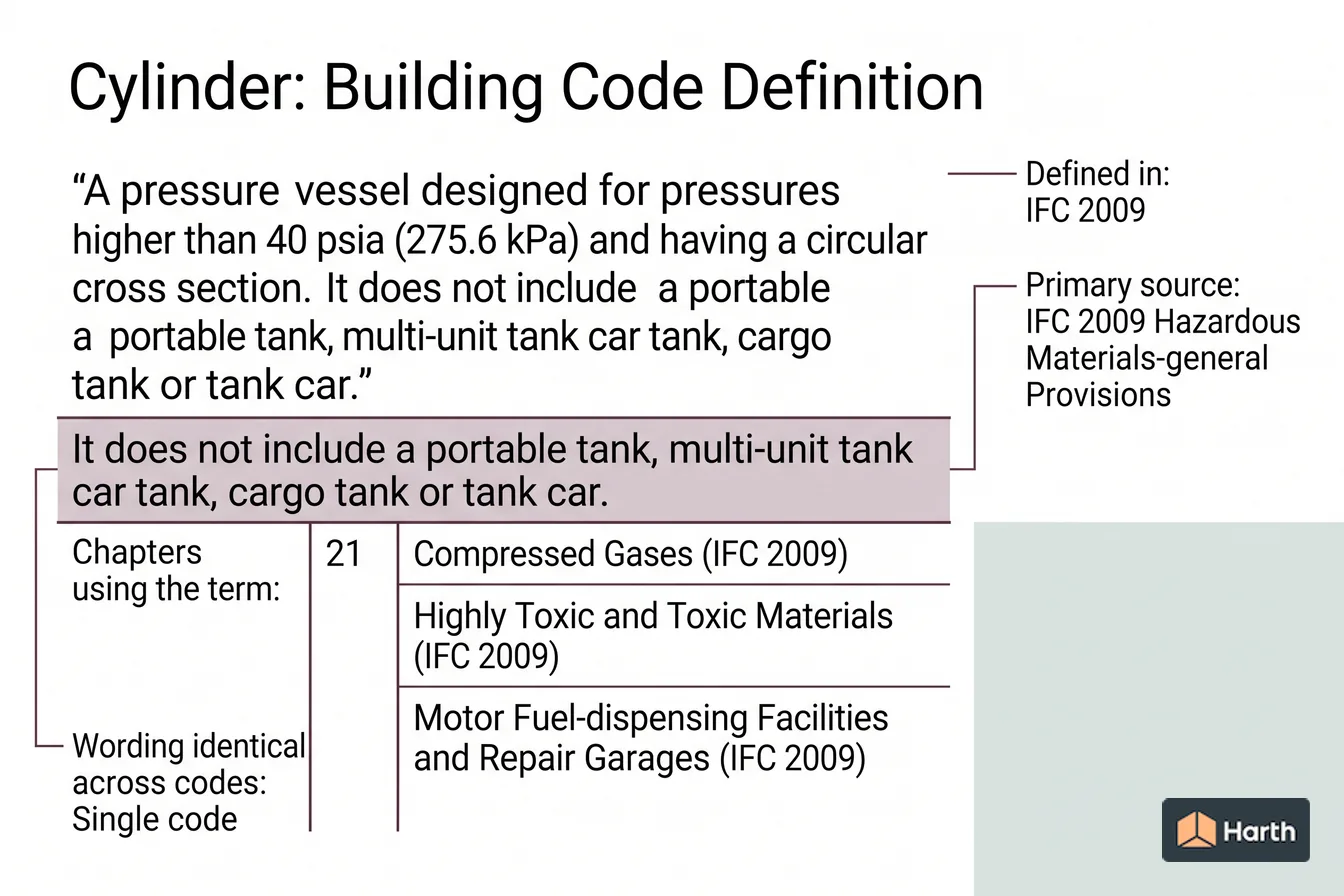
Cylinder is a defined term in the International Fire Code (IFC) 2009, in Hazardous Materials-general Provisions. The code's own words are: “A pressure vessel designed for pressures higher than 40 psia (275.6 kPa) and having a circular cross section. It does not include a portable tank, multi-unit tank car tank, cargo tank or tank car.” No other I-Code in this corpus defines it, so the IFC 2009 definition is the one to work from. The term is used in 21 chapters of this corpus, most often in Compressed Gases (IFC 2009), Highly Toxic and Toxic Materials (IFC 2009), Motor Fuel-dispensing Facilities and Repair Garages (IFC 2009). These pages transcribe the 2009 model text; verify the definition against the edition and amendments your authority having jurisdiction has adopted.
Content and cited inputs reviewed by Scott Barrington, Harth founder and architectural technology specialist · Published 2026-09-07 · Updated 2026-09-07.
What does this term mean?
Cylinder — IFC 2009, Hazardous Materials-general Provisions:
A pressure vessel designed for pressures higher than 40 psia (275.6 kPa) and having a circular cross section. It does not include a portable tank, multi-unit tank car tank, cargo tank or tank car.
What must be verified before using this guidance?
Cylinder is defined once in this corpus, in the Hazardous Materials-general Provisions chapter of the International Fire Code (IFC) 2009:
A pressure vessel designed for pressures higher than 40 psia (275.6 kPa) and having a circular cross section. It does not include a portable tank, multi-unit tank car tank, cargo tank or tank car.
Where cylinder is used in the code
The term appears in 21 chapters of the 2009 I-Codes hosted here. The chapters that lean on it hardest are the ones to read next.
| Chapter | Code | Mentions |
|---|---|---|
| Compressed Gases | IFC 2009 | 150 |
| Highly Toxic and Toxic Materials | IFC 2009 | 82 |
| Motor Fuel-dispensing Facilities and Repair Garages | IFC 2009 | 58 |
| Flammable Gases and Flammable Cryogenic Fluids | IFC 2009 | 41 |
| Welding and Other Hot Work | IFC 2009 | 40 |
| Hazardous Materials-general Provisions | IFC 2009 | 36 |
| Semiconductor Fabrication Facilities | IFC 2009 | 20 |
| Oxidizers, Oxidizing Gases and Oxidizing Cryogenic Fluids | IFC 2009 | 15 |
| Masonry | IBC 2009 | 13 |
| Pyrophoric Materials | IFC 2009 | 9 |
| Liquefied Petroleum Gases | IFC 2009 | 7 |
| Fire Protection Systems | IFC 2009 | 6 |
9 further chapters mention the term.
The term in use
How the code actually writes about cylinder, quoted from the 2009 text hosted here:
Compressed gas container, cylinder and tank valves shall be protected from physical damage by means of protective caps, collars or similar devices in accordance with Sections 3003.6.1 and 3003.6.2.
The maximum flow rate of release for portable tanks and cylinders shall be calculated based on the total release from the cylinder or tank within the time specified in Table 3704.2.2.7.5.
The discharge of CNG from motor vehicle fuel cylinders for the purposes of maintenance, cylinder certification, calibration of dispensers or other activities shall be in accordance with Sections 2208.8.1 through 2208.8.1.2.6.
The terms cylinder is built out of
The definition above leans on 2 other defined terms. Each carries its own code definition, and a local amendment to any of them changes what cylinder covers:
- Pressure Vessel — IFC 2009: A closed vessel designed to operate at pressures above 15 psig (103 kPa).
- Vessel — IFC 2009: A motorized watercraft, other than a seaplane on the water, used or capable of being used as a means of transportation.
Cylinder: what to open, and in what order
Every row is a document this term depends on. The ICC code library and the ICC adoption maps cover the middle rows.
| Check | Where | Confirmed |
|---|---|---|
| Read the definition in the adopted IFC | Hazardous Materials-general Provisions | |
| Re-check the requirement that uses it | Compressed Gases (IFC 2009) | |
| Re-check the requirement that uses it | Highly Toxic and Toxic Materials (IFC 2009) | |
| Re-check the requirement that uses it | Motor Fuel-dispensing Facilities and Repair Garages (IFC 2009) | |
| Re-check the requirement that uses it | Flammable Gases and Flammable Cryogenic Fluids (IFC 2009) | |
| Confirm the dependent definition | Pressure Vessel | |
| Confirm the dependent definition | Vessel | |
| Local amendment to any of the above | Jurisdiction's amendment list |
A research aid, not a code determination. The authority having jurisdiction decides which edition and which amendments apply.
Where can you explore related guidance?
- Explore all glossary guidance
- Pressure Vessel: Building Code Definition
- Vessel: Building Code Definition
Sources and method
Definitions quoted from the 2009 International Codes as transcribed in this site's building-codes collection, with the source chapter linked for each quotation. Usage counts are computed over the chapters hosted here, one copy per code. The ICC code library publishes the current model text and the ICC adoption maps show which edition a jurisdiction has adopted; those sources control.
Source links
Frequently asked questions
What is the code definition of cylinder?
The International Fire Code (IFC) 2009 defines it in Hazardous Materials-general Provisions as: “A pressure vessel designed for pressures higher than 40 psia (275.6 kPa) and having a circular cross section. It does not include a portable tank, multi-unit tank car tank, cargo tank or tank car.” The 2009 model text is reproduced here; the definition that binds your project is the one in the edition your jurisdiction has adopted, as amended locally.
Which parts of the code depend on cylinder?
In this corpus the term is used across 21 chapters, led by Compressed Gases in the IFC 2009. Those are the sections whose scope moves if the definition is amended locally, so read them together with Chapter 2 rather than on their own.
What is the definition of a building code?
Building is a separate defined term. The IBC 2009 defines it as: “Any structure used or intended for supporting or sheltering any use or occupancy.” That is not the same as cylinder, which the IFC 2009 defines as “A pressure vessel designed for pressures higher than 40 psia (275.6 kPa) and having a circular cross section. It does not include a portable tank, multi-unit tank car tank, cargo tank or tank car.” — read both before applying either, and confirm the wording in the edition your jurisdiction has adopted.
What does the code on a gas cylinder mean?
In the 2009 I-Codes hosted here it is a defined term rather than a description. The IFC 2009 states, in Hazardous Materials-general Provisions: “A pressure vessel designed for pressures higher than 40 psia (275.6 kPa) and having a circular cross section. It does not include a portable tank, multi-unit tank car tank, cargo tank or tank car.” It is defined in IFC 2009. Because it is a defined term, whatever the adopted edition says it means is what every section using it means — so check Chapter 2 of that edition and any local amendment before relying on this wording.
Related pages
- Cubic Foot: Building Code Definition
Cubic Foot — IRC 2009 definition: The amount of gas that occupies 1 cubic foot (0.02832 m3) when at a temperature of …
- Curtain Wall: Building Code Definition
Curtain Wall — IECC 2009 definition: Fenestration products used to create an external nonload-bearing wall that is designed to separate the exterior …
- Cutout Box: Building Code Definition
Cutout Box — IRC 2009 definition: An enclosure designed for surface mounting and having swinging doors or covers secured directly to and …
- Dalle Glass: Building Code Definition
Dalle Glass — IBC 2009 definition: A decorative composite glazing material made of individual pieces of glass that are embedded in a …
- Damper, Volume: Building Code Definition
Damper, Volume — IRC 2009 definition: A device that will restrict, retard or direct the flow of air in any duct, or …
- Damper: Building Code Definition
Damper — IBC 2009 definition: See "Ceiling radiation damper," "Combination fire/smoke damper," "Fire damper" and "Smoke damper."