Building Code Glossary
Overcurrent: Building Code Definition
How the IRC 2009 define overcurrent, where the wording differs, and which chapters depend on the term.
On this page
Last updated September 7, 2026 · Definitions quoted from the 2009 International Codes as transcribed in this site's building-codes collection, with the source chapter linked for each quotation. Usage counts are computed over the chapters hosted here, one copy per code. The [ICC code library](https://codes.iccsafe.org/codes) publishes the current model text and the [ICC adoption maps](https://www.iccsafe.org/advocacy/code-adoption-maps/) show which edition a jurisdiction has adopted; those sources control.
Direct answer
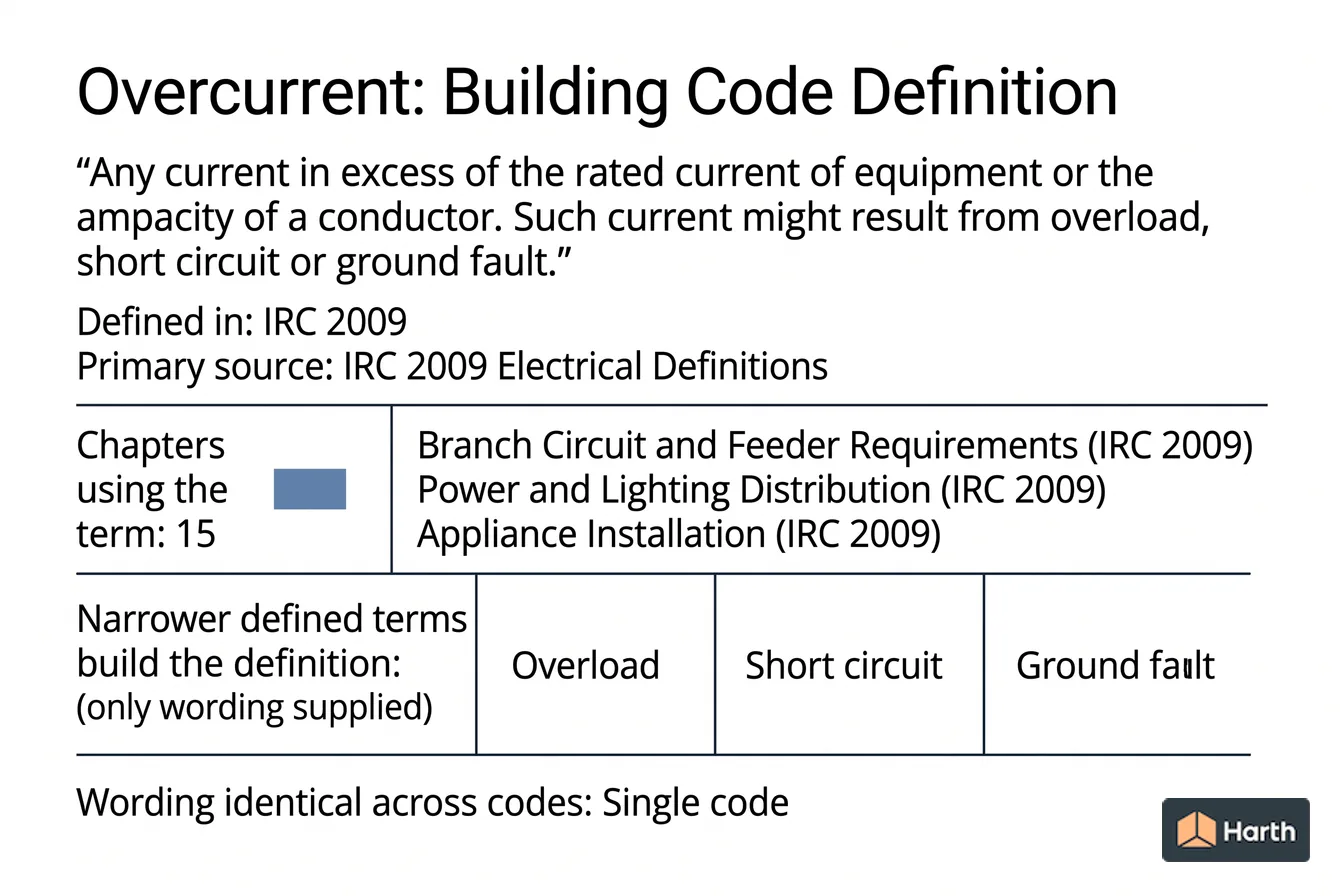
Overcurrent is a defined term in the International Residential Code (IRC) 2009, in Electrical Definitions. The code's own words are: “Any current in excess of the rated current of equipment or the ampacity of a conductor. Such current might result from overload, short circuit or ground fault.” No other I-Code in this corpus defines it, so the IRC 2009 definition is the one to work from. The term is used in 15 chapters of this corpus, most often in Branch Circuit and Feeder Requirements (IRC 2009), Power and Lighting Distribution (IRC 2009), Appliance Installation (IRC 2009). These pages transcribe the 2009 model text; verify the definition against the edition and amendments your authority having jurisdiction has adopted. Record the jurisdiction, the adopted edition, the application date and any local amendment that rewrites the definition before you use it on a live project, because a term redefined by amendment changes every requirement that depends on it.
Content and cited inputs reviewed by Scott Barrington, Harth founder and architectural technology specialist · Published 2026-09-07 · Updated 2026-09-07.
What does this term mean?
Overcurrent — IRC 2009, Electrical Definitions:
Any current in excess of the rated current of equipment or the ampacity of a conductor. Such current might result from overload, short circuit or ground fault.
What must be verified before using this guidance?
Overcurrent is defined once in this corpus, in the Electrical Definitions chapter of the International Residential Code (IRC) 2009:
Any current in excess of the rated current of equipment or the ampacity of a conductor. Such current might result from overload, short circuit or ground fault.
Where overcurrent is used in the code
The term appears in 15 chapters of the 2009 I-Codes hosted here. The chapters that lean on it hardest are the ones to read next.
| Chapter | Code | Mentions |
|---|---|---|
| Branch Circuit and Feeder Requirements | IRC 2009 | 39 |
| Power and Lighting Distribution | IRC 2009 | 18 |
| Appliance Installation | IRC 2009 | 15 |
| Services | IRC 2009 | 11 |
| Electrical Definitions | IRC 2009 | 5 |
| Fire Protection Systems | IBC 2009 | 3 |
| Fire Protection Systems | IFC 2009 | 3 |
| Swimming Pools | IRC 2009 | 3 |
| Building Services and Systems | IFC 2009 | 2 |
| Construction Requirements for Existing Buildings | IFC 2009 | 2 |
| Means of Egress | IFC 2009 | 2 |
| General Requirements | IRC 2009 | 2 |
3 further chapters mention the term.
The term in use
How the code actually writes about overcurrent, quoted from the 2009 text hosted here:
This chapter covers branch circuits and feeders and specifies the minimum required branch circuits, the allowable loads and the required overcurrent protection for branch circuits and feeders that serve less than 100 percent of the total dwelling unit load.
Enclosures for switches or overcurrent devices shall not be used as junction boxes, auxiliary gutters, or raceways for conductors feeding through or tapping off to other switches or overcurrent devices, except where adequate space for this purpose is provided.
Each appliance shall be protected against overcurrent in accordance with the rating of the appliance and its listing.
The terms overcurrent is built out of
The definition above leans on 4 other defined terms. Each carries its own code definition, and a local amendment to any of them changes what overcurrent covers:
- Equipment — IRC 2009: All piping, ducts, vents, control devices and other components of systems other than appliances that are permanently installed and integrated to provide control of environmental conditions for buildings.
- Conductor — IPC 2009: A pipe inside the building that conveys storm water from the roof to a storm or combined bUilding drain.
- Overload — IRC 2009: Operation of equipment in excess of normal, full-load rating, or of a conductor in excess of rated ampacity that, when it persists for a sufficient length of time, would cause damage or dangerous overheating.
- Ampacity — IRC 2009: The current in amperes that a conductor can carry continuously under the conditions of use without exceeding its temperature rating.
Overcurrent: what to open, and in what order
Every row is a document this term depends on. The ICC code library and the ICC adoption maps cover the middle rows.
| Check | Where | Confirmed |
|---|---|---|
| Read the definition in the adopted IRC | Electrical Definitions | |
| Re-check the requirement that uses it | Branch Circuit and Feeder Requirements (IRC 2009) | |
| Re-check the requirement that uses it | Power and Lighting Distribution (IRC 2009) | |
| Re-check the requirement that uses it | Appliance Installation (IRC 2009) | |
| Re-check the requirement that uses it | Services (IRC 2009) | |
| Confirm the dependent definition | Equipment | |
| Confirm the dependent definition | Conductor | |
| Confirm the dependent definition | Overload | |
| Local amendment to any of the above | Jurisdiction's amendment list |
A research aid, not a code determination. The authority having jurisdiction decides which edition and which amendments apply.
Where can you explore related guidance?
- Explore all glossary guidance
- Equipment: Building Code Definition
- Conductor: Building Code Definition
- Overload: Building Code Definition
- Ampacity: Building Code Definition
Sources and method
Definitions quoted from the 2009 International Codes as transcribed in this site's building-codes collection, with the source chapter linked for each quotation. Usage counts are computed over the chapters hosted here, one copy per code. The ICC code library publishes the current model text and the ICC adoption maps show which edition a jurisdiction has adopted; those sources control.
Source links
Frequently asked questions
What is the code definition of overcurrent?
The International Residential Code (IRC) 2009 defines it in Electrical Definitions as: “Any current in excess of the rated current of equipment or the ampacity of a conductor. Such current might result from overload, short circuit or ground fault.” The 2009 model text is reproduced here; the definition that binds your project is the one in the edition your jurisdiction has adopted, as amended locally.
Which parts of the code depend on overcurrent?
In this corpus the term is used across 15 chapters, led by Branch Circuit and Feeder Requirements in the IRC 2009. Those are the sections whose scope moves if the definition is amended locally, so read them together with Chapter 2 rather than on their own.
What is the definition of overcurrent?
In the 2009 I-Codes hosted here it is a defined term rather than a description. The IRC 2009 states, in Electrical Definitions: “Any current in excess of the rated current of equipment or the ampacity of a conductor. Such current might result from overload, short circuit or ground fault.” It is defined in IRC 2009. Because it is a defined term, whatever the adopted edition says it means is what every section using it means — so check Chapter 2 of that edition and any local amendment before relying on this wording.
Related pages
- Outdoor Control Area: Building Code Definition
Outdoor Control Area — IFC 2009 definition: An outdoor area that contains hazardous materials in amounts not exceeding the maximum allowable quantities of …
- Outdoor Opening: Building Code Definition
Outdoor Opening — IMC 2009 definition: A door, window, louver or skylight openable to the outdoor atmosphere.
- Outlet: Building Code Definition
Outlet — IRC 2009 definition: A point on the wiring system at which current is taken to supply utilization equipment.
- Overload: Building Code Definition
Overload — IRC 2009 definition: Operation of equipment in excess of normal, full-load rating, or of a conductor in excess of …
- Owner: Building Code Definition
Owner — IBC 2009 definition: Any person, agent, firm or corporation having a legal or equitable interest in the property.
- Oxidizer: Building Code Definition
Oxidizer — IBC 2009 definition: A material that readily yields oxygen or other oxidizing gas, or that readily reacts to promote …