Building Code Glossary
Sump: Building Code Definition
How the IRC 2009, IPC 2009 define sump, where the wording differs, and which chapters depend on the term.
On this page
Last updated September 7, 2026 · Definitions quoted from the 2009 International Codes as transcribed in this site's building-codes collection, with the source chapter linked for each quotation. Usage counts are computed over the chapters hosted here, one copy per code. The [ICC code library](https://codes.iccsafe.org/codes) publishes the current model text and the [ICC adoption maps](https://www.iccsafe.org/advocacy/code-adoption-maps/) show which edition a jurisdiction has adopted; those sources control.
Direct answer
Sump is a defined term in the International Residential Code (IRC) 2009, in Definitions. The code's own words are: “A tank or pit that receives sewage or waste, located below the normal grade of the gravity system and that must be emptied by mechanical means.” The IPC 2009 defines the same term with different wording, so the controlling text depends on which code governs the question in front of you — the comparison below sets the versions side by side. The term is used in 37 chapters of this corpus, most often in Sanitary Drainage (IPC 2009), Flammable and Combustible Liquids (IFC 2009), Sanitary Drainage (IRC 2009). These pages transcribe the 2009 model text; verify the definition against the edition and amendments your authority having jurisdiction has adopted.
Content and cited inputs reviewed by Scott Barrington, Harth founder and architectural technology specialist · Published 2026-09-07 · Updated 2026-09-07.
What does this term mean?
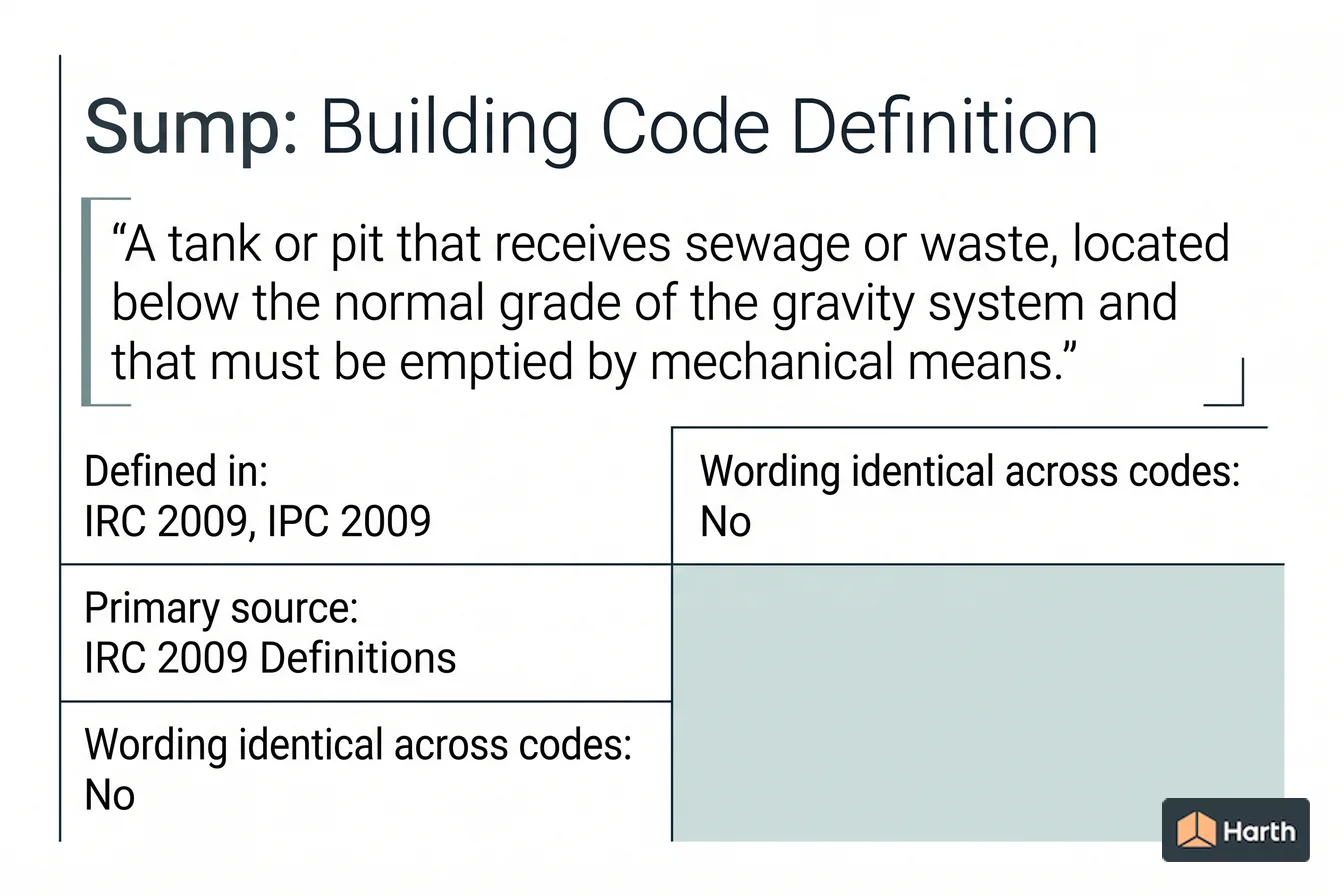
Sump — IRC 2009, Definitions:
A tank or pit that receives sewage or waste, located below the normal grade of the gravity system and that must be emptied by mechanical means.
What must be verified before using this guidance?
Two of the I-Codes in this corpus define Sump, and the wording is not identical — read the version that governs your question.
| Code | Where it is defined | Definition |
|---|---|---|
| IRC 2009 | Definitions | A tank or pit that receives sewage or waste, located below the normal grade of the gravity system and that must be emptied by mechanical means. |
| IPC 2009 | Definitions | A tank or pit that receives sewage or liquid waste, located below the normal grade of the gravity system and that must be emptied by mechanical means. |
Where sump is used in the code
The term appears in 37 chapters of the 2009 I-Codes hosted here. The chapters that lean on it hardest are the ones to read next.
| Chapter | Code | Mentions |
|---|---|---|
| Sanitary Drainage | IPC 2009 | 27 |
| Flammable and Combustible Liquids | IFC 2009 | 19 |
| Sanitary Drainage | IRC 2009 | 16 |
| Hazardous Materials-general Provisions | IFC 2009 | 15 |
| Storm Drainage | IRC 2009 | 15 |
| Soils and Foundations | IBC 2009 | 12 |
| Storm Drainage | IPC 2009 | 12 |
| Definitions | IFC 2009 | 9 |
| Vents | IRC 2009 | 8 |
| Vents | IPC 2009 | 7 |
| Definitions | IPC 2009 | 6 |
| Water Supply and Distribution | IPC 2009 | 6 |
25 further chapters mention the term.
The term in use
How the code actually writes about sump, quoted from the 2009 text hosted here:
Building subdrains that cannot be discharged to the sewerby gravity flow shall be discharged into a tightly covered and vented sump from which the liquid shall be lifted and discharged into the building gravity drainage system by automatic pumping equipment or other approved method.
The sump pit shall be not less than 18 inches (457 mm) in diameter and 24 inches (610 mm) deep, unless otherwise approved.
Subsoil drains shall discharge to a trapped area drain, sump, dry well or approvedlocation above ground.
The terms sump is built out of
The definition above leans on 5 other defined terms. Each carries its own code definition, and a local amendment to any of them changes what sump covers:
- Liquid — IBC 2009: A material that has a melting point that is equal to or less than 68°F (20°C) and a boiling point that is greater than 68°F (20°C) at 14.7 pounds per square inch absolute (psia) (101 kPa).
- System — IFC 2009: An assembly of equipment consisting of a tank, container or containers, appurtenances, pumps, compressors and connecting piping.
- Sewage — IRC 2009: Any liquid waste containing animal matter, vegetable matter or other impurity in suspension or solution.
- Waste — IRC 2009: Liquid-borne waste that is free of fecal matter.
- Grade — IRC 2009: The finished ground level adjoining the building at all exterior walls.
Sump: what to open, and in what order
Every row is a document this term depends on. The ICC code library and the ICC adoption maps cover the middle rows.
| Check | Where | Confirmed |
|---|---|---|
| Read the definition in the adopted IRC | Definitions | |
| Read the definition in the adopted IPC | Definitions | |
| Re-check the requirement that uses it | Sanitary Drainage (IPC 2009) | |
| Re-check the requirement that uses it | Flammable and Combustible Liquids (IFC 2009) | |
| Re-check the requirement that uses it | Sanitary Drainage (IRC 2009) | |
| Re-check the requirement that uses it | Hazardous Materials-general Provisions (IFC 2009) | |
| Confirm the dependent definition | Liquid | |
| Confirm the dependent definition | System | |
| Confirm the dependent definition | Sewage | |
| Local amendment to any of the above | Jurisdiction's amendment list |
A research aid, not a code determination. The authority having jurisdiction decides which edition and which amendments apply.
Where can you explore related guidance?
- Explore all glossary guidance
- System: Building Code Definition
- Sewage: Building Code Definition
- Liquid: Building Code Definition
- Waste: Building Code Definition
Sources and method
Definitions quoted from the 2009 International Codes as transcribed in this site's building-codes collection, with the source chapter linked for each quotation. Usage counts are computed over the chapters hosted here, one copy per code. The ICC code library publishes the current model text and the ICC adoption maps show which edition a jurisdiction has adopted; those sources control.
Source links
Frequently asked questions
What is the code definition of sump?
The International Residential Code (IRC) 2009 defines it in Definitions as: “A tank or pit that receives sewage or waste, located below the normal grade of the gravity system and that must be emptied by mechanical means.” The 2009 model text is reproduced here; the definition that binds your project is the one in the edition your jurisdiction has adopted, as amended locally.
Which parts of the code depend on sump?
In this corpus the term is used across 37 chapters, led by Sanitary Drainage in the IPC 2009. Those are the sections whose scope moves if the definition is amended locally, so read them together with Chapter 2 rather than on their own.
What is a sump in a building?
In the 2009 I-Codes hosted here it is a defined term rather than a description. The IRC 2009 states, in Definitions: “A tank or pit that receives sewage or waste, located below the normal grade of the gravity system and that must be emptied by mechanical means.” It is defined in IRC 2009, IPC 2009. It is not the same as Building, which the IBC 2009 defines separately as “Any structure used or intended for supporting or sheltering any use or occupancy.” Because it is a defined term, whatever the adopted edition says it means is what every section using it means — so check Chapter 2 of that edition and any local amendment before relying on this wording.
What is a sump?
In the 2009 I-Codes hosted here it is a defined term rather than a description. The IRC 2009 states, in Definitions: “A tank or pit that receives sewage or waste, located below the normal grade of the gravity system and that must be emptied by mechanical means.” It is defined in IRC 2009, IPC 2009. Because it is a defined term, whatever the adopted edition says it means is what every section using it means — so check Chapter 2 of that edition and any local amendment before relying on this wording.
Related pages
- Suite: Building Code Definition
Suite — IBC 2009 definition: A group of patient treatment rooms or patient sleeping rooms within Group 1-2 occupancies where staff …
- Sump Pump: Building Code Definition
Sump Pump — IRC 2009 definition: A pump installed to empty a sump.
- Sump Vent: Building Code Definition
Sump Vent — IPC 2009 definition: A vent from pneumatic sewage ejectors, or similar equipment, that terminates separately to the open air.
- Sunroom: Building Code Definition
Sunroom — IRC 2009 definition: A one-story structure attached to a dwelling with a glazing area in excess of 40 percent …
- Supervising Station: Building Code Definition
Supervising Station — IBC 2009 definition: A facility that receives signals and at which personnel are in attendance at all times to …
- Supervisory Service: Building Code Definition
Supervisory Service — IBC 2009 definition: The service required to monitor performance of guard tours and the operative condition of fixed suppression …