Solar & Daylight Data
Sun Path & Solar Angles for Phoenix, AZ
Computed solar-noon altitudes for Phoenix (latitude ~33.4 degrees N) at the solstices and equinox, and what they mean for overhang sizing and west-facade heat control.
On this page
Last updated August 17, 2026 · NOAA Solar Calculator / standard solar geometry equations. Noon altitude computed as 90 - |latitude - declination| for Phoenix latitude ~33.4 degrees N, declination +23.44 / 0 / -23.44. Values are approximate and ignore atmospheric refraction, the equation of time, and local horizon obstructions. Official references: [NOAA solar calculation details](https://www.gml.noaa.gov/grad/solcalc/solareqns.PDF).
Direct answer
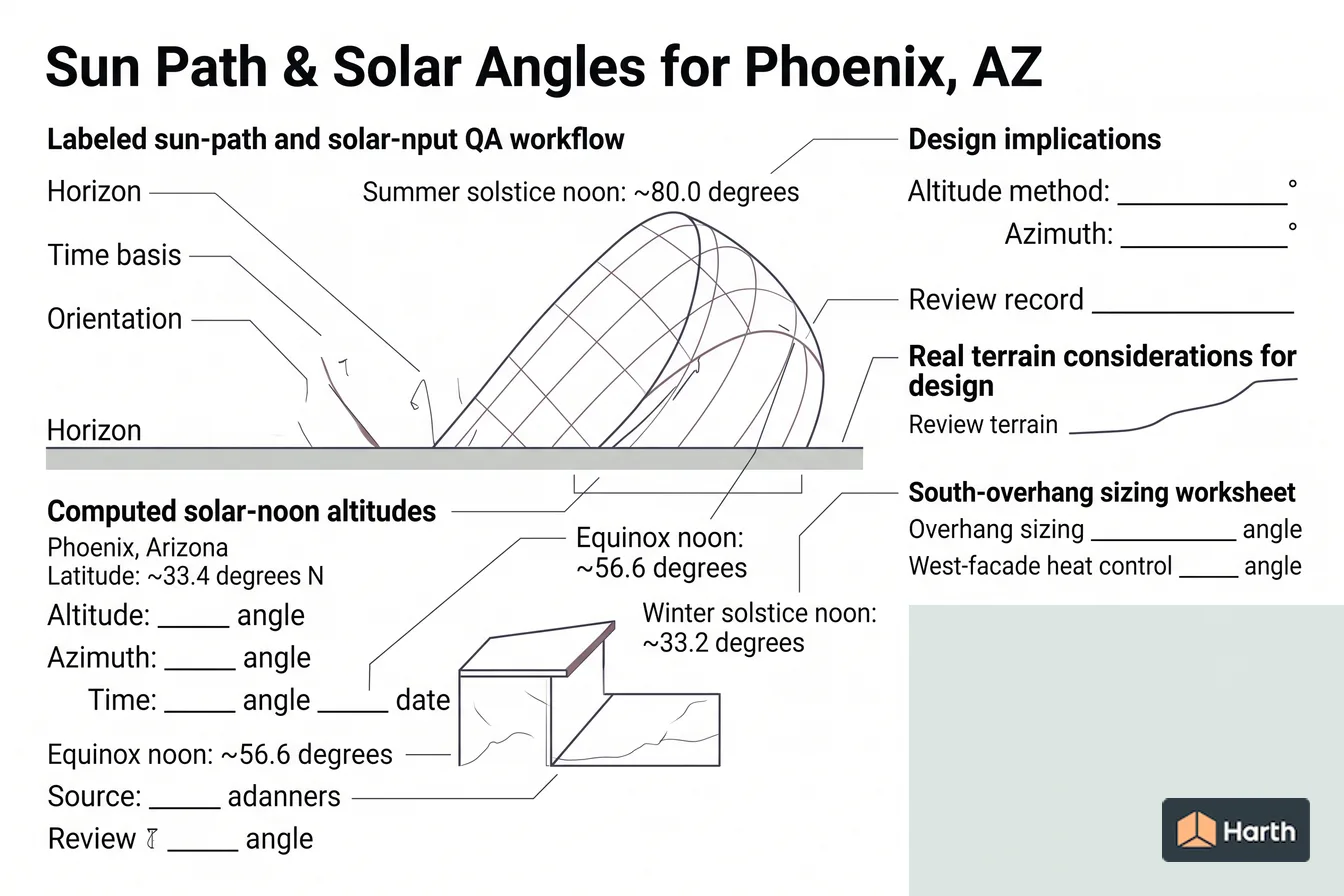
Computed solar-noon altitudes for Phoenix (latitude ~33.4 degrees N) at the solstices and equinox, and what they mean for overhang sizing and west-facade heat control. A key reference is latitude: ~33.4 degrees N; check the cited source, edition, units, and applicability before using it for design, compliance, procurement, or approval. Latitude is ~33.4 degrees N; Phoenix, Arizona. Summer solstice noon is ~80.0 degrees; sun nearly overhead. Equinox noon is ~56.6 degrees; 90 - latitude. Phoenix sits at roughly 33.4 degrees north, a hot-arid climate where the design priority is keeping direct sun off glass in summer while still using the sun's low winter path. The solar-noon altitudes below are computed from latitude and declination and are approximate.
Content and cited inputs reviewed by Harth team · Published 2026-08-14 · Updated 2026-08-17.
Which solar conditions control the result?
Phoenix sits at roughly 33.4 degrees north, a hot-arid climate where the design priority is keeping direct sun off glass in summer while still using the sun's low winter path. The solar-noon altitudes below are computed from latitude and declination and are approximate.
Computed solar-noon altitudes
| Date | Declination | Noon altitude | Notes |
|---|---|---|---|
| Summer solstice | +23.44 degrees | ~80.0 degrees | sun nearly overhead |
| Equinox | 0 degrees | ~56.6 degrees | 90 - latitude |
| Winter solstice | -23.44 degrees | ~33.2 degrees | low sun from the south |
Each value follows noon altitude = 90 - |latitude - declination|. The ~46.9 degree swing between the solstices is what makes fixed south shading effective here.
Design implications
- South facade — overhangs work. With the summer sun near 80 degrees, a modest horizontal overhang shades south glazing through the hottest months, while the ~33 degree winter sun passes beneath it to reach the glass. Size the projection to the two solstice angles.
- West facade — the hard problem. Low late-afternoon sun drives peak cooling loads through west glass. Overhangs are nearly useless against it; use vertical fins, external screens, low-SHGC glazing, or reduce west glass area.
- East facade — morning gain. Similar low-angle geometry to the west but coincident with cooler morning air, so it is usually a lesser priority.
- Roof and horizontal glazing. Near-overhead summer sun makes skylights and horizontal glazing significant heat sources; treat them carefully in an arid, high-irradiance climate.
Take it into design with real terrain
These angles describe the sky; the shadows that actually fall on your building also depend on neighbors, terrain, and orientation. Place your massing on the real Phoenix site in Harth to see the computed sun in context — how a west screen performs at 5 p.m. in June, or where a low winter sun reaches interior floors — then refine shading against a full-year study.
See understanding sun-path diagrams to visualize the full annual path, and solar altitude and azimuth explained for the underlying geometry.
Phoenix south-overhang sizing worksheet
For a vertical south-facing window, a first-pass noon shadow depth uses projection = vertical shade distance ÷ tan(solar altitude). With Phoenix latitude 33.45° N and the declination-only solar-noon method stated in the source note:
| Design date | Noon altitude | Projection / vertical shade distance | Example: shade 6 ft vertically |
|---|---|---|---|
| June solstice | 79.99° | 0.176 | 1.06 ft |
| Equinox | 56.55° | 0.661 | 3.97 ft |
| December solstice | 33.11° | 1.532 | 9.19 ft |
The 1.06-foot summer result is a geometry check, not a final overhang. Test the full occupied-hour range, facade azimuth, overhang offset, glass height, daylight, surrounding obstructions and the local horizon. NOAA’s solar calculator is the external verification reference; document coordinates, time zone, dates and calculation method with any exported dataset.
Where can you explore related guidance?
- Explore all solar data guidance
- Understanding Sun-Path Diagrams
- Solar Altitude and Azimuth: Meaning, Formulas & Worked Example
Sources and method
NOAA Solar Calculator / standard solar geometry equations. Noon altitude computed as 90 - |latitude - declination| for Phoenix latitude ~33.4 degrees N, declination +23.44 / 0 / -23.44. Values are approximate and ignore atmospheric refraction, the equation of time, and local horizon obstructions. Official references: NOAA solar calculation details.
Source links
Frequently asked questions
How were these Phoenix solar angles calculated?
They come from the standard solar-noon formula, noon altitude = 90 - |latitude - declination|, using Phoenix's latitude of about 33.4 degrees N. At the summer solstice declination is +23.44, giving 90 - |33.4 - 23.44| = 80.0 degrees; at the equinox declination is 0, giving 90 - 33.4 = 56.6 degrees; at the winter solstice declination is -23.44, giving 90 - |33.4 + 23.44| = 33.2 degrees. These are approximate — they ignore atmospheric refraction and the equation of time — but they are accurate enough for concept-stage shading design.
Why is west-facade heat such a problem in Phoenix?
In late afternoon the sun is low in the western sky, so it strikes west-facing glass almost perpendicularly, right as ambient air temperature peaks. A horizontal overhang does little against low western sun because the light comes in under it. Effective control on the west facade relies on vertical fins, deep reveals, external screens or shutters, low-SHGC glazing, or simply minimizing west glass — not on the overhangs that work so well on the south.
How deep should a south-facing overhang be in Phoenix?
Size it to the two solstice altitudes. With a summer noon sun near 80 degrees, even a shallow overhang throws shade down the full height of south glass, while the ~33 degree winter sun slips underneath to reach the glass for passive warmth and daylight. A common approach is to project the overhang so its shadow line reaches the sill at summer noon; the low winter angle then guarantees winter admission. Confirm the exact projection with a full-year shading study.
Related pages
- Sun Path & Solar Angles for Nashville, TN
Sun-path design data for Nashville, TN: solstice and equinox solar-noon altitude, shadow ratios, assumptions, and an architect-oriented shading worksheet.
- Sun Path & Solar Angles for New Orleans, LA
Sun-path design data for New Orleans, LA: solstice and equinox solar-noon altitude, shadow ratios, assumptions, and an architect-oriented shading worksheet.
- Sun Path & Solar Angles for New York, NY
Sun-path design data for New York, NY: solstice and equinox solar-noon altitude, shadow ratios, assumptions, and an architect-oriented shading worksheet.
- Sun Path & Solar Angles for Portland, OR
Sun-path design data for Portland, OR: solstice and equinox solar-noon altitude, shadow ratios, assumptions, and an architect-oriented shading worksheet.
- Sun Path & Solar Angles for Salt Lake City, UT
Sun-path design data for Salt Lake City, UT: solstice and equinox solar-noon altitude, shadow ratios, assumptions, and an architect-oriented shading worksheet.
- Sun Path & Solar Angles for San Diego, CA
Sun-path design data for San Diego, CA: solstice and equinox solar-noon altitude, shadow ratios, assumptions, and an architect-oriented shading worksheet.