What Changed Between Code Editions
How to Compare Two Building Code Editions Without Missing Anything
A repeatable method for working out what actually changed between two code editions on a specific project — starting from the definitions rather than the technical chapters.
On this page
Last updated September 7, 2026 · Method assembled from the structure of the I-Codes themselves and from the published edition-change record: ICC's code-change and Significant Changes programme, the [ICC code library](https://codes.iccsafe.org/codes) for reading two editions side by side, and the state adoption record at [iccsafe.org/adoptions](https://www.iccsafe.org/adoptions). Examples cited are sourced on the individual edition pages in this collection. The adopting jurisdiction's ordinance controls.
Direct answer
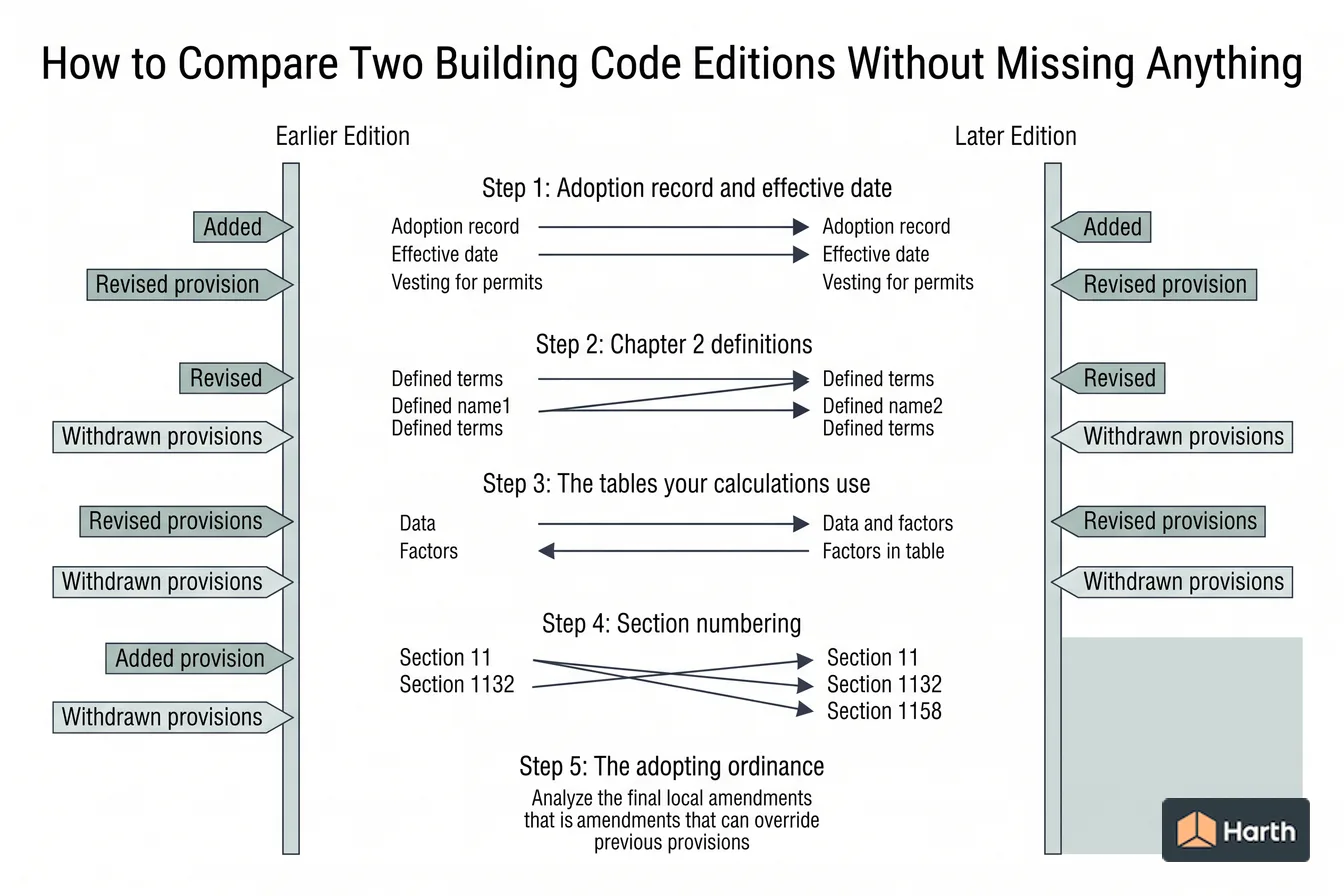
Comparing two code editions is a sequence, and the order matters more than the effort. Start with the adoption record: which edition the jurisdiction adopted, when it takes effect, and what the vesting rule is for permits already filed — a project may never face the new edition at all. Then read Chapter 2, because a changed definition moves the scope of every section that uses the term and does so without appearing in any technical chapter. Then check the tables your own calculations depend on, since a factor such as the business occupant load allowance can change without any surrounding text changing. Then map section numbering, because a renumbered provision breaks every cross-reference in your specification and code-analysis sheet. Finally, read the jurisdiction's adopting ordinance, which can amend or delete anything above. Working the other way round — technical chapters first — reliably misses the changes that matter most.
Content and cited inputs reviewed by Scott Barrington, Harth founder and architectural technology specialist · Published 2026-09-07 · Updated 2026-09-07.
What must be verified before using this guidance?
1. Confirm the adoption record and the effective date
Before comparing anything, establish whether the comparison is needed. Find the adopting instrument, its effective date, and the jurisdiction's vesting rule for applications already filed. A project that vests under the previous edition needs no comparison; a project straddling the date needs the date in writing.
2. Read Chapter 2 of both editions, side by side
This is the step people skip and the step that pays. Definitions are the switches that decide which requirements apply. A term whose definition is narrowed pulls the scope of every section that uses it, and no technical chapter records the edit. Work through the defined terms your project actually relies on — occupancy, storey, grade plane, mezzanine, fire area, habitable space — and read both versions.
3. Check the tables your calculations depend on
Factors change without narrative. The business occupant load allowance moved from 100 to 150 square feet per occupant between the 2015 and 2018 IBC, and nothing in the surrounding text announces it. List the tables your code-analysis sheet actually reads — occupant load, allowable area, travel distance, fixture counts, fire-resistance ratings — and compare the specific cells you use.
4. Map the section numbering
Renumbering is not a change in requirement, but it breaks everything that points at the requirement: specifications, code-analysis sheets, review comments, standard details, office templates. Build a small cross-reference table of the sections you cite by number, and update the templates once rather than project by project.
5. Read the adopting ordinance
Local amendments sit on top of everything above and can add, modify or delete any provision. A jurisdiction that adopts a new edition and simultaneously carries forward an old amendment can produce a combination that exists nowhere in the model code.
What to record
A comparison is only useful if it survives the project. Keep the result as a short register rather than as a reading exercise — one row per change that touches your work, with the section, the effect and the drawing or specification affected.
Where the comparison usually bites
Across recent I-Code transitions, four areas account for most of the practical impact:
- Occupant load factors and egress sizing — small factor changes propagate into stair width, exit count and fixture counts at once.
- Construction types and allowable height and area — a new construction type or a restructured table changes what is buildable on the site.
- Energy compliance paths — renamed or restructured paths change the submission, not just the performance target.
- Definitions — the quiet one, and the reason this list starts where it does.
Edition-comparison register
One register per project, filled in once when the jurisdiction changes edition. The point is the last column: a change with no drawing consequence still belongs in the register, recorded as none.
| Item | Entry |
|---|---|
| Jurisdiction | |
| Edition being left | |
| Edition being adopted | |
| Effective date | |
| Vesting rule and our application date | |
| Source of the adoption record | |
| Local amendments consulted (citation) |
| # | Area | Old provision | New provision | Effect on this project | Drawing / spec affected |
|---|---|---|---|---|---|
| 1 | Definitions | ||||
| 2 | Occupancy classification | ||||
| 3 | Height and area | ||||
| 4 | Construction type | ||||
| 5 | Fire resistance | ||||
| 6 | Occupant load factors | ||||
| 7 | Egress width and exit count | ||||
| 8 | Travel distance and common path | ||||
| 9 | Accessibility standard referenced | ||||
| 10 | Energy compliance path | ||||
| 11 | Plumbing fixture counts | ||||
| 12 | Structural load standard referenced | ||||
| 13 | Section numbering changes to update in templates |
This register records a comparison, not a compliance determination. The authority having jurisdiction decides which edition applies and how an amendment reads.
Where can you explore related guidance?
- Explore all code changes guidance
- IBC 2015 to 2018: The Changes That Move a Drawing
- IBC 2018 to 2021: Mass Timber and the New Construction Types
- IBC 2021 to 2024: What Changed for Design Teams
- IECC 2018 to 2021: How Much More Efficient, and What Changed
Sources and method
Method assembled from the structure of the I-Codes themselves and from the published edition-change record: ICC's code-change and Significant Changes programme, the ICC code library for reading two editions side by side, and the state adoption record at iccsafe.org/adoptions. Examples cited are sourced on the individual edition pages in this collection. The adopting jurisdiction's ordinance controls.
Source links
Frequently asked questions
Why start with definitions rather than the technical chapters?
Because a definition change is invisible where it takes effect. If the definition of a term is narrowed, every section that uses the term narrows with it, and none of those sections shows an edit. Reading Chapter 2 of both editions side by side takes an hour and catches the class of change that a chapter-by-chapter read is structurally unable to find.
Does a new edition apply to a project already in design?
Usually not automatically. Adoptions carry an effective date, and most jurisdictions review an application under the edition in force when the application was filed — the vesting rule. The details differ by jurisdiction and sometimes by permit type, so it is worth confirming in writing early: a project that vests under the previous edition does not need the comparison at all.
Is a code-change comparison the same as ICC's Significant Changes book?
No, and the two do different jobs. ICC's Significant Changes volumes are curated by the people who processed the changes and explain the reasoning behind them; they are the authoritative narrative. A project comparison is narrower and more specific: it asks only which changes touch the calculations, details and specifications on this particular job. Use both.
What if the jurisdiction skipped an edition?
Then compare against the edition actually being left, not the one immediately before the new one. A jurisdiction moving from the 2015 IBC to the 2021 IBC absorbs two editions of change at once, and changes introduced in 2018 and then modified in 2021 will not appear correctly in a single-step comparison. Read the transitions in sequence.
Related pages
- IBC 2015 to 2018: The Changes That Move a Drawing
IBC 2015 → 2018: the business occupant load factor moved from 100 to 150 sq ft gross, and a concentrated business use category at 50 sq ft net was added.
- IBC 2018 to 2021: Mass Timber and the New Construction Types
IBC 2018 → 2021: three new mass timber construction types (IV-A, IV-B, IV-C) in §602.4, heavy timber renamed IV-HT, up to 18 storeys, with changes across five more chapters.
- IBC 2021 to 2024: What Changed for Design Teams
IBC 2021 → 2024: tornado loads, updated wind/seismic/snow/rain design, more exposed mass timber in Type IV-B, reorganised §2702 emergency power, and Appendix P sleeping lofts.
- IECC 2018 to 2021: How Much More Efficient, and What Changed
IECC 2018 → 2021: DOE-assessed 9.4% residential and 12.1% commercial site energy savings, plus a Chapter 4 restructure that renamed and clarified the compliance paths.