What Changed Between Code Editions
IECC 2018 to 2021: How Much More Efficient, and What Changed
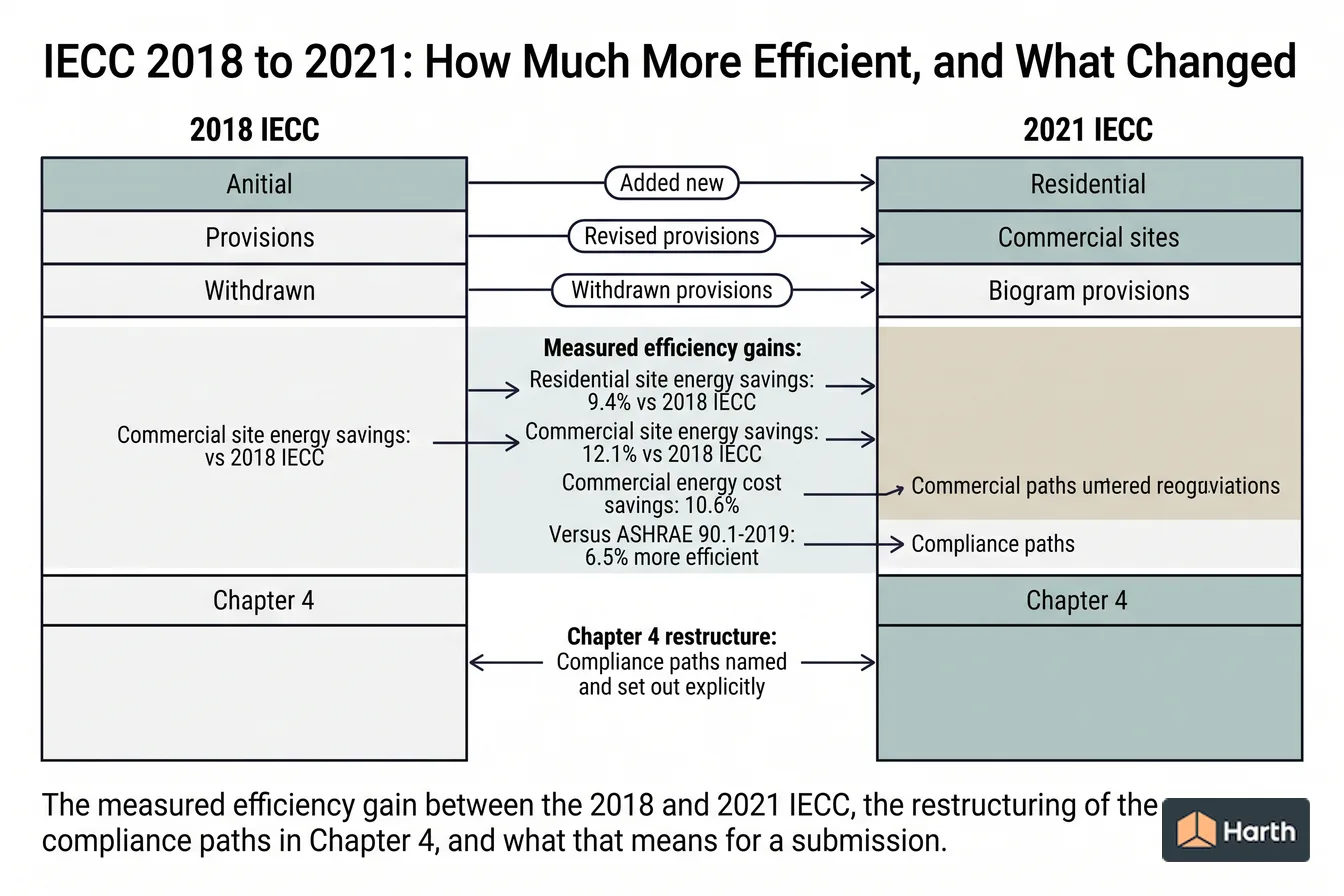
The measured efficiency gain between the 2018 and 2021 IECC, the restructuring of the compliance paths in Chapter 4, and what that means for a submission.
On this page
Last updated September 7, 2026 · Efficiency figures from US Department of Energy analysis as reported by ICC in [DOE finds 2021 IECC commercial provisions provide significant energy and cost savings](https://www.iccsafe.org/about/periodicals-and-newsroom/doe-finds-2021-iecc-commercial-provisions-provide-significant-energy-and-cost-savings/), with the compliance-path restructuring described in the [2021 IECC significant changes summary published by the University of Illinois EnergySense centre](https://energysense.uillinois.edu/2021-iecc-significant-changes/). Code text is published in the [ICC code library](https://codes.iccsafe.org/codes). Savings figures are national aggregates from modelling and are not a prediction for any individual building. The adopted edition and the jurisdiction's amendments control.
Direct answer
The 2021 IECC is a substantial efficiency step and a substantial reorganisation, and the second is what changes a submission. US Department of Energy analysis puts the residential provisions at 9.4 percent site energy savings and 8.7 percent carbon savings relative to the 2018 edition, and the commercial provisions at 12.1 percent site energy savings nationally, with 10.6 percent energy cost savings and 10.2 percent greenhouse gas savings; the commercial provisions are also assessed as 6.5 percent more efficient than ASHRAE Standard 90.1-2019 on a national weighted-average site energy basis. Alongside the numbers, Chapter 4 of both the commercial and residential provisions was restructured: the "prescriptive" and "mandatory" labels were removed, and each available compliance path was given a name with its requirements set out explicitly. Teams that navigate the energy code by remembered labels have to relearn the map.
Content and cited inputs reviewed by Scott Barrington, Harth founder and architectural technology specialist · Published 2026-09-07 · Updated 2026-09-07.
What must be verified before using this guidance?
US Department of Energy analysis of the 2021 IECC against the 2018 edition:
| Measure | Residential | Commercial |
|---|---|---|
| Site energy savings | 9.4% | 12.1% |
| Carbon / greenhouse gas savings | 8.7% | 10.2% |
| Energy cost savings | — | 10.6% |
The commercial provisions were also assessed as 6.5% more efficient than ASHRAE Standard 90.1-2019 on a national weighted-average site energy basis.
These are national aggregates from modelling across a representative building stock, not a prediction for an individual building. A project's actual delta depends on climate zone, form, systems and the compliance path taken.
The change that alters a submission
Chapter 4 of both the commercial and residential provisions was restructured:
- the "prescriptive" and "mandatory" labels were removed from provision headings throughout;
- each available compliance path was given a name, with its requirements set out explicitly.
The routes have not disappeared, but the map has been redrawn. A team that navigates the energy code by remembered labels — "we always do the prescriptive path" — has to find the equivalent named path and read its requirement set, because the boundaries are not guaranteed to sit where the old labels put them.
This is the practical work of the transition: an hour re-reading Chapter 4 before the first submission, rather than a plan-review comment after it.
Why the energy code needs checking separately
Energy code adoption frequently runs on its own timetable. It is often driven by separate state legislation, utility programmes or stretch-code initiatives rather than by the building code adoption cycle, and the national adoption record shows plenty of states carrying a different edition year for the IECC than for the IBC. Some states publish their own energy code entirely and reference the IECC only as a source document.
So the energy code edition is a separate question from the building code edition, asked separately. The state adoption profiles in this collection show both columns for exactly this reason.
What to do at the start of a project
- Confirm the energy code edition and its effective date independently of the building code.
- Establish whether ASHRAE 90.1 is an available alternative in this jurisdiction, and which edition.
- Choose the compliance path deliberately from the named paths in Chapter 4, and record the choice.
- Check for a stretch code — several states adopt one alongside the base code, and the record distinguishes them.
- Read the local amendments, which in energy codes are frequently more aggressive than the model text rather than less.
Scope of this page
This page covers the efficiency delta and the structural change to Chapter 4. It is not a complete change record — the technical provisions moved in many places — and the jurisdiction's adopted text controls.
Energy code transition check
Complete separately from the building code check; the two rarely move together.
| # | Check | Entry |
|---|---|---|
| 1 | Energy code adopted (IECC edition, state code, or ASHRAE 90.1) | |
| 2 | Effective date | |
| 3 | Is it the same edition year as the adopted building code? | Yes / No |
| 4 | Stretch code adopted alongside the base code? | |
| 5 | Is ASHRAE 90.1 an available alternative path, and which edition? | |
| 6 | Climate zone for the site | |
| 7 | Compliance path selected (named path from Chapter 4) | |
| 8 | Requirement set for that path re-read against the new edition? | |
| 9 | Local amendments to the energy code (citation) | |
| 10 | Envelope targets changed from the previous edition? | |
| 11 | Mechanical and lighting targets changed? | |
| 12 | Modelling or REScheck/COMcheck version matched to the edition? | |
| 13 | Submission documents updated to the named path | |
| 14 | Reviewer and date |
This check records a transition review, not a compliance determination.
Where can you explore related guidance?
- Explore all code changes guidance
- How to Compare Two Building Code Editions Without Missing Anything
- IBC 2018 to 2021: Mass Timber and the New Construction Types
- IBC 2021 to 2024: What Changed for Design Teams
- IBC 2015 to 2018: The Changes That Move a Drawing
Sources and method
Efficiency figures from US Department of Energy analysis as reported by ICC in DOE finds 2021 IECC commercial provisions provide significant energy and cost savings, with the compliance-path restructuring described in the 2021 IECC significant changes summary published by the University of Illinois EnergySense centre. Code text is published in the ICC code library. Savings figures are national aggregates from modelling and are not a prediction for any individual building. The adopted edition and the jurisdiction's amendments control.
Source links
Frequently asked questions
Will my building actually be 9 to 12 percent more efficient?
Not necessarily. Those are national aggregate figures from Department of Energy modelling across a representative building stock and climate mix. An individual building's result depends on its climate zone, form, systems and the compliance path taken. Use the figures to understand the direction and magnitude of the code change, not as a performance prediction for a specific project.
What does the Chapter 4 restructuring change for a submission?
The routes are the same in substance but the map is redrawn. Removing the "prescriptive" and "mandatory" labels and giving each compliance path a name with an explicit requirement set makes the choice deliberate rather than habitual — which is helpful, but it also means a team navigating by remembered labels can pick up the wrong requirement set. Re-read Chapter 4 rather than assuming the path you always use is where you left it.
Does adopting the 2021 IECC mean my jurisdiction rejected ASHRAE 90.1?
Not necessarily — many jurisdictions permit ASHRAE Standard 90.1 as an alternative compliance path for commercial buildings, and some adopt 90.1 in place of the IECC commercial provisions entirely. The DOE assessment that the 2021 IECC commercial provisions are 6.5 percent more efficient than 90.1-2019 is a comparison of the two documents, not a statement about which one your jurisdiction enforces. Check the adoption record.
Is the energy code adopted on the same cycle as the building code?
Often not. Energy code adoption frequently runs on its own timetable, driven by separate state legislation or utility programmes, and several states show a different edition year for the IECC than for the IBC in the national adoption record. Confirm the energy code edition separately rather than assuming it matches the building code.
Related pages
- How to Compare Two Building Code Editions Without Missing Anything
A five-step method for comparing code editions: adoption record, then definitions, then your tables, then numbering, then local amendments — in that order, and why.
- IBC 2015 to 2018: The Changes That Move a Drawing
IBC 2015 → 2018: the business occupant load factor moved from 100 to 150 sq ft gross, and a concentrated business use category at 50 sq ft net was added.
- IBC 2018 to 2021: Mass Timber and the New Construction Types
IBC 2018 → 2021: three new mass timber construction types (IV-A, IV-B, IV-C) in §602.4, heavy timber renamed IV-HT, up to 18 storeys, with changes across five more chapters.
- IBC 2021 to 2024: What Changed for Design Teams
IBC 2021 → 2024: tornado loads, updated wind/seismic/snow/rain design, more exposed mass timber in Type IV-B, reorganised §2702 emergency power, and Appendix P sleeping lofts.