What Changed Between Code Editions
IBC 2021 to 2024: What Changed for Design Teams
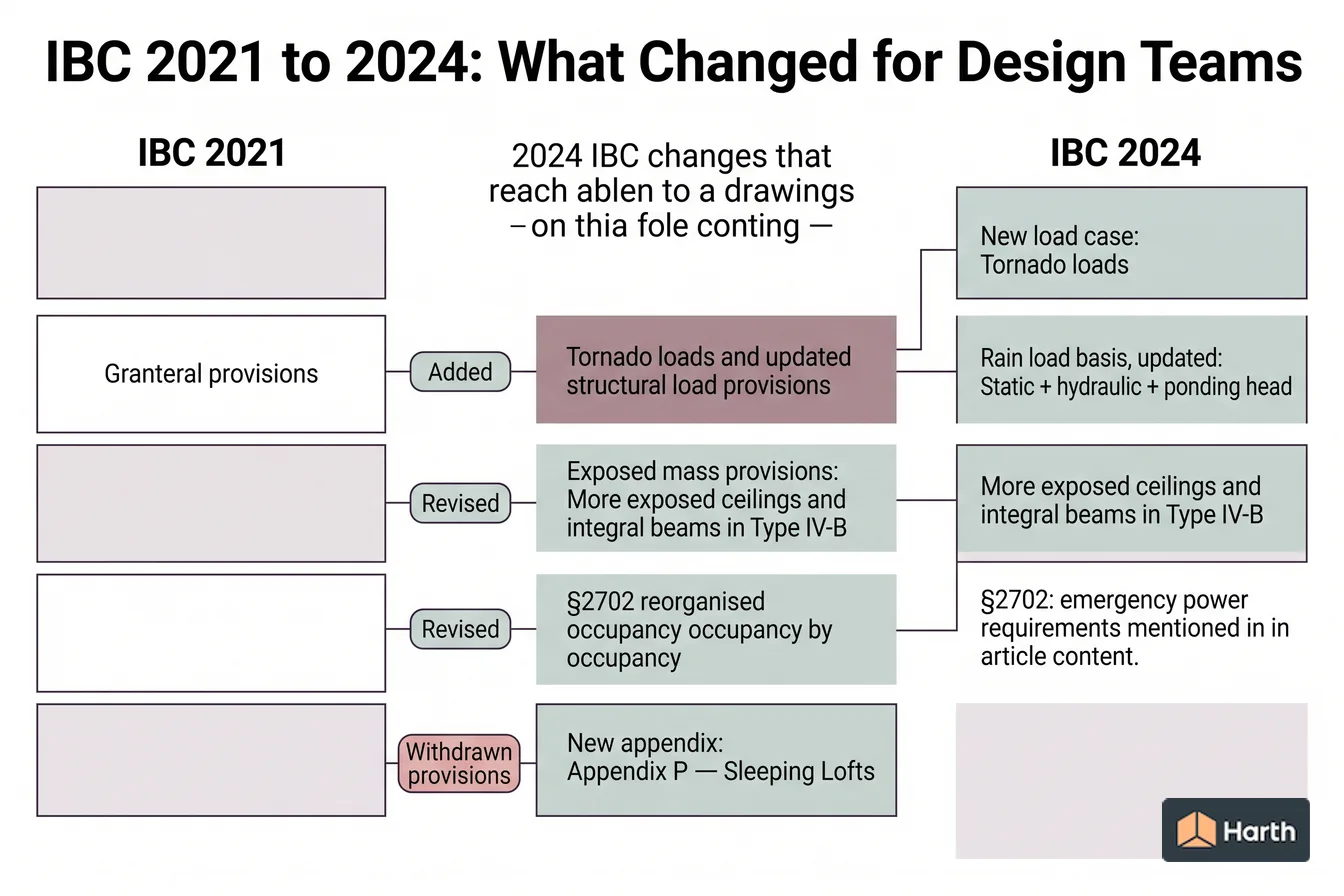
The 2024 IBC changes that reach a drawing — tornado loads and updated structural load provisions, exposed mass timber in Type IV-B, reorganised emergency power, and new sleeping-loft provisions.
On this page
Last updated September 7, 2026 · Changes summarised from ICC's published [2024 IBC Significant Changes session material](https://www.iccsafe.org/wp-content/uploads/Session-30-and-58-2024-IBC-Significant-Changes.pdf) and ICC's [2024 IBC Significant Changes](https://www.iccsafe.org/news-and-events-calendar/2024-ibc-significant-changes-online-live-3/) and [structural changes](https://www.iccsafe.org/news-and-events-calendar/2024-ibc-significant-structural-changes-and-asce-7-22-live-online-2/) programme descriptions, read against the code structure in the [ICC code library](https://codes.iccsafe.org/codes). This page covers changes that reach a drawing or a load case; it is not a complete change record. Very few jurisdictions had adopted the 2024 edition at the time of writing — check the adoption record before treating any of it as current.
Direct answer
The 2024 IBC is a structural edition more than an architectural one. Provisions for tornado loading were added, and the wind, earthquake, snow and rain load provisions were updated — design rain loads are now based on the summation of static head, hydraulic head and ponding head, which changes roof drainage design rather than merely restating it. On the architectural side, the allowance for exposing mass timber ceilings and integral beams in Type IV-B construction was expanded, which is the change most likely to alter what a mass timber building looks like. Section 2702 was reorganised to set out emergency power requirements occupancy by occupancy, with clarifications for large assembly occupancies, buildings with atriums and underground buildings. Chapter 31 temporary structure provisions were updated and expanded, new wind-resistance provisions were added for aggregate-surfaced roofs, and a new Appendix P covers sleeping lofts.
Content and cited inputs reviewed by Scott Barrington, Harth founder and architectural technology specialist · Published 2026-09-07 · Updated 2026-09-07.
What must be verified before using this guidance?
More of the 2024 IBC's practical impact sits in the load provisions than in the architectural chapters:
| Change | Effect |
|---|---|
| Tornado load provisions added | A design consideration that did not previously exist as a distinct case |
| Wind, earthquake and snow loads updated | Member sizes, lateral system, envelope attachment |
| Design rain loads restructured | Now based on the summation of static head, hydraulic head and ponding head — changes roof and drainage design |
| Aggregate-surfaced roofs | New wind-resistance provisions |
| Special inspections | New provisions for pre-engineered metal building systems, including end-plate moment connections and base plate anchorage |
The rain load change is the one most likely to surprise an architect, because it lands on a flat roof that looked settled: a different basis for the design load changes the structure and the drainage strategy together.
The architectural changes
Exposed mass timber in Type IV-B. The allowance for exposing mass timber ceilings and integral beams in Type IV-B construction was expanded. For anyone who has designed to the 2021 provisions this is the single change most likely to alter what the building looks like — more of the structure can be left visible without moving construction type.
Emergency power, Section 2702. The section was reorganised to set out requirements occupancy by occupancy rather than by system, with clarifications added for large assembly occupancies with an occupant load over 1,000, buildings with atriums, and underground buildings. The requirements are easier to read; the reorganisation also means the section numbers a specification points at have moved.
Temporary structures, Chapter 31. Updated and expanded provisions.
Appendix P — Sleeping Lofts. New. Like every IBC appendix, it applies only where the jurisdiction specifically adopts it.
Before you use any of this
Adoption runs behind publication. At the time of writing most US jurisdictions remained on the 2021 or 2018 editions, and a handful had moved to 2024. Two questions come before the change list:
- Has this jurisdiction adopted the 2024 edition, and from what date?
- Did it adopt the appendices, and which ones?
The state adoption profiles in this collection are a starting point for the first; the jurisdiction's own current-code publication settles both.
Scope of this page
This page covers 2021→2024 changes that reach a drawing or a load case. It is not a complete change record — ICC's Significant Changes programme and volume for the cycle are — and the jurisdiction's adopting ordinance controls.
2024 IBC readiness check
Use before committing a project to the 2024 edition, or when a jurisdiction announces adoption.
| # | Check | Entry |
|---|---|---|
| 1 | Has the jurisdiction adopted the 2024 IBC? | Yes / No |
| 2 | Effective date | |
| 3 | Vesting rule for applications already filed | |
| 4 | Appendices adopted (list) | |
| 5 | Referenced structural standard edition (ASCE 7-__) | |
| 6 | Is the site in a region the tornado provisions target? | |
| 7 | Structural engineer briefed on updated wind/seismic/snow/rain? | |
| 8 | Roof drainage re-checked against the new rain load basis | |
| 9 | Overflow drainage re-checked | |
| 10 | Mass timber scheme — exposure reassessed under the Type IV-B allowance | |
| 11 | Emergency power scope re-read against the reorganised §2702 | |
| 12 | Specification cross-references to §2702 updated | |
| 13 | Pre-engineered metal building special inspections in scope? | |
| 14 | Temporary structures on this project (Chapter 31)? | |
| 15 | Office templates and code-analysis sheet updated | |
| 16 | AHJ confirmation obtained in writing (date, name) |
This check records readiness, not compliance. The authority having jurisdiction decides which edition and which appendices apply.
Where can you explore related guidance?
- Explore all code changes guidance
- How to Compare Two Building Code Editions Without Missing Anything
- IBC 2018 to 2021: Mass Timber and the New Construction Types
- IECC 2018 to 2021: How Much More Efficient, and What Changed
- IBC 2015 to 2018: The Changes That Move a Drawing
Sources and method
Changes summarised from ICC's published 2024 IBC Significant Changes session material and ICC's 2024 IBC Significant Changes and structural changes programme descriptions, read against the code structure in the ICC code library. This page covers changes that reach a drawing or a load case; it is not a complete change record. Very few jurisdictions had adopted the 2024 edition at the time of writing — check the adoption record before treating any of it as current.
Source links
Frequently asked questions
Is the 2024 IBC in force anywhere yet?
Adoption of a new edition typically runs a few years behind publication, and at the time of writing most US jurisdictions were still on the 2021 or 2018 editions. Check the adoption record for the specific jurisdiction before treating any 2024 provision as current — and remember that a state adoption and a local adoption can differ.
What does the tornado load addition change in practice?
It introduces a load case that did not previously exist in the code as a distinct design consideration, alongside updated wind, seismic and snow provisions. The practical effect is felt by the structural engineer first, but it reaches architecture through member sizes, lateral system layout and envelope attachment. Where the project is in a region the provisions target, it is worth raising at concept stage rather than at structural coordination.
Does the rain load change affect roof design?
Yes. Basing design rain loads on the summation of static head, hydraulic head and ponding head rather than a simpler basis changes the load a roof must be designed for and, with it, drainage and overflow design. Flat and low-slope roofs with internal drainage are where this shows up, and it is a coordination item between architect, structural engineer and plumbing engineer rather than one discipline's problem.
Do the new appendices apply automatically?
No. IBC appendices apply only where a jurisdiction specifically adopts them, which it may or may not do. Appendix P on sleeping lofts is useful where adopted and irrelevant where not, so confirm the adopting ordinance's treatment of appendices before relying on any of them.
Related pages
- How to Compare Two Building Code Editions Without Missing Anything
A five-step method for comparing code editions: adoption record, then definitions, then your tables, then numbering, then local amendments — in that order, and why.
- IBC 2015 to 2018: The Changes That Move a Drawing
IBC 2015 → 2018: the business occupant load factor moved from 100 to 150 sq ft gross, and a concentrated business use category at 50 sq ft net was added.
- IBC 2018 to 2021: Mass Timber and the New Construction Types
IBC 2018 → 2021: three new mass timber construction types (IV-A, IV-B, IV-C) in §602.4, heavy timber renamed IV-HT, up to 18 storeys, with changes across five more chapters.
- IECC 2018 to 2021: How Much More Efficient, and What Changed
IECC 2018 → 2021: DOE-assessed 9.4% residential and 12.1% commercial site energy savings, plus a Chapter 4 restructure that renamed and clarified the compliance paths.