What Changed Between Code Editions
IBC 2018 to 2021: Mass Timber and the New Construction Types
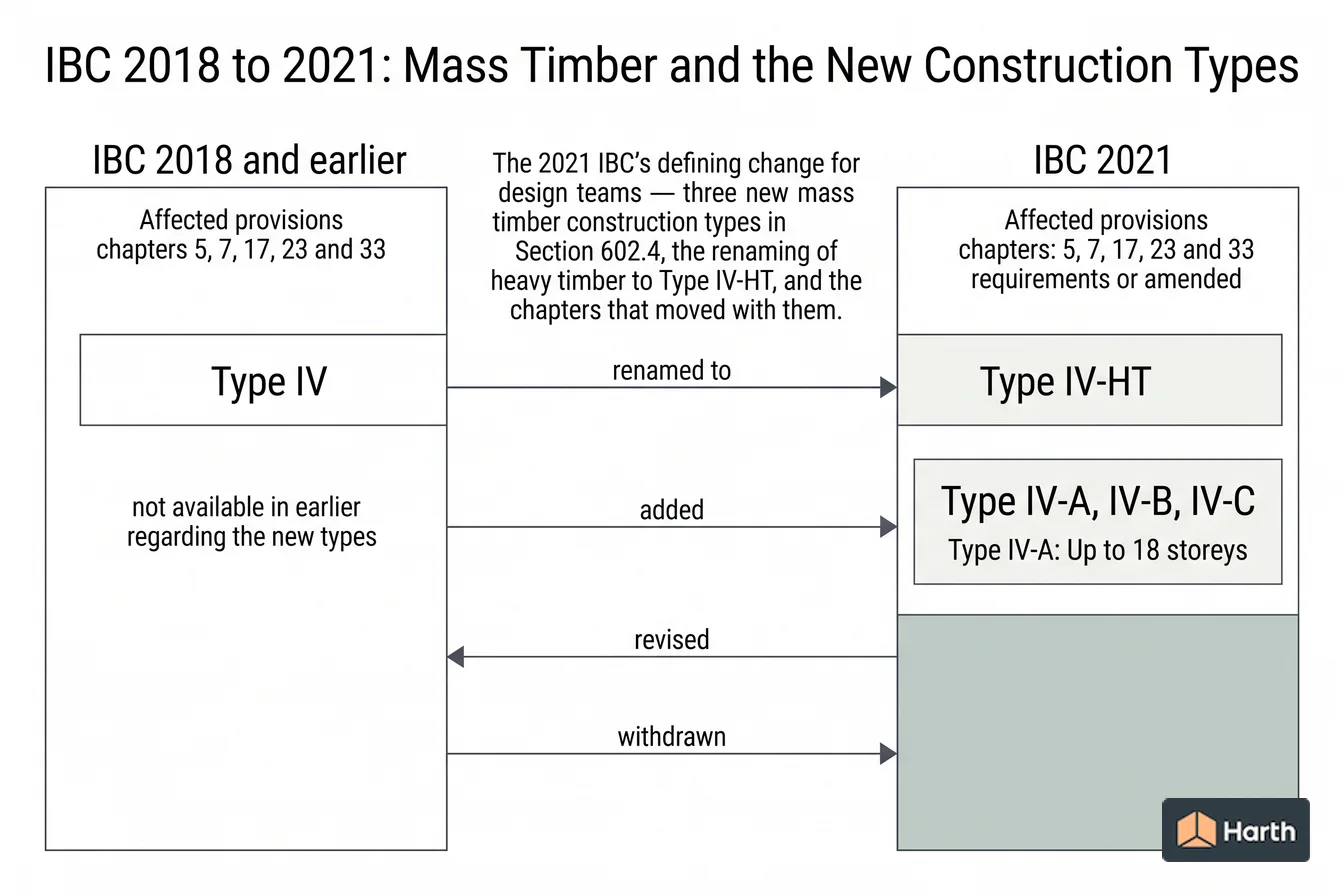
The 2021 IBC's defining change for design teams — three new mass timber construction types in Section 602.4, the renaming of heavy timber to Type IV-HT, and the chapters that moved with them.
On this page
Last updated September 7, 2026 · Changes summarised from ICC's [account of the tall mass timber provisions](https://www.iccsafe.org/building-safety-journal/bsj-technical/tall-mass-timber-provisions-represent-historic-new-building-code-requirements/), the [2021 IBC Section 602.4 text in the ICC code library](https://codes.iccsafe.org/s/IBC2021P1/chapter-6-types-of-construction/IBC2021P1-Ch06-Sec602.4), and [WoodWorks' summary of the tall wood provisions](https://www.woodworks.org/resources/tall-wood-buildings-in-the-2021-ibc-up-to-18-stories-of-mass-timber/). This page covers the changes that alter a design calculation; it is not a complete change record. The adopted edition and the jurisdiction's amendments control.
Direct answer
The 2021 IBC's defining change is the arrival of tall mass timber. Section 602.4 introduces three new construction types — Type IV-A, IV-B and IV-C — built on the former heavy timber type, which was renamed Type IV-HT. Each of the new types adds fire-resistance ratings and a required level of noncombustible protection to the mass timber elements, with Type IV-A the most heavily protected and comparable in intent to Type I-A. Height and area allowances rise accordingly, reaching 18 storeys for Business and Residential occupancies in Type IV-A. Because construction type is an index into so much of the code, the change is not confined to Chapter 6: requirements were added or amended in Chapter 5 for heights and areas, Chapter 7 for fire and smoke protection, Chapter 17 for special inspections, Chapter 23 for wood, and Chapter 33 for safeguards during construction.
Content and cited inputs reviewed by Scott Barrington, Harth founder and architectural technology specialist · Published 2026-09-07 · Updated 2026-09-07.
What must be verified before using this guidance?
The 2021 IBC introduces three new construction types in Section 602.4:
| Type | Basis | Direction |
|---|---|---|
| IV-A | Mass timber with the most noncombustible protection | Highest permitted height; comparable in intent to Type I-A |
| IV-B | Mass timber with limited exposed timber permitted | Intermediate |
| IV-C | Mass timber with more exposed timber permitted | Lowest of the three, still above heavy timber |
| IV-HT | Traditional heavy timber, renamed from Type IV | Unchanged in substance |
The new types are built on the former heavy timber type but add fire-resistance ratings and required levels of noncombustible covering, together with requirements for connections and for off-site prefabrication.
Type IV-A permits up to 18 storeys for Business and Residential occupancies — the headline number, and the one most often quoted without its conditions. Every other combination of type and occupancy sits lower; read Tables 504.3, 504.4 and 506.2.
Why it is not only a Chapter 6 change
Construction type indexes much of the code, so adding a type required edits wherever the type is read:
| Chapter | What moved |
|---|---|
| 5 — General building heights and areas | New rows for the new types in the height, storey and area tables |
| 6 — Types of construction | The new types themselves, in §602.4, and Table 601 ratings |
| 7 — Fire and smoke protection features | Protection requirements for mass timber elements |
| 17 — Special inspections and tests | Inspection provisions for mass timber construction |
| 23 — Wood | The material provisions the new types rely on |
| 33 — Safeguards during construction | Construction-phase fire safety for exposed timber |
A design team evaluating a mass timber scheme reads all six, not one.
The naming trap
"Type IV" no longer means what it meant. In the 2018 IBC and earlier, Type IV is heavy timber. In the 2021 IBC, Type IV is a family of four, and traditional heavy timber is Type IV-HT. A specification, drawing note or office template that says "Type IV" without a suffix is now ambiguous, and the ambiguity spans a very wide range of fire-resistance requirements.
This is worth a template sweep at the point the jurisdiction adopts the 2021 edition — the same class of work as the section-renumbering pass described in the comparison method.
What this means at concept stage
- Check the adopted edition first. A jurisdiction on the 2018 IBC has no IV-A/B/C path in its adopted code, and the alternative-materials route under Section 104 is a determination rather than an assumption.
- Pick the type before the massing. The three types differ in permitted height, in how much timber can be left exposed, and therefore in the architectural result — this is not a late-stage substitution.
- Budget the protection. The noncombustible covering that distinguishes IV-A from IV-C is a cost and a detail, not a note.
- Read Chapter 33 early. Construction-phase fire safety for exposed mass timber affects the site logistics plan, which is a contractor conversation that starts at design stage.
Scope of this page
This page covers the 2018→2021 change that most alters what can be designed. It is not a complete change record — ICC's Significant Changes volume for the cycle is — and the jurisdiction's adopting ordinance controls.
Mass timber feasibility pre-check
Run before a mass timber scheme is committed to. Every row is a question that has stopped a project after concept design.
| # | Check | Entry |
|---|---|---|
| 1 | Adopted IBC edition in this jurisdiction | |
| 2 | Are Types IV-A/B/C available in that edition? | Yes / No |
| 3 | If no — early adoption by amendment, or §104 alternative route? | |
| 4 | Occupancy group(s) proposed | |
| 5 | Storeys proposed above grade plane | |
| 6 | Construction type targeted (IV-A / IV-B / IV-C / IV-HT) | |
| 7 | Allowable storeys for that combination (Table 504.4) | |
| 8 | Allowable height in feet (Table 504.3) | |
| 9 | Allowable area per storey (Table 506.2) | |
| 10 | Extent of exposed timber intended | |
| 11 | Noncombustible protection required for that exposure (§602.4) | |
| 12 | Fire-resistance ratings required (Table 601) | |
| 13 | Special inspection scope (Chapter 17) | |
| 14 | Construction-phase fire safety plan (Chapter 33) | |
| 15 | Specification and template sweep for bare "Type IV" done? | |
| 16 | AHJ pre-application discussion held? (date, name) |
This pre-check records a feasibility position, not a compliance determination.
Where can you explore related guidance?
- Explore all code changes guidance
- How to Compare Two Building Code Editions Without Missing Anything
- IBC 2015 to 2018: The Changes That Move a Drawing
- IBC 2021 to 2024: What Changed for Design Teams
- IECC 2018 to 2021: How Much More Efficient, and What Changed
Sources and method
Changes summarised from ICC's account of the tall mass timber provisions, the 2021 IBC Section 602.4 text in the ICC code library, and WoodWorks' summary of the tall wood provisions. This page covers the changes that alter a design calculation; it is not a complete change record. The adopted edition and the jurisdiction's amendments control.
Source links
Frequently asked questions
What is the difference between Type IV-A, IV-B and IV-C?
They differ in how much of the mass timber must be protected by noncombustible covering and in the fire-resistance ratings required. Type IV-A is the most heavily protected and permits the greatest height; Type IV-B allows more exposed timber with correspondingly lower limits; Type IV-C allows more still. All three sit above traditional heavy timber, now Type IV-HT, in both protection and permitted height. Read Section 602.4 and Table 601 of the adopted edition for the specific ratings.
Can I use Type IV-A in a jurisdiction on the 2018 IBC?
Not as of right. The construction types were introduced in the 2021 edition, so a jurisdiction still on the 2018 IBC has no IV-A, IV-B or IV-C path in its adopted code. Some jurisdictions adopted the mass timber provisions early by amendment, and an alternative-materials-and-methods route under Section 104 may be available, but both are determinations by the authority having jurisdiction rather than something to assume at concept stage.
Why does a Chapter 6 change affect so many other chapters?
Because construction type is one of the two axes — occupancy being the other — that index the rest of the code. Allowable height and area in Chapter 5, fire-resistance ratings in Chapter 7, special inspection requirements in Chapter 17, the wood provisions in Chapter 23 and construction-phase safeguards in Chapter 33 all key off it. Adding a construction type therefore requires edits everywhere the type is read.
Is the 18-storey figure available to every occupancy?
No. The maximum storeys vary by occupancy group and by which of the three types is used, and 18 storeys applies to Business and Residential occupancies in Type IV-A. Every other combination sits lower. Read Tables 504.3, 504.4 and 506.2 of the adopted edition rather than working from the headline number.
Related pages
- How to Compare Two Building Code Editions Without Missing Anything
A five-step method for comparing code editions: adoption record, then definitions, then your tables, then numbering, then local amendments — in that order, and why.
- IBC 2015 to 2018: The Changes That Move a Drawing
IBC 2015 → 2018: the business occupant load factor moved from 100 to 150 sq ft gross, and a concentrated business use category at 50 sq ft net was added.
- IBC 2021 to 2024: What Changed for Design Teams
IBC 2021 → 2024: tornado loads, updated wind/seismic/snow/rain design, more exposed mass timber in Type IV-B, reorganised §2702 emergency power, and Appendix P sleeping lofts.
- IECC 2018 to 2021: How Much More Efficient, and What Changed
IECC 2018 → 2021: DOE-assessed 9.4% residential and 12.1% commercial site energy savings, plus a Chapter 4 restructure that renamed and clarified the compliance paths.