Building Code Glossary
Dead End: Building Code Definition
How the IRC 2009, IPC 2009 define dead end, where the wording differs, and which chapters depend on the term.
On this page
Last updated September 7, 2026 · Definitions quoted from the 2009 International Codes as transcribed in this site's building-codes collection, with the source chapter linked for each quotation. Usage counts are computed over the chapters hosted here, one copy per code. The [ICC code library](https://codes.iccsafe.org/codes) publishes the current model text and the [ICC adoption maps](https://www.iccsafe.org/advocacy/code-adoption-maps/) show which edition a jurisdiction has adopted; those sources control.
Direct answer
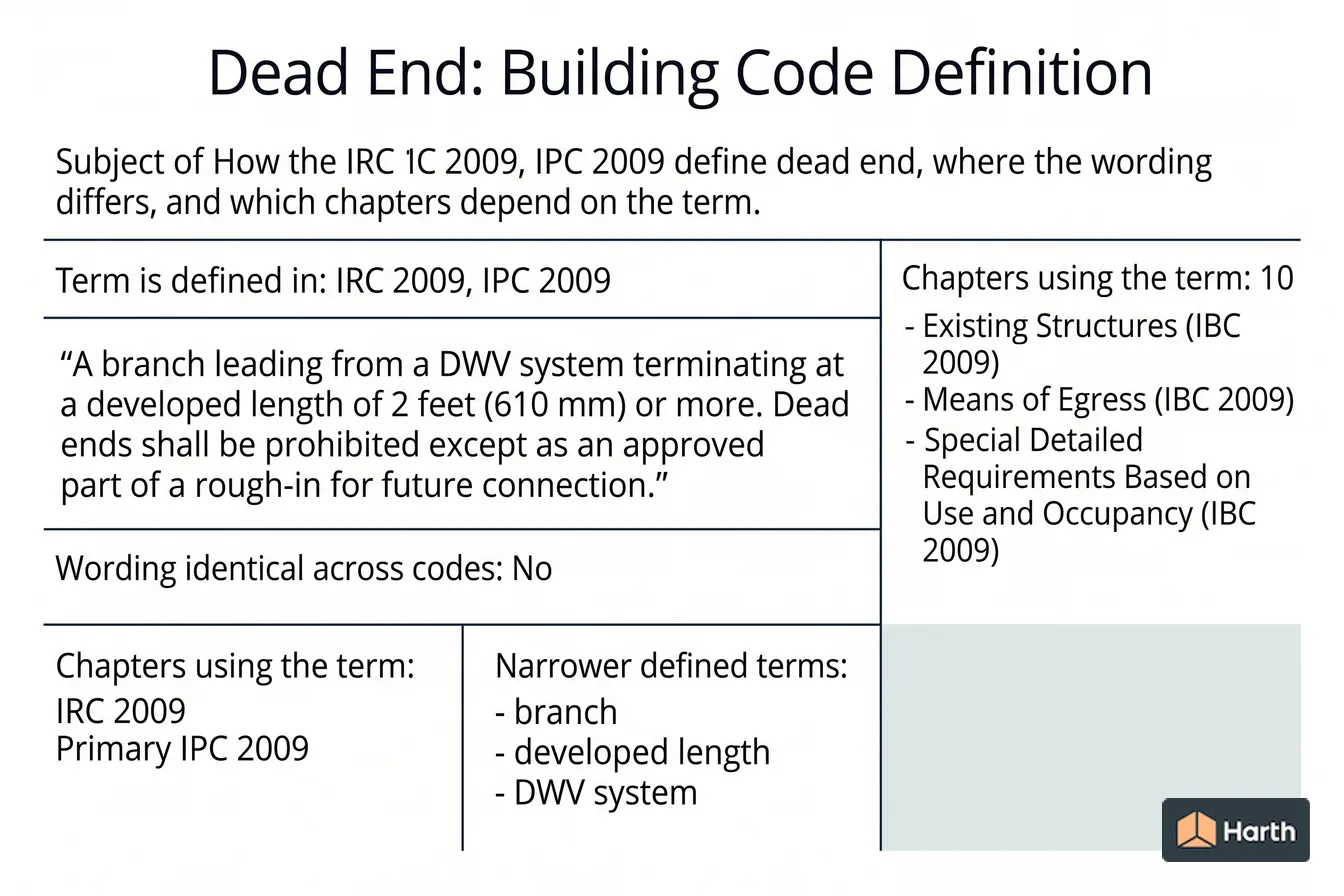
Dead end is a defined term in the International Residential Code (IRC) 2009, in Definitions. The code's own words are: “A branch leading from a DWV system terminating at a developed length of 2 feet (610 mm) or more. Dead ends shall be prohibited except as an approved part of a rough-in for future connection.” The IPC 2009 defines the same term with different wording, so the controlling text depends on which code governs the question in front of you — the comparison below sets the versions side by side. The term is used in 10 chapters of this corpus, most often in Existing Structures (IBC 2009), Means of Egress (IBC 2009), Special Detailed Requirements Based on Use and Occupancy (IBC 2009). These pages transcribe the 2009 model text; verify the definition against the edition and amendments your authority having jurisdiction has adopted.
Content and cited inputs reviewed by Scott Barrington, Harth founder and architectural technology specialist · Published 2026-09-07 · Updated 2026-09-07.
What does this term mean?
Dead End — IRC 2009, Definitions:
A branch leading from a DWV system terminating at a developed length of 2 feet (610 mm) or more. Dead ends shall be prohibited except as an approved part of a rough-in for future connection.
What must be verified before using this guidance?
Two of the I-Codes in this corpus define Dead End, and the wording is not identical — read the version that governs your question.
| Code | Where it is defined | Definition |
|---|---|---|
| IRC 2009 | Definitions | A branch leading from a DWV system terminating at a developed length of 2 feet (610 mm) or more. Dead ends shall be prohibited except as an approved part of a rough-in for future connection. |
| IPC 2009 | Definitions | A branch leading from a soil, waste or vent pipe; a bUilding drain; or a bUilding sewer, and terminating at a developed length of 2 feet (610 mm) or more by means of a plug, cap or other closed fitting. |
Where dead end is used in the code
The term appears in 10 chapters of the 2009 I-Codes hosted here. The chapters that lean on it hardest are the ones to read next.
| Chapter | Code | Mentions |
|---|---|---|
| Existing Structures | IBC 2009 | 16 |
| Means of Egress | IBC 2009 | 6 |
| Special Detailed Requirements Based on Use and Occupancy | IBC 2009 | 6 |
| Means of Egress | IFC 2009 | 5 |
| Construction Requirements for Existing Buildings | IFC 2009 | 4 |
| Sanitary Drainage | IRC 2009 | 4 |
| Fire Service Features | IFC 2009 | 2 |
| High-piled Combustible Storage | IFC 2009 | 2 |
| Definitions | IRC 2009 | 2 |
| Definitions | IPC 2009 | 1 |
The terms dead end is built out of
The definition above leans on 5 other defined terms. Each carries its own code definition, and a local amendment to any of them changes what dead end covers:
- Developed Length — IRC 2009: The length of a pipeline measured along the center line of the pipe and fittings.
- Building Drain — IRC 2009: The lowest piping that collects the discharge from all other drainage piping inside the house and extends 30 inches (762 mm) in developed length of pipe, beyond the exterior walls and conveys the drainage to the building sewer.
- Building Sewer — IRC 2009: That part of the drainage system that extends from the end of the building drain and conveys its discharge to a public sewer, private sewer, individual sewage-diSposal system or other point of disposal.
- Building — IBC 2009: Any structure used or intended for supporting or sheltering any use or occupancy.
- Approved — IBC 2009: Acceptable to the code official or authority having jurisdiction.
Dead End: what to open, and in what order
Every row is a document this term depends on. The ICC code library and the ICC adoption maps cover the middle rows.
| Check | Where | Confirmed |
|---|---|---|
| Read the definition in the adopted IRC | Definitions | |
| Read the definition in the adopted IPC | Definitions | |
| Re-check the requirement that uses it | Existing Structures (IBC 2009) | |
| Re-check the requirement that uses it | Means of Egress (IBC 2009) | |
| Re-check the requirement that uses it | Special Detailed Requirements Based on Use and Occupancy (IBC 2009) | |
| Re-check the requirement that uses it | Means of Egress (IFC 2009) | |
| Confirm the dependent definition | Developed Length | |
| Confirm the dependent definition | Building Drain | |
| Confirm the dependent definition | Building Sewer | |
| Local amendment to any of the above | Jurisdiction's amendment list |
A research aid, not a code determination. The authority having jurisdiction decides which edition and which amendments apply.
Where can you explore related guidance?
- Explore all glossary guidance
- Developed Length: Building Code Definition
- Building Sewer: Building Code Definition
- Building Drain: Building Code Definition
- Rough-in: Building Code Definition
Sources and method
Definitions quoted from the 2009 International Codes as transcribed in this site's building-codes collection, with the source chapter linked for each quotation. Usage counts are computed over the chapters hosted here, one copy per code. The ICC code library publishes the current model text and the ICC adoption maps show which edition a jurisdiction has adopted; those sources control.
Source links
Frequently asked questions
What is the code definition of dead end?
The International Residential Code (IRC) 2009 defines it in Definitions as: “A branch leading from a DWV system terminating at a developed length of 2 feet (610 mm) or more. Dead ends shall be prohibited except as an approved part of a rough-in for future connection.” The 2009 model text is reproduced here; the definition that binds your project is the one in the edition your jurisdiction has adopted, as amended locally.
Which parts of the code depend on dead end?
In this corpus the term is used across 10 chapters, led by Existing Structures in the IBC 2009. Those are the sections whose scope moves if the definition is amended locally, so read them together with Chapter 2 rather than on their own.
Is a cul de sac a dead end?
In the 2009 I-Codes hosted here it is a defined term rather than a description. The IRC 2009 states, in Definitions: “A branch leading from a DWV system terminating at a developed length of 2 feet (610 mm) or more. Dead ends shall be prohibited except as an approved part of a rough-in for future connection.” It is defined in IRC 2009, IPC 2009. Because it is a defined term, whatever the adopted edition says it means is what every section using it means — so check Chapter 2 of that edition and any local amendment before relying on this wording.
Related pages
- Damper: Building Code Definition
Damper — IBC 2009 definition: See "Ceiling radiation damper," "Combination fire/smoke damper," "Fire damper" and "Smoke damper."
- Dangerous: Building Code Definition
Dangerous — IBC 2009 definition: Any building or structure or portion thereof that meets any of the conditions described below shall …
- Day Box: Building Code Definition
Day Box — IBC 2009 definition: A portable magazine designed to hold explosive materials constructed in accordance with the requirements for a …
- Dead Loads: Building Code Definition
Dead Loads — IBC 2009 definition: The weight of materials of construction incorporated into the building, including but not limited to walls …
- Decorative Glass: Building Code Definition
Decorative Glass — IBC 2009 definition: A carved, leaded or DaIle glass or glazing material whose purpose is decorative or artistic, not …
- Decorative Materials: Building Code Definition
Decorative Materials — IBC 2009 definition: All materials applied over the building interior finish for decorative, acoustical or other effect (such as …